Minnesota projects $2.5 billion surplus for now, $3 billion shortfall later in decade
Published in News & Features
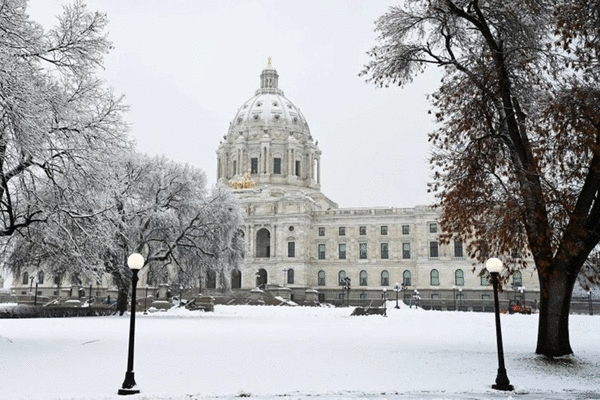
ST. PAUL, Minn. — Minnesota’s projected budget surplus has grown to nearly $2.5 billion in the current two-year budget cycle, though a projected shortfall of almost $3 billion is expected in the following two years.
The new budget forecast released Thursday by the Minnesota Department of Management and Budget shows a larger surplus in the 2026-2027 budget than projected at the end of the June special legislative session, growing by $579 million.
But budget officials also raised concern that this year’s two-year budget may not have done enough to address shortfalls in 2028-2029.
The projected shortfall later this decade rose from $1.1 billion at the end of the special session to nearly $3 billion in November.
And that comes after lawmakers found spending cuts to address future shortfalls. Before the Legislature set the state’s current two-year budget, MMB estimated Minnesota would have $456 million surplus in the 2026-2027 biennium and a $6 billion deficit in 2028-2029.
“Clearly, there’s more work to do to address and protect a negative balance, but I do want to acknowledge the decisive actions taken by the governor and legislators earlier this year,” said MMB Commissioner Erin Campbell. “They made a material and positive difference in our budget outlook.”
Still, Campbell said there would be difficult decisions ahead for lawmakers. Already, state leaders are looking for ways to cut special education transportation aid as part of this year’s budget deal.
The November forecast, typically released in the first week of December, gives Minnesota lawmakers insights into the state’s fiscal picture as they prepare to return to the Capitol for the legislative session early the following year.
There’s been some improvement in the immediate term, but the state could still face a significant fiscal challenge down the road.
What’s driving the numbers? Minnesota continues to spend more money than it takes in.
The closing balance for the state was $4.8 billion at the end of the most recent fiscal year. The state spent $2.1 billion more than it took in, leaving the current projected surplus of $2.5 billion.
So when the state spends $4.4 billion more than it takes in as is projected in 2028-2029, plus gets hit with $935 million in expected inflation, the state will end up with a nearly $3 billion deficit.
Higher health care costs and slow economic growth remain a challenge for the state, according to state budget officials. The largest areas of expense increases are in the Department of Health and Human Services, where forecast costs increased $1.4 billion in the current two-year budget window and another $1.3 billion in 2028-2029.
State Budget Director Ahna Minge said about 90% of that growth comes from higher costs in the state medical assistance program, Minnesota’s Medicaid program, due to rising health care costs.
Special education and long-term disability waivers were among the biggest drivers of state costs at the March forecast, and that remains the case. Both could see cuts — special education transportation reimbursements already did as part of this year’s budget deal, though exactly how those cuts will happen will be up to a “blue ribbon commission” that doesn’t immediately have to make a decision.
What’s behind the slight increase for the near-term surplus now at $2.5 billion?
It’s the result of a “better-than-expected fiscal year close and higher near-term revenue collections, partially offset by increased spending estimates,” MMB said in a summary of its November forecast.
Meanwhile, the state’s “rainy day fund,” or general fund reserves, remain “strong” and at their statutory target of $3.8 billion. The state can use the money in case of an unforeseen emergency.
Democratic-Farmer-Labor legislative leaders and Gov. Tim Walz blamed President Donald Trump for the state’s fiscal issues. And, Republicans pointed to spending growth and fraud in government programs as the main problem.
While a future deficit in 2028-2029 grew since the end of the session, updated numbers are still a significant improvement over the last major update from state budget officials in March.
In March, state officials warned that “significant near-term economic and fiscal uncertainty” from tariffs and other policy changes under Trump could hurt the state’s fiscal position.
“Today, despite a worsening economy nationally, as you’ve seen, and because of the destabilization of the economy, the tariffs and a lot of other things going on, Minnesota’s financial position is better,” said Walz, blaming “chaos” caused by the president for fiscal uncertainty. Walz is seeking reelection next year.
It’s yet to be seen how federal program cuts might affect Minnesota’s budget in the coming years. New rules Medicaid passed by congressional Republicans earlier this year, for instance, won’t go into effect until after the 2026 midterm elections. Those changes are expected to put a greater financial burden on local governments and result in 140,000 Minnesotans losing coverage.
House and Senate Republicans again pushed back against Walz and DFL legislative leaders’ assertions that the Trump administration is to blame for the deficit looming later this decade.
House Republican Floor Leader Harry Niska, of Ramsey, pointed to increased spending and taxes while the DFL controlled Minnesota government in 2023 and 2024.
“We have long-term continued deficits because of bad policy for Minnesota,” Niska said. “And continued attempts to deflect from that bad policy by talking about federal policy that has nothing to do with the … the problems that we have to deal with in Minnesota.”
“We have — again — both a spending problem and a fraud problem,” said Republican House Speaker Lisa Demuth, who is running for governor. “We will be addressing it when we return to session on Feb. 17.”
House DFL Caucus Leader Zack Stephenson disputed whether the forecast related to fraud. Most of the fraud cases in Minnesota involve federal dollars.
“People saw the cost of their health insurance skyrocket,” he said. “The biggest simple takeaway from this budget forecast is that the same healthcare cost increases that are hitting family budgets across Minnesota are now impacting the state budget.”
The state was in a much better fiscal position more than two years ago, when MMB projected a nearly $18 billion surplus.
That year, Democratic-Farmer-Labor-controlled state government passed a more than $70 billion state budget that grew spending by nearly 40% — with a lot of the increase coming from one-time spending.
In June, a Legislature divided closely between the DFL and Republicans passed a $66 billion two-year budget, close to $5 billion less than the 2023 budget.
Special education transportation aid is one of the biggest areas for cuts. State leaders said that they’d have to curb spending this year to address shortfalls looming later this decade.
An updated forecast MMB releases in early March is generally when the Legislature begins deciding how it will spend money. Although the state will not have to pass a two-year budget in 2026, as this happens in odd-numbered years.
Past state budgets
Here’s a listing of past state two-year budgets:
• 2025-2026 — $66 billion.
• 2023-2024 — $72 billion.
• 2021-2022 — $52 billion.
• 2019-2020 — $48 billion.
• 2017-2028 — $46 billion.
• 2015-2016 — $41.5 billion.
• 2013-2014 — $38 billion.
• 2011-2012 — $35.7 billion.
©2025 MediaNews Group, Inc. Visit at twincities.com. Distributed by Tribune Content Agency, LLC.





Comments