How to make San Diego more affordable? Mayor Todd Gloria is betting on this kind of housing
Published in News & Features
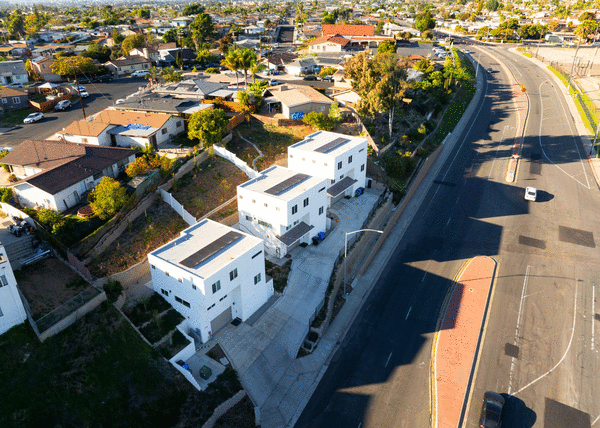
SAN DIEGO — San Diego is launching an effort to make its pricey single-family neighborhoods more affordable to young families by rezoning some properties to allow duplexes, cottages, townhomes and bungalow courts.
City officials say the cheaper options would blend well visually with single-family homes and create more options for middle-income families beyond renting apartments in towers or saving for single-family homes they might never afford.
Mayor Todd Gloria said it’s fortunate the new housing options the city needs are similar enough in size to single-family homes that they won’t damage neighborhood character by adding startlingly large structures.
“It’s intended to be a gentle form of density,” Gloria told The San Diego Union-Tribune on Tuesday, contending the new zoning would help more talented young people stay in the city. “We have to signal to these people that they are wanted and welcome here.”
San Diego’s recent efforts to solve its housing crisis have focused mostly on encouraging the development of high-rise and mid-rise apartment buildings, mostly on the outer edges of single-family neighborhoods.
While Gloria said he’s proud of those efforts and believes they have reduced rents in some neighborhoods by increasing the housing supply, the mayor said San Diego must help people who prefer to live within single-family areas.
Those opportunities would be created by the city rezoning some properties in single-family neighborhoods to allow construction of duplexes, cottages, townhomes and bungalows.
Such housing is already sprinkled — mostly unobtrusively — into single-family areas of San Diego’s older neighborhoods like Hillcrest, North Park, Golden Hill, South Park and Normal Heights.
Most of that housing was built in the 1930s and 1940s, and Gloria said he’s hoping for a second wave nearly 100 years later.
He said the initiative, called Neighborhood Homes for All of Us, would also provide a new for-sale option that would give many renters a chance to become first-time homebuyers more cheaply.
Calling the row homes and duplexes a “new slat on the housing ladder,” Gloria said they would also make single-family neighborhoods more vibrant.
Nearly 80% of city land is zoned for single-family residential housing, but concerns about sprawl have prevented the city from adding any new single-family housing in recent years except in places like Otay Mesa.
City officials say that has created enormous demand for the existing single-family homes, pushing prices so high that most appealing neighborhoods are essentially unaffordable to most people — even for those willing to rent.
This has forced many middle-income families to live in one-bedroom and two-bedroom apartments in large towers with no yards and none of the single-family vibes they seek, Gloria said.
City officials say the initiative will be handled carefully and slowly. They will start with focus groups and stakeholder meetings to gauge which new types of housing would be embraced the most.
Then they will meet with the development community to gauge interest in building such housing, which is expected to be more appealing to small-scale developers than to the developers now building high-rises.
Next will come a feasibility study to determine where such projects could be successfully financed and whether enough residents would be willing to live in them.
Next spring and summer, city officials say they expect to release renderings of potential projects and then begin exploring rezoning options.
The city could create new zoning, expand what’s allowed in some existing single-family zones or both.
City officials say the new zoning isn’t likely to be added to all single-family neighborhoods, suggesting that car-dependent neighborhoods like Carmel Valley and Rancho Bernardo aren’t generally considered good candidates.
Other unlikely places include high-risk wildfire areas and areas that lack good jobs and educational opportunities.
Geoff Hueter, leaders of a group called Neighbors for a Better San Diego that often fights housing density, said he thinks the mayor’s new proposal has some merit.
Hueter said it will be crucial for the new housing options to match the mass and scale of the nearby single-family housing and that he hopes city officials will pay attention to distances from property lines and related issues.
Because the housing spurred by the initiative will be newly built, it might not immediately be as affordable as some older homes that have become less expensive as they have aged.
Gloria is expected to announce the initiative at a Wednesday news conference at 10:30 a.m. in Mira Mesa. He’s scheduled to be joined by City Council President Joe LaCava and some community leaders.
----------
©2025 The San Diego Union-Tribune. Visit sandiegouniontribune.com. Distributed by Tribune Content Agency, LLC.






Comments