Space Force's gladiator-inspired Guardian Arena descends on Florida's Space Coast
Published in News & Features
PATRICK SPACE FORCE BASE, Fla. — A trio of runners dressed in camouflage fatigues tucked into light brown boots round the track with gritted teeth, red faces, and muscles strained in their necks, giving one last push at full sprint with the finish line in sight.
Shirts soaked in sweat, they’re each holding onto a rope and can’t let go.
That’s the rule — until they plow through the final stretch. Then the rope gets tossed aside.
One teammate is hunched over, hands on his knees, while another has his hands at his hips, staring at the sky. A third splays across the grass on his back, actually laughing and giving his teammates a thumbs up that he’s OK.
The three just clocked a time of under 18 minutes, having completed the first physical trial of the Space Force Guardian Arena III competition. This year’s competition, held over two days earlier this week, conferred trophies and bragging rates on the best teams among 100-plus participants, most representing the country’s various armed services.
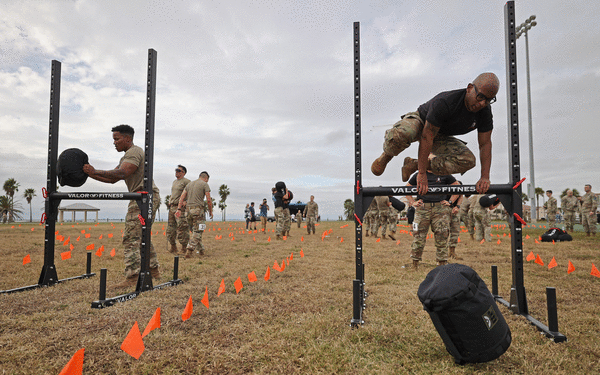
This intro event, called Guardian Strike, required teams to run five laps around a track and head into into an obstacle course afterward each time to perform one of a series of strength and agility tests.
That included tackling the sand worm, a 200-pound, 10-foot-long tube that’s essentially three sand bags sewn together. Teammates had to lift the awkward apparatus from the ground, hoisting it 10 times onto their shoulders.
Amid shouts, high fives, winces and smiles, 35 three-person teams representing different Space Force operations from around the nation all completed the run.
Among them were the “Launch Legends” of Space Launch Delta 45, the unit that oversees launch operations in Cape Canaveral. Their commander, Col. Brian Chatman, cheered them on.
“All of this looks awesome,” Chatman said. “I was talking with a couple of buddies, man. I wish they had this back when we were lieutenants and captains. This would have been great. But this worm with the soft bag trying to do a coordinated lift just seems intense.”
And this was just a taste of what was to come.
This marks the third year of the event, which began with a safety briefing and written intelligence exam at Kennedy Space Center Visitor Complex on Monday morning before migrating to Patrick Space Force Base for two days of rigorous obstacles.
“Couldn’t be more excited. We run the world’s busiest spaceport. We bring Guardians out to compete in these games and have the opportunity to show off the Space Coast,” Chatman said. “It’s awesome end-to-end. And the competitiveness, coming together with the caliber of Guardians that we’re bringing out to this competition, just highlights how top tier the Space Force is.”
While the 105 competitors represent about 1% of the uniformed Space Force, which recently topped 10,000 officers and enlisted personnel, teams include not just Guardians but also members of the Air Force, Navy, civilians and even one international participant from Australia.
Vying for the title are 54 officers, 44 enlisted men and women and eight civilians. The youngest is 21 and oldest is 49.
Chief Master Sgt. of the Space Force John Bentivegna, the highest ranking enlisted officer for the branch, laid out the purpose behind the competition.
“What do we value as a service? What do we value as Guardians? It’s critical thinking, cognitive teamwork,” he said. “Physical fitness, there’s one aspect of it, but we really like to focus on human performance.”
So the events add academics, teamwork and problem solving.
“Most of these men and women work out of windowless rooms, working on consoles, analyzing data, quick decision times, hard problem sets,” he said. “So it’s a different type of thing that we’re looking for, as opposed to sailor or soldier or Marine.”
One task from the 2024 event was figuring out how to assemble a mobile satellite communications terminal and acquire a signal. But participants also had to lug all the pieces of heavy equipment before getting to work.
Ahead of any actual competition during introductions, he warned the competitors, who were applauding the efforts of the organizers, that they might soon be of a different disposition.
“I’m telling you this time tomorrow, you will not be clapping for the people who put this together,” he said.
The main organizer of the physical aspects of the event is civilian coach Adam Whisler, a former enlisted Army soldier, who now works with the Space Force with its Guardian Resilience Team in Colorado.
“I know this equipment inside and out because we’ve done it so many times,” he said. “And so generally, we’re able to kind of find out that best strategy as testers.”
And while he respects teams that come up with shortcuts, he also tries to figure those out beforehand. Last year, for instance, he told teams they had to hold onto the 10-foot piece of rope, but some teams decided to just cut the rope into three pieces.
“I didn’t brief that last year, and I didn’t make that mistake this year,” Whisler said. “You’re always going to have loopholes that I haven’t expected.”
Retired NASA astronaut and recently promoted Brigadier Gen. Nick Hague was on hand as his role as Assistant Deputy Chief of Space Operations.
“They told me that you guys really don’t have any clue about what’s about to happen. I do, and I’m nervous for you all,” he said.
The first-day event was physically demanding, but minuscule compared to what was in store for day two, which featured 14 stations strewn across Patrick SFB combining physical and tactical problems to be completed in less than eight hours.
The combined distance for teams to travel if they were to hit all of the stations came to 13.1 miles, which is the same as a half marathon. Whisler said he focuses on the physical side while leaving the tactical challenges to other event organizers.
“I just get to do the fun stuff and make people hurt,” he said.
The overall lead for this year’s event is Major Alyson Gleason, based out of the Pentagon. Last year, she earned her Ph.D. in kinesiology, or human performance, and considers this year’s physical challenges more taxing.
“We’ve got anything you could think of. I call them torture devices. Fitness is my world, but anything you can think of that you’ve seen on TV, we probably have it coming out there,” she said.
That includes sandbags, bench presses, kettlebells, jumping boxes, rowing and biking, she said. The day one event was just a taste, with teams going hard for less than 30 minutes to complete the complicated obstacle course.
“We get to showcase the fact that we have some incredible athletes who are also very, very smart,” she said. “And not all of the services can say that, at least about such a large group of people. There’s some sharp folks.”
Competitor Captain Alex Colla, now with Space Delta 12 in Colorado, won the inaugural Guardian Arena with his team in 2023. He helped with planning in 2024, but was back to compete this year.
He wasn’t concerned with the physical challenges, but was looking forward to the mental hurdles that might get thrown his way.
“When it comes to trying to solve problems, words definitely matter,” he said. “It’s really paying attention to the rules at each station to see, well, it doesn’t specifically say that, so I’m gonna try it, and if I get called on it, I get called on it.”
He’s pleased the event showcases the unique strength of the Space Force while dispelling some misconceptions.
“A lot of times, people think that we are just people behind a computer screen. Although that is true, we are so much more than that,” he said. “We have to think critically, think expeditiously, and be able to come up with answers to very complex problems. I think this is a great representation of that.”
The first Guardian Arena was turned around from conception to execution in about three months, while both the second and this year’s event had about eight months of planning.
Three-time competitor Lt. Col. Colin McSorley with Space Delta 13 based out of Joint Base Andrews in Maryland finished second in 2023 and fourth in 2024.
“I’m hoping our team podiums this year, but really I hope our team can push it to the max and come away with no regrets,” McSorley said. “One of the great things about being a part of this competition is connecting with all the other Guardians, seeing where they’re at, seeing the younger Guardians, and how they’re developing, and what they bring to the fight.”
Dripping with sweat, McSorley was walking off having just completed his team’s Guardian Strike run.
“It doesn’t feel any better than last year,” he said, but grinning ear-to-ear.
_____
©2025 Orlando Sentinel. Visit at orlandosentinel.com. Distributed by Tribune Content Agency, LLC.






Comments