Illinois National Guard still federalized as President Trump extends order, despite troops sitting idle
Published in News & Features
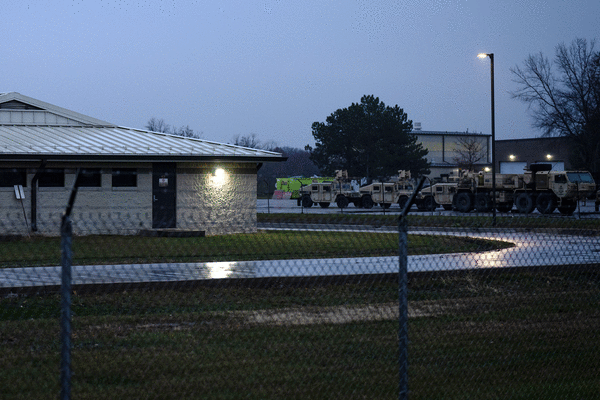
SPRINGFIELD, Ill. — Three hundred Illinois National Guard troops remain under Republican President Donald Trump’s control roughly a week after an initial 60-day federal activation order expired, continuing a clash over his unprecedented decision to seize authority over state soldiers who have spent almost their entire time confined to a base in northern Illinois and performing no operational missions.
Democratic Gov. JB Pritzker’s office said Wednesday that the 60-day federalization order — issued Oct. 4 in conjunction with the Trump administration’s Operation Midway Blitz deportation efforts — was earlier extended for at least another month, even though the soldiers have mostly remained at an Illinois Army National Guard training site in Marseilles and were never deployed for the White House’s stated purpose of protecting federal officers and assets.
“The Illinois National Guard was informed that the previous mobilization order for the federalized Illinois National Guard soldiers was amended and extended an additional 32 days,” a spokesperson for Pritzker’s office said in a statement, meaning the troops will remain federalized until at least roughly the end of the year. “Governor Pritzker strongly condemns the ongoing politicization of our brave servicemembers by the Trump Administration and remains unwavering in his opposition of federalizing members of the National Guard against the wishes of the Governor. The State of Illinois will continue to fight this blatant overreach to the fullest extent in the courts.”
The ongoing federalization — the first in Illinois history over a governor’s objections — also drew heightened scrutiny after a federal judge in California on Wednesday ordered the Trump administration to return control of that state’s National Guard to California’s Democratic Gov. Gavin Newsom. The judge ruled that the White House overstepped its authority in extending a deployment in Los Angeles, a finding that could affect National Guard units in other states, such as Illinois, that the federal government has commandeered. The Trump administration is expected to appeal the judge’s decision.
Pritzker has repeatedly denounced the president’s move as an abuse of power and unnecessary, noting the Illinois troops have neither patrolled streets nor guarded federal buildings and pointing out that Trump said he originally intended to send guard troops into Chicago to curtail crime. In addition, many agents from U.S. Immigration and Customs Enforcement and the Border Patrol assigned to the Chicago region specifically as part of Operation Midway Blitz have left the area.
In a statement, U.S. Northern Command, which oversees the National Guard deployment, said the soldiers “are conducting planning and training but not engaging in Federal Protection Mission operational activities.” A Defense Department spokesperson noted that federal personnel and property in the Chicago region could still require protection.
But David Harris, a former adjutant general who oversaw the Illinois National Guard from 1999 to 2003, said he doesn’t see the troops doing anything productive under federal control.
“One of the key things about any military operation is you have a mission to perform, whatever it is. The commander knows what the mission is and will do his or her best to achieve the mission. What is the mission of these soldiers at this point? What are they doing?” asked Harris, who is now the director of the Illinois Department of Revenue. “It really is in my mind unconscionable that they are still on federal duty.”
“They’re planning and preparing for what?” Harris also said. “If there’s any danger out there to federal facilities in Illinois, why aren’t they guarding those federal facilities now?”
It remains unclear how many of the 300 Illinois National Guard members are the same as those who were called up in early October, as National Guard activations “allow commanders to maximize the number of volunteers” under federal orders, according to Northern Command’s website.
“This also helps commanders balance leave and passes over the upcoming holiday season, while ensuring there are enough troops to fulfill mission requirements,” the website said.
In addition to federalizing 300 Illinois National Guard troops in October, Trump’s Department of Defense deployed 200 members of the Texas National Guard that month to Illinois to, according to a memo issued by Defense Secretary Pete Hegseth and obtained by the Tribune, shield ICE and Border Patrol agents and protect federal facilities and “locations where violent demonstrations” were taking place as protests raged in the Chicago area in response to Midway Blitz.
The Texas National Guard troops departed Illinois last month, ending their 41-day deployment in which soldiers spent less than 24 hours on the streets as part of Midway Blitz. Most of the time, the Texas troops lived at a U.S. Army Reserve training center in southwest suburban Elwood.
With his opposition to troops from another state being deployed to Illinois, Pritzker didn’t allow the Texas Guard members to stay at a state-owned facility. But he did allow the Illinois National Guard members to use the state-owned National Guard site in Marseilles, which is about 75 miles southwest of Chicago, because it allowed them to stay “close to home” and provided them access to “appropriate facilities,” including functioning showers, internet access and a small United Service Organization center for recreational activities, Pritzker’s office has said.
The troops from Illinois and Texas were kept off the streets due to the ongoing legal dispute between the Trump administration and the state of Illinois, which filed a lawsuit days after Trump’s October federalization. Although Illinois won some lower-court rulings, the case is now before the conservative-majority U.S. Supreme Court.
The lack of meaningful activity by the troops mirrors conditions in California, where about 100 federalized National Guard members in Los Angeles have largely been confined to base or limited building-security roles, according to The Associated Press. That prompted California to seek a preliminary injunction, which U.S. District Judge Charles Breyer granted Wednesday, though he delayed the order to allow the Trump administration to appeal. Breyer rejected arguments that the court had no power to review the deployment extensions, saying the administration appeared to want “a blank” check free of constitutional limits.
In June, Trump called up about 4,000 California National Guard members, without Newsom’s approval, to aid in immigration enforcement. Back then, there had been clashes between immigration enforcement officers and protesters, including during one demonstration where protesters threw rocks at federal vehicles, according to AP. But officials in California say those conditions have since changed.
The deployments have also fueled questions about cost.
In addition to sending National Guard troops to Los Angeles and Chicago, Trump also claimed he needed to federalize guard troops in Washington, D.C.; Portland, Oregon; and Memphis, Tennessee, to assist with immigration raids, crack down on protests or assist in deterring crime. Two National Guard members from West Virginia who were deployed to Washington, D.C., were shot last month, one fatally, by an Afghan national.
A study by the progressive-leaning Institute for Policy Studies estimated that National Guard operations in all five locales have cost roughly $473 million, including for personnel who never deployed beyond bases. The tally includes an estimated $12.8 million for the Chicago region spent for Illinois and Texas National Guard member deployments — roughly $4.66 million of it for the Texas Guard activation from Oct. 10 through Nov. 15, the study showed.
Pritzker’s office has not been able to shed any light on costs but said the use of the Marseilles site and other associated costs, such as meals and lodging, “are either directly paid by the federal government or 100 percent federally reimbursed.”
Citing figures from the Army, U.S. Sen. Dick Durbin’s office has said the expected costs for federalizing all 500 National Guard soldiers in Illinois for a full two months was $19.4 million, which works out to $323,333 per day. Democratic U.S. Sen. Elizabeth Warren of Massachusetts also released a report on Department of Defense costs and estimated the Illinois deployment cost $12 million.
Durbin, the state’s senior Democrat from Springfield, said the deployments produced “just not the results to justify the money spent.”
U.S. Sen. Tammy Duckworth, a Democrat from Hoffman Estates and a retired Army lieutenant colonel, is set to question Defense Department officials Thursday at a Senate Armed Services Committee hearing.
“Across the United States, Donald Trump has illegally deployed our nation’s servicemembers into American cities under unclear and false pretexts and despite the costs to our military and civil rights,” she said in a statement, calling for transparency and accountability. “The American people and our troops deserve answers.”
_____
©2025 Chicago Tribune. Visit chicagotribune.com. Distributed by Tribune Content Agency, LLC.





Comments