Trump pardoned them for Jan. 6. Now they want millions of dollars
Published in News & Features
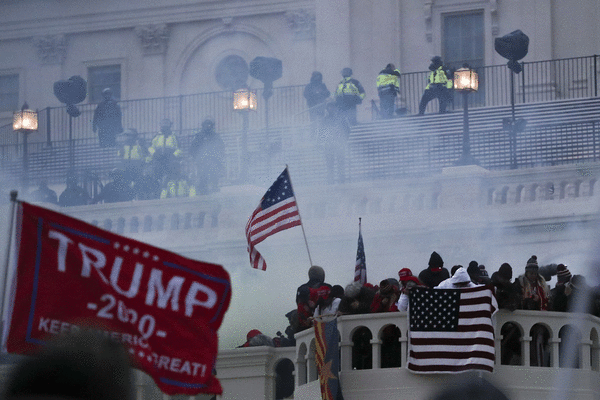
WASHINGTON — Almost 400 people pardoned or granted clemency by President Donald Trump in connection with the Jan. 6, 2021, attack on the U.S. Capitol are now seeking millions of dollars in payouts from the federal government, according to their lawyer.
Attorney Mark McCloskey on Wednesday delivered hundreds of claims in person, wheeling a cart with five bankers’ boxes into a Justice Department office building in Washington. The St. Louis-based lawyer declined to share copies, citing his clients’ privacy, but said most are seeking $1 million to $10 million for alleged injuries and property damage during their arrest, prosecution and, in many cases, imprisonment.
It’s the latest instance of Trump supporters and allies pressing claims for taxpayer funds since he reclaimed the White House a year ago. The Justice Department confirmed in court papers that it’s in settlement talks with Michael Flynn, an ex-Trump administration official and conservative activist, and Stefan Passantino, who served as a White House lawyer during Trump’s first term.
Trump previously told reporters that the Justice Department “probably” owes him “a lot of money” but said he’d give it “to charity” or use it to pay for White House renovations. The New York Times reported that he had filed administrative claims seeking $230 million for the now-defunct investigations into his 2016 campaign and his handling of classified material after he left the White House in 2021.
After Trump won the 2024 presidential race, he signed a proclamation on his first day in office granting pardons, sentence commutations and other clemency to the more than 1,500 people charged with playing a role in the riot that unfolded as Congress met to certify Joe Biden’s 2020 victory over Trump.
Trump’s order described the prosecution effort — the largest in the Justice Department’s history — as “a grave national injustice.”
Earlier this year, U.S. officials agreed to pay nearly $5 million this year to settle a claim brought by the family of Ashli Babbitt, who was shot and killed by a police officer inside the Capitol on Jan. 6.
A Justice Department spokesperson declined to comment. A White House spokesperson did not respond to a request for comment on Wednesday.
The president’s Jan. 6 clemency action covered an array of crimes prosecuted by Biden’s Justice Department, from misdemeanor trespassing to felony charges for assaulting police — approximately 140 officers were injured, according to government reports — carrying guns and other weapons to the Capitol, and seditious conspiracy. Trump pardoned nearly everyone who had pleaded guilty or been convicted at trial and ordered pending cases dropped.
McCloskey said in an interview his clients deserved to be paid because they had “lost everything,” from jobs and professional licenses to their ability to travel freely and maintain bank accounts. McCloskey gained notoriety — and support from Trump — after he and his wife faced state charges for pointing guns at racial justice protesters passing their home in St. Louis in 2020. They later received gubernatorial pardons. He expressed optimism that Trump would aid the Jan. 6 defendants, noting the president’s record of public support before and after his November electoral win.
Mary McCord, a former senior Justice Department official, said that Trump’s clemency actions didn’t undermine the original legal foundations for Jan. 6-related charges, and that the bar generally is high to press claims against prosecutors and law enforcement officers.
“Because somebody was pardoned, that absolutely does not mean there wasn’t a basis for the prosecution,” said McCord, executive director of the Institute for Constitutional Advocacy and Protection at Georgetown University Law Center.
The U.S. government and federal employees are largely immune from being sued for official actions, but there are exceptions for allegations of personal injuries or property damage. Under the Federal Tort Claims Act, individuals can sue in federal court if an agency denies their claim — known as a Standard Form 95 or SF 95 — or fails to act within six months.
Paul Figley, a former senior official in the Justice Department office that handles tort claims, said that presidential clemency shouldn’t affect how the government decides if a person has a valid case for government compensation.
“If they were convicted and had a good claim, they could still bring the claim,” said Figley, an emeritus professor at American University’s Washington College of Law and a visiting professor at Villanova University’s Charles Widger School of Law.
McCloskey said the Justice Department rebuffed several Jan. 6-related claims he submitted earlier in the year for what he described as procedural defects, but that more recently he hadn’t received rejections. He said the collection of claims he brought to Washington on Wednesday — directed to the Justice Department, FBI, Bureau of Prisons, U.S. Marshals Service and U.S. Capitol Police — was the largest group he’d filed to date.
“I’m hoping this mass filing today will bring it to the attention of the powers that be,” McCloskey said.
_____
©2025 Bloomberg L.P. Visit bloomberg.com. Distributed by Tribune Content Agency, LLC.





Comments