Pilgrims flock to celebrate Virgin of Guadalupe -- the "Mother of Mexico"
Published in News & Features
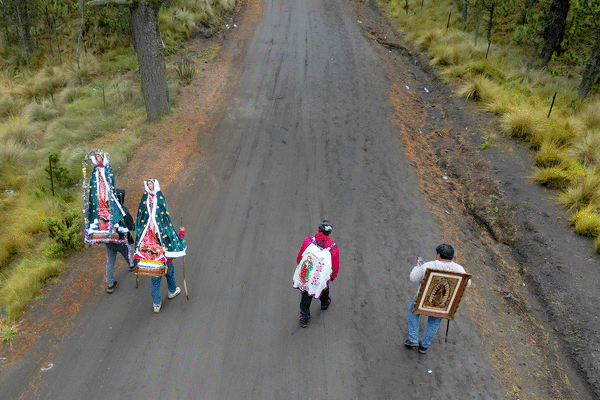
MEXICO CITY — Edivaldo Hernández Villar crawled on his knees toward the Basilica of Guadalupe, wincing and whispering prayers.
It was the final stretch of a punishing four-day pilgrimage to Mexico's most venerated shrine, where Catholics believe the Virgin Mary miraculously appeared nearly 500 years ago.
Hernández, his wife and their teen son had trekked 100 miles from their rural village to the nation's capital, walking with heavy backpacks all day and sleeping under the stars at night. As with an estimated 10 million other Mexicans who will make their way to the basilica this month, their journey had been an act of faith, of penitence, and of thanks.
"You endure cold, you endure hunger, you cross mountains," said Hernández, a 34-year-old farmer. "All for her."
There is no figure more central to Mexican religious, cultural and national identity than the Virgin of Guadalupe.
Her serene gaze is ubiquitous, adorning T-shirts, trucks and the walls of most homes. People name their children after her and tattoo their skin with her likeness: a queenly woman surrounded by sunbeams, her head bowed in prayer.
Ada Carrillo, one of the devout who crowed the basilica this week, said she unites all of Mexico, transcending political, geographic and class divides. Even President Claudia Sheinbaum, who is Jewish, has worn clothes emblazoned with the image of Guadalupe.
A few days before the virgin's feast day on Friday, Carrillo looked around the vast plaza outside the grand church, where Indigenous dancers from southern states mingled with cowboys from the north and cosmopolitan types from Mexico City. Competing bands played booming, brass-heavy songs. Teenagers and street dogs dozed in the sun. A priest gave nonstop blessings, flinging holy water from a pink plastic bucket.
"Here there are no colors, no classes," Carrillo said. "Just faith."
It was in the winter of 1531, a few years after the Spanish conquest, when the virgin was said to have miraculously appeared at the base of Tepeyac Hill, a site where the Aztecs had worshiped the goddess Tonantzin. An indigenous man named Juan Diego said she spoke to him in his native Nahuatl, and asked him to build a church in her honor.
A skeptical Catholic bishop disregarded Juan Diego's story at first. To help Juan Diego, who was later named a saint, prove his story, the virgin is said to have imprinted her image on his cloak. That was on Dec. 12, a date celebrated by Mexicans ever since.
Now, millions come to the basilica, where the cloak is displayed, each December, with most arriving in the days leading up to Dec. 12. At midnight on that day, devotees famously sing Las Mañanitas, the traditional birthday song, for the virgin, and set off fireworks.
Pilgrims come from across Mexico, arriving on foot, motorcycle, bicycle, bus and even wheelchair. Many, like Hernández, knee-walk across the stones of the vast plaza to the basilica's doors.
The working class La Villa neighborhood of Mexico City where the basilica is located fills with trucks festooned with with wreaths and Christmas lights and hordes of pilgrims camping in the streets.
People come bearing roses to ask for help — with matters of health, of heart, of business. The come to pray for peace for relatives who have passed.
Others come to express gratitude for miracles that they credit to the Virgin.
Carrillo, 46, had been told by doctors years ago that she was infertile. She had traveled to the basilica from her home in Tabasco state to beg Guadalupe to bestow on her at least one child.
This week, Carrillo walked the steps to the basilica with her daughter, Ximena, a busy high school school student who just celebrated her 15th birthday.
As Carrillo lit a candle for Guadalupe, tears welled. She pulled her daughter close and murmured a small prayer. "Thank you for the blessing," she said.
The basilica is one of the most visited pilgrimage sites in the world, and on this afternoon drew tour groups from Vietnam, China and the United States. Inside the cavernous church, priests celebrated Mass hourly, and an electronic walkway kept visitors from lingering in front of Juan Diego's famous cape.
Religious scholars say the tradition of Guadalupe, which mixes Indigenous beliefs with Christian ones, helped solidify Catholicism's dominance in Mexico. It has also helped prevent the encroachment of evangelical Christianity seen in many other parts of Latin America, with few here willing to give up their devotion to the "Virgencita," as Guadalupe is widely known.
Significantly, Mexico's virgin has brown skin, a detail not lost on the Indigenous population, today or centuries ago. Today some Mexicans refer to her as Guadalupe Tonantzin.
Theresa Sanchez, 66, a retiree from Mexico City who arrived with the help of a cane, said she sees Guadalupe as a connection to Mexico's Indigenous past and views her pilgrimage to the basilica as a way to "thank Mother Earth for all that she had given us."
She views the cult of Guadalupe as both an effort by the Spanish to promote the adoption of Catholicism in the New World and an opportunity for native Mexicans to who "couldn't maintain their beliefs in an open way" to preserve traditions.
Many pilgrims arrived at the basilica with artifacts of devotion — mostly statues of Guadalupe from their local churches. Safely bringing the blessed objects home was an important part of the journey. Many pilgrims take turns running hundreds of miles back to their pueblos, carrying a torch lit at the foot of Tepayac.
Antonio and Jesús Zamora, brothers from Michoacán state, were preparing to run 260 miles back to their hometown. Antonio, 70, had recently been declared free of prostate cancer, and said that with every step he would be thanking Guadalupe for his quick recovery.
He and his younger brother have lived for decades in Missouri, where he worked until retiring from the hotel business. During all that time, he said he returned to Mexico every December to visit the shrine.
He has asked Guadalupe for good health, for a strong family and for an end to the cartel violence plaguing his home state.
"I pray for peace," he said. "For Michoacán. For Mexico. For the United States. For for the world."
This year, he said, he also thought about all the immigrants in America who weren't able to visit the basilica because they lack documents allowing them to travel between Mexico and the U.S.
The immigrant community, he said, had been battered like never before in recent months. He asked Guadalupe for help with that, too.
"I prayed for my people," Zamora said. "And I prayed for Donald Trump, too."
©2025 Los Angeles Times. Visit at latimes.com. Distributed by Tribune Content Agency, LLC.





Comments