Rob Reiner, 'When Harry Met Sally' director, 'All in the Family' actor and political activist, dead at 78
Published in News & Features
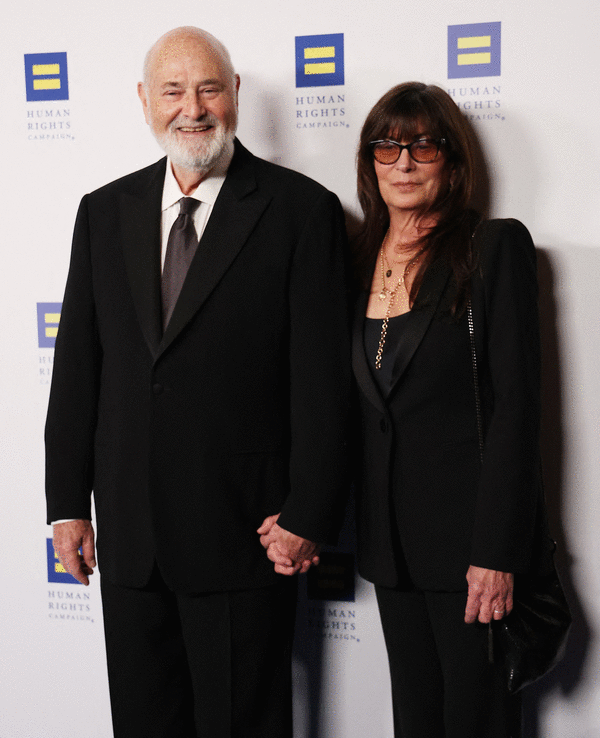
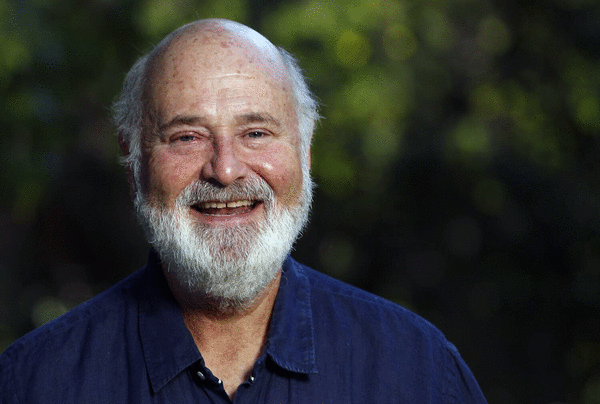
LOS ANGELES -- Rob Reiner, a writer, director, producer, actor and political activist whose career in Hollywood spanned more than six decades and included some of the most iconic titles in movie history, was found dead Sunday with his wife, Michele Singer Reiner, at the home they shared in Brentwood. He was 78.
“It is with profound sorrow that we announce the tragic passing of Michele and Rob Reiner,” a spokesperson for the family said in a statement Sunday. “We are heartbroken by this sudden loss, and we ask for privacy during this unbelievably difficult time.”
Reiner will be remembered as the director of the seminal 1980s rom-com “When Harry Met Sally...,” the actor whose character “Meathead” faced off regularly against Archie Bunker, and the political activist who backed early childhood programs in California and railed loudly for years against President Trump.
The oldest child of comedian Carl Reiner and singer Estelle Reiner, Robert Reiner was born March 6, 1947, in the Bronx, New York. Raised by a father who won 11 Primetime Emmys and a Grammy in addition to the Mark Twain Prize for American Humor, Rob Reiner attended Beverly Hills High School and studied film at UCLA. He then went to work in Hollywood as an actor and writer before moving on to directing and producing.
Reiner’s writing credits in the 1960s included “The Smothers Brothers Comedy Hour,” “The Glen Campbell Goodtime Hour” and the TV movie “Where the Girls Are.” In the 1970s, he wrote several episodes of “All in the Family” as well as the Primetime Emmy Awards telecast in 1978 and episodes of “The Tonight Show Starring Johnny Carson.”
Reiner married Penny Marshall, star of TV’s “Laverne & Shirley,” in 1971 and adopted Tracy, the daughter Marshall had from a previous marriage. Reiner and Marshall divorced in 1981.
He wrote for the first “Comic Relief,” hosted by Robin Williams, Billy Crystal and Whoopi Goldberg. That and the dozen “Comic Relief” telethons that followed raised awareness and money to fight poverty in the U.S. and elsewhere.
“This Is Spinal Tap” in 1984 further established Reiner’s comedic sensibilities in the American milieu. His work took a dramatic turn when he directed the 1986 adaptation of Stephen King’s novella “Stand by Me,” which starred Wil Wheaton, River Phoenix, Corey Feldman and Jerry O’Connell, but he returned to comedy with 1987’s “The Princess Bride” starring Cary Elwes, Robin Wright and Mandy Patinkin. Also in 1987, he co-founded production company Castle Rock Entertainment.
Then he directed what would emerge as one of the most beloved rom-coms ever — “When Harry Met Sally...,” starring Crystal and Meg Ryan.
On the set of the movie he met photographer Michele Singer and the two married in 1989, the year the film came out. They went on to have three children, Jake, Nick and Romy, born in 1991, 1993 and 1997, respectively.
Reiner was finally nominated for a best picture Academy Award in 1994 for “A Few Good Men,” starring Jack Nicholson and Tom Cruise, though the movie lost out that year to Clint Eastwood’s Western “Unforgiven.”
Reiner’s work had sweeping cultural impacts. Three of his movies, “When Harry Met Sally...,” “The Princess Bride” and “This is Spinal Tap,” are on the National Film Registry. The phrase “up to eleven,” coined in “This Is Spinal Tap” during an improvised sequence between Reiner and Christopher Guest, is in the Oxford English Dictionary.
“It’s weird that something that we just threw off like that suddenly becomes part of the lexicon of our lives,” Reiner said on NPR’s“Fresh Air” in September. “It’s very strange how these things have taken root.”
In 2015, Reiner was the producer on “Being Charlie,” a drama based on his family’s struggles while son Nick was addicted to hard drugs and rotating in and out of rehabs and homelessness.
“It was very, very hard going through it the first time, with these painful and difficult highs and lows,” Reiner told The Times in 2015. “And then making the movie dredged it all up again.”
Growing up, Reiner balanced conflicting feelings about his relationship with his own father, who was someone he strongly admired. But he also felt as though his father didn’t fully know him. That dichotomy inspired a scene in “Stand by Me” when Gordie declares his father hates him.
“Loving your father and looking up to your father doesn’t necessarily mean you’re feeling that back,” Reiner said on“Fresh Air” in September, recalling how writing that scene made him cry. Reiner, added, however, that he had two “great guides” in his life, his father, who died in 2020, and “All in the Family” creator Norman Lear.
Reiner was a writer on “The 40th Kennedy Center Honors” in 2017, capping a career that included myriad variety show writing credits. “ Spinal Tap II: The End Continues,” which he directed, was his final project as a scribe. “Spinal Tap at Stonehenge: The Final Finale,” due out in 2026, was his final directing credit.
Reiner was nominated five times for supporting actor Emmys for his “All in the Family” work, winning in 1974 and 1978. He was up for two Emmys in 2024 for the documentary “Albert Brooks: Defending My Life.”
A staunch liberal, Reiner also emerged as a force in California politics and child welfare and education issues, and campaigned for presidential candidates including former Vice President Al Gore, endorsed former Secretary of State Hillary Clinton for president and spoke up for President Biden’s reelection. Reiner was also an unapologetic critic of President Trump.
He campaigned in California against tobacco use and in 1998 saw the passage of Proposition 10, which called for a tax on tobacco products to be spent on early childhood programs. Reiner became chairman of the First 5 California Children and Families Commission in January 1999. He resigned in March 2006 amid accusations that the commission had used tax money to boost his campaign for the ultimately unsuccessful Proposition 82, which would have raised income taxes on wealthy Californians to pay for preschool for 4-year-olds. An audit later concluded that he and the commission had not violated state law.
“Rob Reiner has always put California’s kids first, and I thank him for the great work he has done over the last seven years,” then-Gov. Arnold Schwarzenegger said in a statement at the time. “Because of Rob’s efforts, California has become a national leader in providing early childhood health and education services for our youngest children and their families.”
____
Times editor Brittany Levine Beckman contributed to this report.
©2025 Los Angeles Times. Visit at latimes.com. Distributed by Tribune Content Agency, LLC.






Comments