'The river will not wait for us': Strict timeline set for Colorado River deal
Published in News & Features
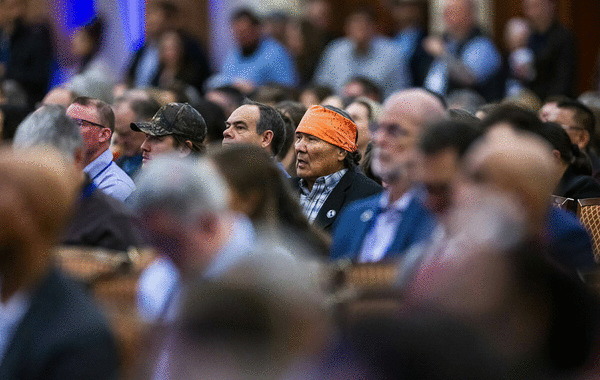
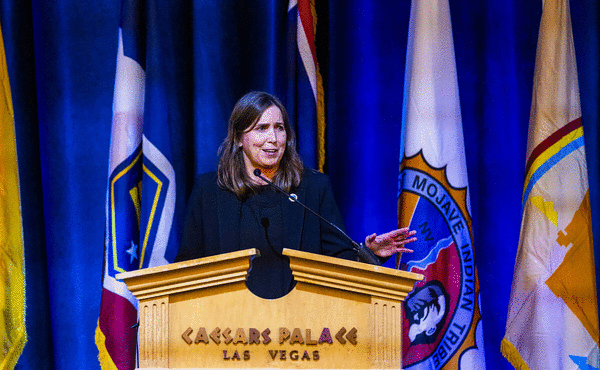
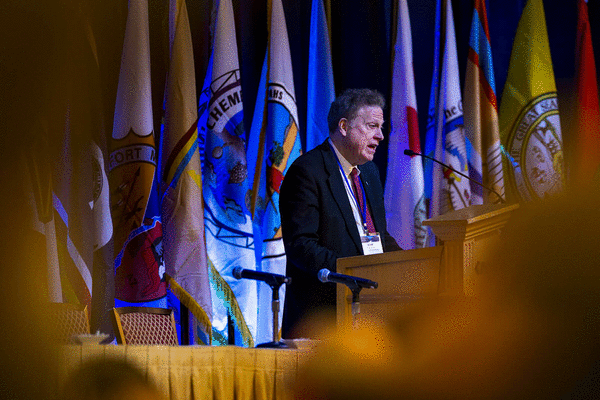



LAS VEGAS — Federal officials gave the clearest timeline yet for when a breakthrough could come in closed-door negotiations over the water supply of 40 million Americans.
On Wednesday, Assistant Secretary of Water and Science Andrea Travnicek said the public will have another document to review as early as the end of this year. It will come amid what could prove to be the most critical policy talks in the history of the American West.
The seven states that draw water from the Colorado River system, including Nevada, are wrapped up in heated negotiations with time running out to strike a deal before a Feb. 14 deadline. This week, all eyes are on Las Vegas as the Colorado River Water Users Association conference sparks discussion about the precarious future of the basin.
“The time of grandstanding and rhetoric has passed,” Travnicek said in her keynote address at Caesars Palace. “The river will not wait for us.”
A shrinking river has bred enduring conflict. The Lower Basin states of Nevada, California and Arizona have been at odds with the Upper Basin states of Colorado, Utah, New Mexico and Wyoming over whether cuts to water use should be shared.
Officials from California indicated at a news conference Tuesday that they are willing to compromise on several of their legal arguments, and appointees from each of the seven states will speak on a joint panel Thursday.
Nevada Gov. Joe Lombardo revealed last week that Interior Secretary Doug Burgum had invited the seven states’ governors and negotiators to meet in Washington, D.C., and Lombardo hopes that will happen in January.
Whatever the outcome of the negotiations, declining water availability and anticipated shortages will have immense implications for the growing economies of Western states, from the dense population centers of Salt Lake City and Phoenix to the billion-dollar agriculture industries of Arizona and California.
A draft environmental impact statement, in which the federal government will lay out multiple potential paths for an agreement, will be released in the next few weeks, said Carly Jerla, a senior water resource program manager at the Bureau of Reclamation.
Much of the interstate talks have centered on the perspectives of state negotiators, but a rare public comment period will open following the document’s release. The Valentine’s Day deadline for a seven-state consensus stands, and the final documents in the process will become available in the spring or summer, Jerla said.
Between the next two releases of documents, the federal government will identify its preferred path, she said.
“We want to continue to facilitate, but not dictate these operations,” Jerla said. “The goal here is to inform decision-makers and encourage parties to adopt agreements that put consultation and negotiation first in terms of controversies, rather than resorting to litigation.”
Jerla spoke of worsening conditions for the Colorado River Basin, namely that the federal government is projecting that flows into Lake Powell this winter are likely to land anywhere between 44 and 73 percent of average.
Since 2006, that crucial, annual replenishment of Lake Powell from Rocky Mountain snowpack has declined about 15 percent, Jerla added.
A throughline of Wednesday’s remarks from federal officials was that ending up in court is an unattractive option.
Scott Cameron, acting commissioner of the Bureau of Reclamation, has said that Burgum is prepared to intervene should the states not come to an agreement. Experts say that’s a recipe for a court case.
On Wednesday, however, Cameron reaffirmed his intention of coaxing the states toward a deal rather than having the states waste time arguing in court.
“A bunch of water lawyers are going to be able to put their children and grandchildren through graduate school,” he said. “There are much better ways to spend several hundred million dollars in the face of hydrologic changes.”
Cameron added that he and Travnicek have flown to the West every other week since early April to have meetings with the negotiators. The meetings are “not low-key,” he said, and “typically involve a frank exchange of views.”
“Crisis must become a catalyst for problem-solving,” Cameron said. “We have the data and the knowledge, not withstanding the deep uncertainty. … What we need is the will, the individual and collective will, to act boldly, to accept the risk, to think creatively and to prioritize the long-term health of the river and the communities it sustains.”
_____
©2025 Las Vegas Review-Journal. Visit reviewjournal.com.. Distributed by Tribune Content Agency, LLC.






Comments