Survivors juggle sorrow, hope on NASA's day remembering Challenger, Columbia, Apollo 1
Published in News & Features
CAPE CANAVERAL, Fla. — It was a cold morning in Florida when the last words heard by any of Space Shuttle Challenger’s crew were uttered by pilot Michael Smith.
The seven members of mission 51-L, the 25th space shuttle mission, had just lifted off from Kennedy Space Center’s Launch Pad 39-B and were climbing east over the Atlantic.
“Uh oh,” Smith said 73 seconds after liftoff, before all transmission ceased. One of Challenger’s solid rocket boosters had leaked fuel onto the external fuel tanks, causing the shuttle to break up in a massive explosion and killing all on board.
Smith and crewmates Christa McAuliffe, who would have been the first teacher in space, commander Francis R. "Dick" Scobee, Ronald E. McNair, Ellison Onizuka, Gregory Jarvis and Judith Resnick perished, marking the second major tragedy in NASA history.
It was Jan. 28, 1986, 40 years ago next week.
“It’s hard to believe it was that long ago,” said four-time astronaut and former NASA associated administrator Bob Cabana during NASA’s Day of Remembrance ceremony Thursday at Kennedy Space Center’s Visitor Complex. “For those of us who were around at the time, the picture of those two solid rocket motors, their plumes going off in separate directions against that clear, blue Florida sky that morning is something that’s firmly etched in our brains that we will always remember.”
The ceremony marked the lives of the Challenger seven, along with the three Apollo 1 crew members who died Jan. 27, 1967 during a launch pad fire on Cape Canaveral, the seven members of Space Shuttle Columbia’s STS-107 mission who died Feb. 1, 2003 when it disintegrated upon reentry, and other astronauts who died during training accidents on Earth in the pursuit of space.
Smith’s daughter Alison Smith Balch, now 54, was 14 when it happened. She spoke about her father’s legacy.
“Yes, my dad was an astronaut, but to my brother Scott, my sister Erin,” she began, her voice cracking forcing her to pause momentarily, “and to me, he was just ‘Dad,’ and to my mom, ‘Mike.'”
She recalled how her father loved spending time with family, teaching through doing, like setting up all three kids with a lawn mowing business.
“It was not about making money, maybe a little, but mostly it was about learning how to work, how to take responsibility, how to keep going when things did not go perfectly,” she said. “Those values were not unique to my father. They were shared by every member of the Challenger crew and by the families who stood beside them.”
In the wake of the disaster, the families had to pick up the pieces, and one of the ways they chose to cope was to focus on education. Efforts since the tragedy have helped support the Astronauts Memorial Foundation Center for Space Education and more than 30 Challenger Centers across the country.
“The mission did not end. It continues. I am deeply grateful for the way my dad encouraged learning in our lives, day after day, in very ordinary ways, and I know that he and every member of the Challenger crew would love seeing the impact of what has grown from their legacy,” she said.
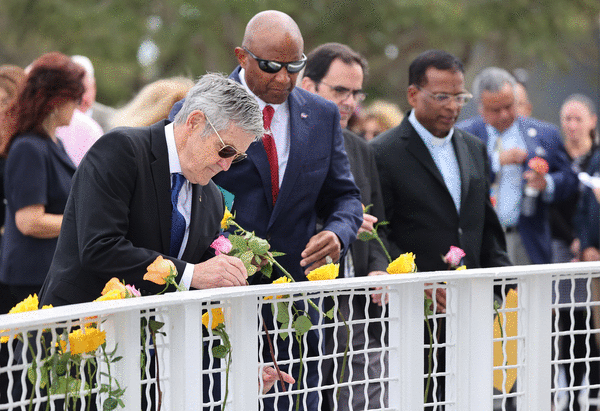
She, her siblings and mother joined other survivors of fallen astronauts to place flowers at KSC’s Space Mirror Memorial, which has the names etched into the towering monolith just adjacent the massive building that houses one of Challenger’s sister shuttles, Atlantis.
Cabana was just an astronaut candidate about seven months into training when Challenger exploded and had fond memories of the crew who had welcomed him in Houston. One of his fellow astronauts was dating Resnick and they all had dinner together. Onizuka offered up his garage full of tools if ever he needed help with his car. As for Mike Smith, Cabana considered him a hero.
“He’s what I aspired to be. He was a naval academy graduate, naval aviator test pilot, shuttle pilot. That’s what I was hoping to do,” he said. “They were just wonderful, wonderful people.”
Cabana said coming together to remember the crews of Apollo 1, Challenger and Columbia each year is not only to honor them, but also necessary to remind the nation that what NASA does is vital for its future, its economy and its status as a world leader.
“It is in our DNA to explore and go beyond our limits and expand our knowledge and exploration of space,” he said. “To stop it would be a great disservice to these crews. It would mean they gave their lives for nothing. We must go on. It is what they would expect and demand of us.”
But the lessons learned from the disasters have to steer NASA in its drive to push boundaries.
“We must dedicate ourselves to ensuring the mistakes of the past never happen again, that we are ever vigilant to prevent any new ones that put our crews at risk,” he said. “Only through technical excellence in an environment of open and honest communication will we have a chance to ensure that is the case.”
He’s confident the lessons are steering NASA’s choices today, though, including how the agency chose to bring home the Boeing Starliner crew safely, and how it plans to send the four crew of Artemis II this year on its lunar flyby mission.
“I can’t guarantee that we won’t lose another crew someday, but we must guarantee that we will do our very best to identify the problems within our control, to fix them with the best of our ability, and that everyone involved will be able to freely voice their concerns and be listened to,” he said.
He led the procession to help the survivors honor the fallen.
“To those of us who are part of the NASA family, these crews are more than just names on the mirror,” he said. “They were our friends, our family, and they will always be with us.”
-------------
©2026 Orlando Sentinel. Visit at orlandosentinel.com. Distributed by Tribune Content Agency, LLC.





Comments