National college enrollment records slight bump, but Minnesota schools fare better
Published in News & Features
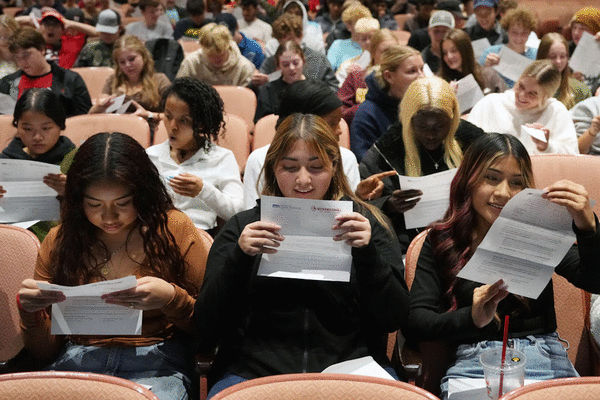
MINNEAPOLIS — Despite the often gloomy forecasts about unprecedented challenges in higher education, Minnesota saw small gains in college enrollment in fall 2025 compared with 2024, marking two consecutive years of increases and signaling that students have returned after plummeting pandemic-era enrollment.
According to newly released data, total enrollment across the state of all postsecondary students was up about 2%, with undergraduate numbers alone rising more than 2%. Graduate student enrollment, however, declined by 2%.
Minnesota fared slightly better than the nation and the region; total national enrollment increased by 1% overall and about 1% among undergraduates, though graduate enrollment remained about the same. Enrollment across the Midwest was basically flat, too. That’s according to data from the National Student Clearinghouse Research Center, a nonprofit that released its final fall numbers earlier this month.
“It’s some pretty encouraging indicators that Minnesota, when you’re looking at undergraduate students, is both tracking higher than the national average and higher than our regional average,” said Wendy Robinson, the Office of Higher Education’s assistant commissioner of program, policy and grants. “That feels true given what we’ve seen in terms of increased demand on our state financial aid programs.”
It also follows what colleges’ own data have shown, she said, adding that her office doesn’t release its enrollment report until summer.
The state and national upticks are notable at a time when parents and students are increasingly weighing the value of a college education and its price tag as student debt and tuition continue to rise.
Colleges are facing other major headwinds, from the growing influence of artificial intelligence to President Donald Trump’s ongoing war on higher education, which has included cutting billions of dollars in research funding, axing various diversity, equity and integration efforts and restricting the number of international students who come here to study.
Minnesota historically exports more high school students to other states for college than it brings in, Robinson said, but that trend is “starting to pull back a little bit” this year. She credits the state’s North Star Promise program, which provides free tuition to any Minnesota public college or university for students whose families make $80,000 or less, and the Direct Admissions program, which tells high school seniors which colleges they are already eligible to attend without even applying.
“Strong enrollment trends at both the two-year and four-year level is something that we like to see,” Robinson said. “We are like one of the top 10, and maybe top five states in the country [whose] workforce needs demand a college degree.”
In the fall, Minnesota State’s network of 33 public colleges and universities saw an overall rise of more than 4% in enrollment. The University of Minnesota system also experienced an approximate 3% gain — similar to last year and with growth at every individual campus.
The Minnesota Private College Council, the state association for nonprofit private institutions, also saw mostly enrollment gains in fall 2025, said Paul Cerkvenik, the council’s president. The group doesn’t share its aggregate enrollment numbers until February.
Undergraduate enrollment at its 18 institutions is up about 2%, said Cerkvenik, which is slightly higher than last year’s increase, though graduate enrollment is down nearly 5%.
Cerkvenik said the number of high school graduates in Minnesota has been rising slightly for the past few years, contributing to increased undergraduate numbers, and the Direct Admissions program has boosted enrollment.
“I think [Direct Admissions] is a game-changer,” he said, adding that the state has also helped by encouraging high school students to complete their Free Application for Federal Student Aid (FAFSA) forms, leading to more kids attending college.
Undergraduate enrollment at private schools has seen gains each of the last five years, meaning several years of smaller classes have graduated and incoming bigger classes will continue to positively impact total enrollment for years to come, Cerkvenik said.
Across the country, about 19.4 million students are now enrolled in postsecondary education, said Hee Sun Kim, senior research associate for the National Student Clearinghouse Research Center. Kim said the growth was mostly driven by community college enrollment, which rose 3%, while public four-year colleges saw an increase of 1.4% in students.
Community college growth could be buoyed by ongoing increases in the number of high school students who are also enrolled in college classes, Kim said.
Certificates, which take less time to complete than a degree and are often tied to workplace skills, are also offered by community colleges. Enrollment in certificate programs leapt by 6% in fall 2025; since 2021, enrollment has ballooned by more than 28%.
First-year enrollment was steady nationally, with a negligible decline.
“I think there are pockets that are seeing some declines that are notable,” Kim said. " One of the things would be definitely the decline in international graduate students."
Their numbers dropped nearly 6%, she said, after years of growth. Undergraduate students from other countries saw a 3% bump, but that’s a much smaller increase than even the previous year, Kim said.
Cerkvenik said he thinks the tides of public opinion may be turning in favor of higher education.
“I’ve seen some things in polls lately suggesting attitudes toward higher education are generally on the upswing,” he said, mentioning several national surveys. “There’s a lot of doom and gloom out there about higher ed, but I think ... it’s hiding an underlying story that things aren’t as bad as sometimes [they’re] portrayed.”
©2026 The Minnesota Star Tribune. Visit at startribune.com. Distributed by Tribune Content Agency, LLC.






Comments