Minnesota prosecutors formally demand evidence from Trump administration over the killing of Renee Good
Published in News & Features
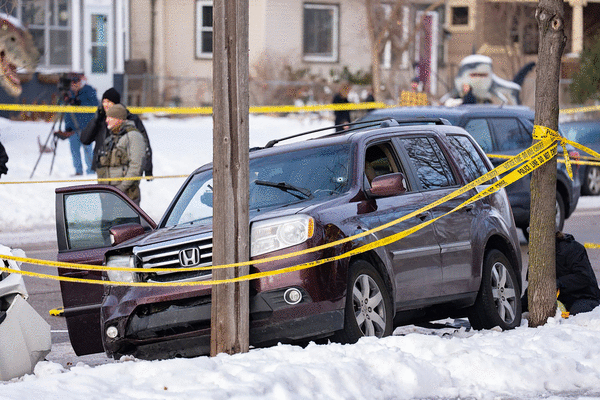
MINNEAPOLIS — State prosecutors have formally demanded that the Trump administration turn over any evidence gathered by federal authorities after the shooting death of Renee Good by ICE agent Jonathan Ross.
Hennepin County Attorney Mary Moriarty announced Monday that her office had served what are known as Touhy letters on the Department of Justice and the Department of Homeland Security. The legal filing seeks a wide range of potential evidence from Good’s killing on Jan. 7 in south Minneapolis and has a Feb. 17 deadline to respond. The demand letters come as the county attorney — alongside the Minnesota Bureau of Criminal Apprehension and the Minnesota Attorney General’s Office — continues to pursue an independent state investigation into Ross’s deadly use of force.
“I expect the federal government to provide the requested information, documents and physical items to our office,” Moriarty said in a statement announcing the letters. “The federal government has been clear that they are not conducting an investigation into Renee Good’s death. But we are. We require these records as part of our ongoing thorough investigation into her death at the hands of a federal agent, Jonathan Ross.”
Touhy requests are a filing for information from federal agencies in legal proceedings. The name stems from a Supreme Court ruling in 1951 that clarified how and when the federal government needs to produce records or witness testimony.
A request seeking comment on the Touhy letters was left with the Department of Homeland Security.
Moriarty said her office is seeking a variety of information from the crime scene and relating to the shooting, including: any video evidence, including dashcam or body camera footage and footage recorded by federal agents on personal phones; names of any officers involved in the shooting, on the scene of the shooting or who responded to the shooting; statements provided by federal agents about the shooting; physical evidence such as shell casings, firearms, vehicles and uniforms and the chain of custody for that evidence; medical records for agents or officers who were injured during the shooting; and the policies and procedures the officers were following at the time of the shooting.
The independent state investigation arose after the FBI, at the direction of U.S. Attorney of Minnesota Daniel Rosen, told the BCA they would not be given access to any evidence gathered by federal law enforcement after the shooting.
That decision broke with decades of normal cooperation between federal and state law enforcement, which Ellison alluded to in a statement announcing the Touhy letters.
“It’s unprecedented that the county attorney’s office is sending these letters at all. Federal investigators should already be cooperating with state investigators in a joint investigation into Renee Good’s shooting death at the hands of federal agents,” Ellison said. “The county attorney’s office is sending these letters because the federal government continues not to do so. My office and I will keep working with Hennepin County to do everything in our power to support state investigators’ efforts to conduct a complete, transparent, and impartial investigation.”
Days after the shooting, U.S. Deputy Attorney General Todd Blanche said his office had no intention of investigating Ross for violating Good’s civil rights. Shortly after that, Moriarty and Ellison held a press conference announcing the opening of a secure portal for citizens to submit video evidence from the crime scene.
In the Touhy letters, which the Hennepin County Attorney’s Office posted to its website, Moriarty notes that her office has a duty to investigate potential crimes within Hennepin County and has jurisdiction to do so against federal officers.
She notes that the request for evidence “is extraordinarily time-sensitive” because it is the practice of the BCA to complete use-of-force investigations within 60 days.
“Prompt access to federal law enforcement witnesses is essential to ensuring that evidence is not lost due to the effects of fading memories, external factors influencing recollection, or witnesses becoming unavailable,” Moriarty wrote. “Prompt access to documentary and physical evidence is equally important for the same reason.”
In the three weeks since Good was shot while protesting immigration enforcement on Portland Ave., state records have revealed a handful of details about the killing, including that Good suffered four gunshot wounds, which video analysis shows likely came from three bullets. The Minneapolis Fire Department incident reported noted that Good had two apparent gunshot wounds to the right side of her chest, one to the left forearm and one to the left side of her head.
An independent autopsy, conducted at the request of Good’s family, concluded that the gunshots to her chest and arm were not immediately life threatening and the gunshot to the head, which was fired through her open driver’s side window, killed her. The Hennepin County Medical Examiner conducted its autopsy and found Good’s cause of death to be homicide — a medical definition, not a criminal charge.
The federal government still has not identified Ross as the agent who shot Good. That information was first released by the Minnesota Star Tribune and arose when the DHS said the agent who killed Good had been dragged by a car in a previous enforcement incident in Minnesota. Court records showed that agent was Ross.
Good, a 37-year-old mother of three, had recently moved to Minnesota with her wife, Becca, who was also interacted with Ross moments before the shooting.
_____
©2026 The Minnesota Star Tribune. Visit startribune.com. Distributed by Tribune Content Agency, LLC


Comments