White House, GOP leaders sway votes for rule on spending bill
Published in News & Features
WASHINGTON — Top House Republicans are plowing forward with plans to vote Tuesday on a roughly $1.2 trillion spending package that punts on full-year funding for the Homeland Security Department after securing support from their right flank on a key procedural vote.
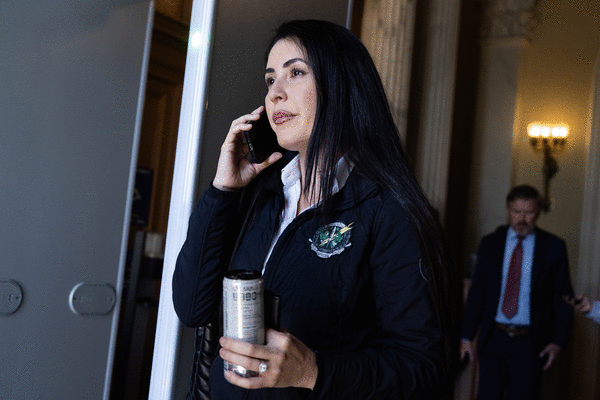
After a meeting with President Donald Trump at the White House, Rep. Anna Paulina Luna, R-Fla., said she was satisfied that her key demand — passage of legislation requiring proof of citizenship and photo ID to vote, known as the “SAVE America Act” or SAVE Act for short —would be met in the Senate.
The idea is that Senate GOP leaders will force Democrats into a “standing filibuster,” also known as a talking filibuster, if they want to indefinitely block the measure from coming to the floor. That means Democrats would have to hold the floor continuously rather than under the typical practice of a “silent filibuster,” where the minority can block a bill simply by telegraphing that 60 votes do not exist to advance the measure.
“We personally talked with the president about that, and he’s all for it and he wants the SAVE America Act,” Luna said Monday night, with Rep. Tim Burchett, R-Tenn., in agreement. “The standing filibuster is an old-school parliamentary procedure, but it’s a way to break through what we consider traditional norms to get voter ID passed.”
Two-speech rule
Senate Minority Leader Charles E. Schumer, D-N.Y., contemplated a similar mechanism when his party was in the majority in 2022, on voting rights legislation.
The plan involved enforcing the chamber’s Rule 19, which allows a simple-majority vote to bar senators from speaking more than twice “on any one question” during the same legislative day. And the majority can extend a legislative day indefinitely by simply recessing overnight.
“Once members of the minority party have exhausted all of their speaking rights and defended their position on the Senate floor, the debate will have run its course and the Senate will move to vote on final passage at a majority threshold,” Schumer said at the time.
Schumer and others in his caucus ultimately went further than simply enforcing the two-speech rule; they proposed a rule change that would have barred additional amendments, motions or points of order during debate on the voting rights bill. Former Democratic Sens. Joe Manchin III of West Virginia and Kyrsten Sinema of Arizona joined with the Republicans to defeat the proposal.
There wasn’t any immediate confirmation from Senate GOP leaders that they’d signed off on anything like this plan, which could tie the floor in knots as Democrats might find considerable stamina within their ranks to keep talking. Sen. Cory Booker, D-N.J., for example, set the record for a floor speech last year, at over 25 hours.
Senate Majority Leader John Thune, R-S.D., has also been reluctant to entertain proposals that could undermine the legislative filibuster.
And it’s not even clear if Senate Republicans could pass the bill, as Democrats could potentially move to table it with a simple majority. The Senate version of the earlier House-passed SAVE Act has 49 GOP cosponsors, with centrists Lisa Murkowski of Alaska and Susan Collins of Maine, as well as Rules Chairman Mitch McConnell, R-Ky., missing from the list.
But the White House meeting apparently went well enough to quell immediate concerns on the rule’s vote count, which will be a Republican-only exercise.
Speaker Mike Johnson, R-La., said Monday that he has the votes to adopt a rule governing floor consideration for the spending package, which includes the Defense, Labor-HHS-Education, Financial Services, National Security-State, and Transportation-HUD bills with a two-week stopgap extension for Homeland Security funding.
Agencies covered by those bills are now partially shuttered after stopgap funding lapsed early Saturday. Johnson can’t afford to lose more than one Republican to adopt a rule over Democratic opposition, assuming all members vote. Still, he said he’s not inclined to open up the funding bill to add the voter ID measure, which he said would come up for a separate vote as it has in the past.
“Republicans are serious about governing,” Johnson said. “We’ll demonstrate that, and we’ll push forward our priorities on the integrity of elections. So we could do all that simultaneously, and we will, but we’re going to get this job done, get the government reopened.”
Democrats warned that any inclusion of the SAVE Act, which they say would disenfranchise millions of eligible voters who lack a birth certificate or passport, would sink the spending package.
“The SAVE act is dead on arrival in the Senate and every single Senate Democrat will vote against any bill that contains it,” Schumer said on the floor Monday.
House Minority Leader Hakeem Jeffries, D-N.Y., made it clear that Democrats would not provide the widespread support necessary for the package to to be cleared under suspension of the rules, which needs a two-thirds majority vote. Nor will they back the rule, Jeffries said, which is typically a party-line vote.
Democrats in recent days have raised additional concerns with Homeland Security funding after the second fatal shooting of a U.S. citizen by federal immigration agents in Minneapolis.
In a nod to the public backlash, Homeland Security Secretary Kristi Noem said Monday that “every officer in the field in Minneapolis” will wear body cameras, with a plan to expand the program nationwide as funding becomes available.
Trump, in a post on Truth Social, added that negotiators will continue discussions “in good faith to address the issues that have been raised,” as Democrats press for further restrictions on immigration agents in the wake of the fatal shootings.
Democratic support?
Though Democrats aren’t prepared to support a rule for the package, some members could join Republicans to support a final vote for the spending measure if a rule gets adopted.
Rep. Rosa DeLauro of Connecticut, the top Democrat on the House Appropriations Committee, said Monday that she would support the legislation, which “gives us time and it gives us leverage.”
Further complicating Democrats’ decision whether to back the package is the fact that agencies like the Federal Emergency Management Agency and Transportation Security Administration are also funded under the Homeland Security continuing resolution.
“Everyone’s going to evaluate those dynamics individually,” Jeffries said Monday. He said there were a “diversity of perspectives” that his caucus would continue to discuss at meetings leading up to Tuesday’s expected votes.
But most Democrats appear likely to vote against the bill, saying they refuse to provide any more funding for the Immigration and Customs Enforcement and Customs and Border Protection agencies without new restrictions on immigration crackdowns in place.
House Homeland Security Committee ranking member Bennie Thompson, D-Miss., and most of his panel’s Democrats wrote to caucus members Monday urging them to oppose the bill.
“Democrats must act now to demand real changes that protect our communities before [ICE and CBP] receive another dollar in funding,” they wrote, adding a final demand at the end of the letter: “Kristi Noem must go.”
Shutdown status
The funding lapse marks the second partial government shutdown of the congressional session. Lawmakers are expecting a much shorter lapse than the historic 43-day shutdown seen last year and minimal effects.
The IRS has already said it plans to continue “normal activities” as tax filing season pick ups, despite the funding lapse, thanks to funds already in hand from the Biden administration’s 2022 reconciliation law.
But as the partial shutdown fully kicked in Monday, the government already reported a delay in releasing economic data. The Bureau of Labor Statistics confirmed that the previously scheduled Friday release of the jobs report for January will be pushed back due to the shutdown.
Still looming in the background, meanwhile, is the issue at the heart of the ongoing partial shutdown: Democrats’ demands for further changes to ICE policy in the wake of the fatal shooting. Lawmakers are seeking further transparency and comparable standards to local law enforcement in terms of oversight.
Republicans, meanwhile, see the negotiations as a potential opportunity to extract some concessions from Democrats, with policy aims like a push to criminalize the actions of local officials who lead “sanctuary cities” that don’t help enforce federal immigration policy.
“Any conversation … has to include a discussion of how to make it safer for our federal law enforcement agents to effectively carry out their duties,” Thune said Monday on the Senate floor. “We need to address not only issues like increased training for ICE officers, but things like preventing the constant harassment and worse that officers have faced for simply trying to do their jobs.”
---------
—Valerie Yurk, Daniel Hillburn, Niels Lesniewski and Paul M. Krawzak contributed to this report.
-------
©2026 CQ-Roll Call, Inc. Visit at rollcall.com. Distributed by Tribune Content Agency, LLC.





Comments