Kentucky nursing home residents could get 'granny cams' to watch for abuse under bill
Published in News & Features
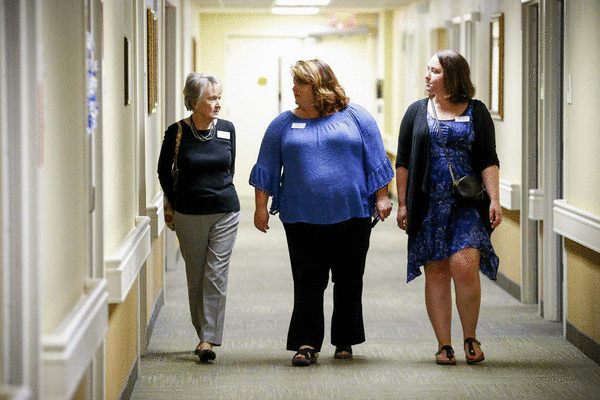
LEXINGTON, Ky. — A Kentucky legislator has proposed a so-called “granny cam” law to allow nursing home residents to position video cameras in their rooms that could catch incidents of elder abuse.
House Bill 491, filed by state Rep. DJ Johnson, R-Owensboro, would require nursing homes to allow residents and their families or other legal guardians to install video- and audio-recording equipment in the residents’ rooms.
The recording equipment would not be hidden; in fact, a sign at the room’s entrance would announce its presence. For shared rooms, the resident’s roommate would have to agree to the surveillance, although the equipment would be pointed away from the roommate.
Nursing home advocates say the cameras, already authorized in at least 20 states, could be an invaluable tool in protecting some of Kentucky’s most vulnerable citizens, by offering proof when they’re mistreated.
“It’s not a replacement for quality care. It’s not a replacement for family involvement. But I think that having some video monitoring available has been helpful in the past for family members and for residents who have not been believed about the quality of care they’ve been experiencing in the nursing home,” said Denise Wells, executive director of the Nursing Home Ombudsman Agency of the Bluegrass.
Before the COVID-19 pandemic, Kentucky nursing homes had among the worst collective ratings in the country for health and safety quality, the Herald-Leader has reported. In 2018, 43 percent were rated “below average” or “much below average” by the U.S. Centers for Medicare and Medicaid Services.
Since the pandemic, Kentucky state health officials have struggled with a massive backlog in their mandatory annual inspections of nursing homes, leaving some facilities largely unscrutinized for years, the Herald-Leader has reported.
When family members ask questions about a loved one’s bruises or other injuries, they’re sometimes not taken seriously because they’re outside visitors, Wells said. Likewise, when an elderly resident says a staff member hurt them, it’s sometimes assumed they suffer from cognitive decline and imagine things, she said.
“Unfortunately — and this is in line with the fact that people with disabilities are much more likely to experience abuse — it’s typically because they are viewed by a perpetrator as somebody who is not a reliable witness, so to speak,” Wells said.
“We definitely work with residents, as ombudsmen, who have concerns about certain caregivers,” she said. “When they report something, that caregiver might get suspended for two days pending an investigation, but then they’re placed right back in that person’s room, because the allegation was not substantiated.”
Johnson, the bill’s sponsor, said he doesn’t know if it will get a committee hearing during this legislative session, much less be signed into law. There might just be a discussion this year, he said.
Families should “have a right to keep an eye on” their loved ones living in nursing homes, Johnson said. However, he said, he’s not only hearing from families interested in his bill, he’s also hearing from the nursing home industry, which has “general concerns.”
“So the bill, I would say, is in flux,” Johnson said.
“I don’t think we’ve seen a final version of it,” he said. “The whole point is to have these conversations so we can come up with what would be the best legislation doing anything at all.”
The major lobbying group representing the nursing home industry in Frankfort, recently renamed the Kentucky Coalition for Aging Resources and Empowerment, did not respond to a request for comment for this story.
Texas was the first state to authorize “granny cams” in nursing homes in 2001.
Among the many states to follow Texas is Ohio, which enacted Esther’s Law in December 2021.
Ohio’s law is named for dementia patient Esther “Mitzi” Piskor, a victim of elder abuse at a Cleveland nursing home. Her son, Steve, who was suspicious because of his mother’s bruises and withdrawn behavior, hid a camera in her room. It captured video of aides brutally tossing Esther into and out of her bed and a wheelchair.
Several of the aides were fired and convicted of crimes following an investigation.
©2026 Lexington Herald-Leader. Visit at kentucky.com. Distributed by Tribune Content Agency, LLC.




Comments