Thai election win for Anutin gives royalists chance at stability
Published in News & Features
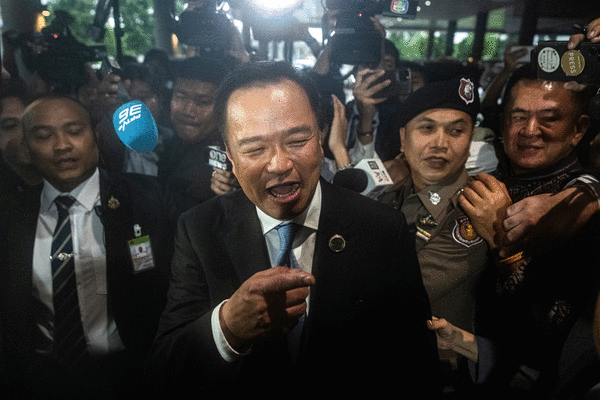
Since the turn of the century, election night has usually been great for pro-democracy reformers and miserable for Thailand’s royalists. Now the establishment has finally backed a winner, and the country may see some stability as a result.
Early results from Sunday’s vote show the ruling Bhumjaithai party is on track to secure 191 seats in the 500-member House of Representatives — nearly triple the last election in 2023. Prime Minister Anutin Charnvirakul’s party used its incumbency advantage and a campaign defined by rising nationalism following a tense border conflict with Cambodia to surprise election pundits.
Bhumjaithai has also positioned itself as a defender of royal interests, including by resisting any efforts to change laws that would allow freer discussion about the monarchy, which remains a taboo subject in Thailand. King Maha Vajiralongkorn granted Anutin an audience on the eve of the vote — an event officially unrelated to the election but which caught attention because of the timing.
“Sometimes the devil you know might be the one you can kind of live with,” said Thitinan Pongsudhirak, a professor of political science at Chulalongkorn University, who has written about Thai politics for decades. “People are thinking about continuity, stability.”
“The palace surprise mattered,” he added, in reference to Anutin’s meeting with the king.
The outcome represents the best-case scenario for the royalist establishment, which has used military coups and court decisions to oust half a dozen prime ministers since the turn of the century, including telecom billionaire Thaksin Shinawatra and his allies. The result also marks a significant setback for the pro-democracy movement that had sought to curtail the powers of the monarchy.
Thai voters opted instead for a middle-of-the-road party, which for years aligned itself with the government of the day, usually in return for prime cabinet positions. Now Bhumjaithai will have the opportunity to helm what could be a commanding majority coalition in the lower house of parliament after successfully rebranding itself as the only viable vote for stability in a nation that has cycled through 10 prime ministers in 20 years.
“We think Thailand is now in a steady state and we look forward to moving on with an even stronger cabinet and government,” Anutin told reporters on Sunday evening.
He’ll still need coalition partners to secure a 251-seat majority needed to form a ruling government. Potential partners include populist Shinawatra-backed Pheu Thai, with 74 seats, and Klatham with 59, as well as several smaller parties.
For Thailand watchers, the main question now is whether Anutin can leverage his strong showing at the polls to turn around a weak economy that’s grappling with dwindling competitiveness, wary foreign investors and an aging population. Growth has averaged about 1% a year since the pandemic, well below regional peers like Vietnam and Indonesia, and exacerbated by a turbulent geopolitical climate and the trade pressures of a second Trump administration.
While the People’s Party won the biggest share of the popular vote on a platform of structural change and economic reform, Anutin’s victory ensures a more moderate, status-quo-friendly vision for Thailand — one defined by more modest goals that include cash handouts and an economic growth target of 3%. Bhumjaithai has also floated an initiative to hire 100,000 caregivers for Thailand’s aging population and replacing traditional conscription with a volunteer military.
Despite the strong support for the establishment, Thais also voted on Sunday in a referendum to replace the 2017 military-drafted constitution, a reform process that the Bhumjaithai-led government has long sought to contain. Anutin has signaled that while he supports a rewrite in principle, his administration will shield the royalist establishment from any radical changes.
“An election outcome that keeps a Bhumjaithai-aligned establishment coalition in power would likely be viewed by investors as the most market-friendly scenario in the near term, thanks to policy continuity and ongoing fiscal support for consumption and infrastructure,” said Poon Panichpibool, a Krung Thai Bank strategist.
The result is a bitter pill for a reformist movement led by the People’s Party. As results solidified into the evening, the mood at the People’s Party headquarters in Bangkok turned somber. Early cheers for a symbolic popular mandate faded against the reality of a provincial seat count that favored the establishment.
Natthaphong Ruengpanyawut, the party’s leader, ruled out a partnership with Bhumjaithai, but said he would respect the result.
Bhumjaithai has thrived during coups and court dissolutions since breaking away from Thaksin’s camp in 2008, making itself an indispensable partner to royalist generals and pro-democracy reformers alike, while leading the charge on populist measures that includes a flagship push to legalize marijuana.
Anutin’s ascent to the establishment’s vanguard was finalized in 2023, when he stepped into the vacuum left by outgoing junta leader Prayuth Chan-ocha. He refused to join a progressive coalition over its pledge to amend the lèse-majesté law, the kingdom’s strict royal defamation code.
Anutin’s moment to lead came in September, when he became the third prime minister in two years after the ouster of Paetongtarn Shinawatra on an ethical breach. Since then, Anutin has leveraged nationalistic fervor stoked by a border conflict with Cambodia to peel away rural support from the once-dominant Pheu Thai.
The shift has profound implications for a sputtering export-reliant economy that has prioritized populist fixes over structural reform.
“If Bhumjaithai leads the next government, fiscal policy will likely be more prudent, though still with some stimulus,” said Peter Mumford, who covers Southeast Asia at risk consultancy Eurasia Group. “Economic reforms would likely only be incremental under a conservative-led government.”
A Bhumjaithai victory promises a smoother transition than the 2023 deadlock, even without an outright majority. Crucially, the party has also managed to consolidate control over the Senate. Though nominally nonpartisan, the upper house now grants Anutin significant sway over constitutional amendments, legislation and the independent agencies that investigate politicians.
Meanwhile, for backers of the Thai reformist movement, it’s a reminder that in Thailand’s democracy, winning the most votes is rarely enough to win the right to rule.
“We still have hope,” Phattaranan Saengsrichai, a 21-year-old communication art student, said after casting her vote. “Rome did not get built in a day.”
_____
(With assistance from Suttinee Yuvejwattana, Randy Thanthong-Knight, Anuchit Nguyen, Emma Clark, Pathom Sangwongwanich and Cecilia Yap.)
_____
©2026 Bloomberg L.P. Visit bloomberg.com. Distributed by Tribune Content Agency, LLC.





Comments