China expanding aid for Russia's war, Western officials say
Published in News & Features
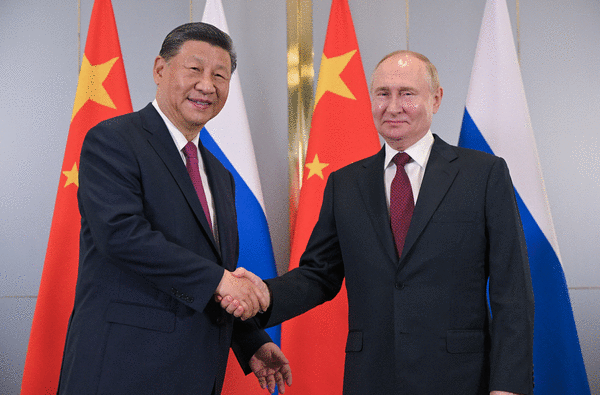
China increased its support for Russia’s war in Ukraine in 2025 and is likely to deepen cooperation with Moscow further this year, Western officials said, casting doubt on efforts by European leaders to improve relations with Beijing.
President Xi Jinping has become more assertive and confident in his supporting Russia’s Vladimir Putin, and attempts by the Europeans to persuade their Chinese counterparts to help end the war have become more challenging over the past year, the officials said.
Russia’s war in Ukraine wouldn’t be able to continue without ongoing Chinese support, particularly the export of dual-use components and critical minerals used in Russian drone production, the officials said. They described Beijing as the key facilitator of the war.
“China could call Vladimir Putin and end this war tomorrow,” U.S. Ambassador to NATO Matthew Whitaker said during a panel late Friday at the Munich Security Conference. “This war is being completely enabled by China.”
The private assessments, shared with Bloomberg on condition of anonymity, are more pessimistic than most Western leaders’ public statements on China’s role in the Russia-Ukraine war.
On Saturday, Foreign Minister Wang Yi gave an address to the Munich conference in which he reiterated his country’s position on Ukraine, saying China is not a party that’s directly involved and “doesn’t have the final say” on any political settlement. Instead, Beijing was continuing to press for peace talks.
“China will, in our own way, give our full support for the peace process,” Wang said.
In a meeting with Wang at the conference, German Chancellor Friedrich Merz said Berlin expects Beijing to use its influence over Russia and push Moscow towards ending its war in Ukraine, according to people familiar with the talks.
German Defense Minister Boris Pistorius also called out China for supporting Russia in its war against Ukraine.
“Moscow is not acting alone. It is pursuing its revisionist agenda by cooperating with China, Iran, and North Korea,” Pistorius told an audience in Munich on Saturday. “It is trying to use international fora such as BRICS and turn them into anti-Western blocs.”
Wang also met with Ukrainian Foreign Minister Andrii Sybiha. China has sought to maintain cordial relations with Ukraine despite its refusal to condemn Putin’s action in the conflict. Wang told Sybiha that Xi “actively supports peace talks,” according to the official Xinhua News Agency.
“China never stirs up trouble or takes advantage of situations for its gain, nor accepts shifting blame or shirking responsibility,” the Chinese Foreign Ministry said in a statement.
Distracting and dividing the West
Chinese officials may have initially been concerned by the economic impact of Russia’s war but they have since come to the view that it benefits Beijing because it means Europe is focused on Ukraine rather than Asia, and relations between Europe and the US have become strained, the people said.
“These frank reflections on China’s integral role in providing the materials that support Russia’s war machine beg the question of how sustainable it is to keep up the pretense that China can be a trusted or serious trading partner for the U.K.,” said Sam Goodman, a senior policy director at the China Strategic Risks Institute.
European leaders have overlooked their misgivings about China’s role in prolonging the war to improve relations with Beijing in the face of trade tensions with U.S. President Donald Trump. French President Emmanuel Macron and British Prime Minister Keir Starmer visited China for meetings with Xi in recent weeks, while German Chancellor Friedrich Merz is due in Beijing later this month. Trump is also expected to meet Xi in China in April.
European leaders have argued that only by engaging with Xi can they hope to influence his position on security issues. Still, they have also used their visits to Beijing to pursue closer trade ties.
China has helped blunt the effects of Western sanctions since the earliest days of the war, buying Russian oil and selling dual-use goods to its neighbor. A Bloomberg News investigation last year reported how Moscow had capitalized on its friendly ties with Beijing to skirt Western sanctions and acquire the know-how and capability to build drones to attack Ukraine.
Trade between the two sides has increased to $253 billion in 2024 from $152 billion in 2021. Over that period, Russia rose to China’s fifth-largest trading partner from its 10th.
China and Russia have a long and complicated relationship, drifting from allies to bitter rivals during the Cold War before Xi came to power in 2012 and struck up a personal relationship with Putin. While the Western officials said suspicions lingered between Beijing and Moscow, they assessed that their incentives to work together outweighed their differences.
Still, Wang reaffirmed China’s view that “the legitimate security concerns of all countries should be taken seriously,” a reference to Russia’s claims that it has been forced to counter NATO expansion on its Western flank.
———
(With assistance from Michael Nienaber.)
©2026 Bloomberg L.P. Visit bloomberg.com. Distributed by Tribune Content Agency, LLC.






Comments