Florida Cabinet OKs $40 million to local agencies, many rural, for immigration crackdown
Published in News & Features
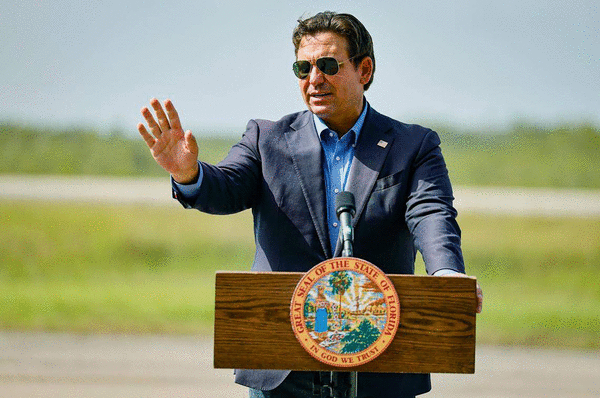
Gov. Ron DeSantis and members of the Florida Cabinet on Tuesday approved roughly $40 million to reimburse local law enforcement agencies — primarily in rural counties — for a rapid buildup of equipment and detention capacity as part of the state’s escalating immigration crackdown.
The total marked a sharp, last-minute reduction from the $53 million spending plan that had appeared on the Cabinet’s agenda ahead of the meeting. State officials did not immediately explain why the overall amount was scaled back.
The Florida Cabinet — which includes Attorney General James Uthmeier, Chief Financial Officer Blaise Ingoglia and Agriculture Commissioner Wilton Simpson — voted as the State Board of Immigration Enforcement to approve grant applications from 18 agencies across 16 counties.
Anthony Coker, the board’s executive director, told Cabinet members that one of the largest requests — from the Lee County Sheriff’s Office — had been revised. The agency’s original $23.6 million proposal was modified “to include two years of equipment” at a reduced cost of about $9.9 million, Coker said.
According to an updated list of the approved reimbursements provided to the Herald/Times by the governor’s office, the Lee County requests approved by the state board included a $4.3 million, two-year contract for body cameras equipped with artificial intelligence translation technology.
The itemized list of reimbursements offers one of the clearest looks yet at how local law enforcement agencies are expanding their immigration enforcement operations as part of DeSantis’ push to align Florida with the Trump administration’s crackdown on illegal immigration. Equipment expenses made up about $27.8 million, or over half, of the $46 million reimbursements newly approved by the Cabinet.
Some of the most expensive equipment requests came from Lee County, though their status remains uncertain. According to the agenda, the county sought $2.1 million from the state to cover the purchase of 1,200 Angel Armor vests at $1,806.25 each.
In its application, the Lee County Sheriff’s Office said deputies “often operate in high-risk environments, including detention facilities and joint federal–local operations, where mobility, comfort, and sustained protection are critical.” Properly fitted body armor, the agency wrote, allows for a full range of motion and reduces fatigue during long shifts, enabling officers to remain alert while conducting screenings, interviews or transporting detainees.
Other sizable requests included $3.78 million from the Jackson County Sheriff’s Office for radios and dispatch consoles, and $182,500 from the Osceola County Board of County Commissioners for a “new generation body scanner” that “would provide a faster scan time, can detect elevated body temperatures, and provides a high-resolution X-ray image with no distortion.”
“This upgrade is critical for detecting weapons, cellphones, and contraband that’s hidden under clothing and inside the body of ICE detainees,” Osceola County wrote in its reimbursement application. The county also requested a nearly $60,000 reimbursement for ballistic vehicle panels.
The board’s agenda also included a $1.4 million carveout to award bonuses to about 950 law enforcement and correctional officers who assist with detention efforts.
Of the $40 million approved Tuesday, roughly $14 million will fund new grant awards, Coker said. The remaining $26 million will go to agencies seeking amendments to previously approved requests, many asking for additional funds.
The reimbursements are part of a broader $250 million pool set aside by the Florida Legislature and championed by DeSantis to support local participation in immigration enforcement. The state has already approved tens of millions of dollars in earlier rounds.
Agencies have sought reimbursement for a wide array of tools and programs, including body cameras, license plate readers, surveillance towers, specialized software, training under the federal 287(g) program — which authorizes local officers to perform certain immigration enforcement functions — and jail bed space for immigrants awaiting federal processing.
_____
©2026 Miami Herald. Visit miamiherald.com. Distributed by Tribune Content Agency, LLC.





Comments