Israel plans new foothold on the Red Sea to fight the Houthis
Published in News & Features
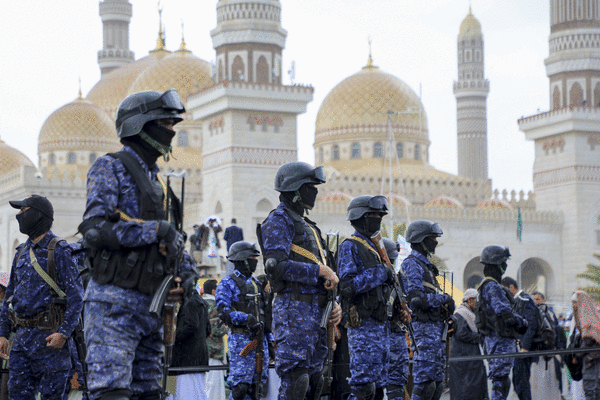
While the Iran war rages, Israel is quietly planning for a potential base at the mouth of the Red Sea from which to strike one of the Islamic Republic's last proxies still operating at full strength: the Houthis of Yemen.
That’s thanks to Somaliland, the breakaway territory on the Gulf of Aden that Prime Minister Benjamin Netanyahu’s government recognized in December — a move that handed Israel its first diplomatic presence across from Yemen. Now, the Jewish state will follow up with a strategic security partnership that may involve Israel building a base – possibly covert – on its pristine coast, despite widespread regional criticism, according to Khadar Hussein Abdi, Somaliland’s minister of the presidency.
“In terms of security, we will have a strategic relationship and that encompasses a lot of things,” Abdi told Bloomberg at his office in Hargeisa, the capital. “We haven’t discussed with them if it becomes a military base, but definitely there will be an analysis at some point.”
Since the U.S. and Israel attacked Iran on Feb. 28, oil and gas prices have surged, with the Strait of Hormuz — which carries about a fifth of the world’s oil — effectively closed. As the conflict has dragged on, the shipping industry has faced escalating war-risk insurance premiums, with Iran striking several vessels. So far the Houthis have held back on attacking ships in the waterway but have suggested they could enter the war.
Even if the war ends swiftly, it underscores the importance of Israel’s desire to secure a presence at the gateway to the Red Sea.
Israel has already begun laying the groundwork for a potential base. Last June, a small group of Israeli security officials arrived in Somaliland to visit its strategic coastline, according to people familiar with the matter.
The group spent days surveying the self-declared nation’s beaches, in order to identify a possible site for a base or installation to fight the Houthis, based just 260 kilometers (160 miles) across the Gulf of Aden in Yemen, the people said. A spokesperson for the Israeli government didn’t immediately respond to a request for comment.
One location under consideration by Israel, according to people familiar with the matter, is an area of high terrain about 100 kilometers (62 miles) west of Berbera, the port city where the United Arab Emirates – which normalized relations with Israel under the Abraham Accords – has both a DP World harbor and a military airstrip.
The Houthis — considered a terrorist group by the U.S. — have held their fire since the U.S.-Israeli attacks on Iran, but remain Tehran’s most formidable proxy after Israel crippled both Hamas and Hezbollah. Tensions between the group and Israel escalated in 2023, after the Yemeni militia began bombing both the Red Sea and the Jewish state in retaliation for the war in Gaza.
An Israeli general has established a special intelligence unit on the Houthis and said in a background briefing with Bloomberg that they have hundreds of rockets that can reach Israel.
“The Israeli relationship with Somaliland matters in large part because the Houthis are expanding along the Horn of Africa,” said Ari Heistein, a research fellow at the Jerusalem Institute for Strategy and Security. “If the ongoing U.S.-Israel campaign degrades Iran’s ability to support the movement, the region could become an even more critical strategic arena for them.”
The two governments had discussed Israeli recognition for years, according to regional officials. But the deal was sealed quickly late last year because of Israeli intelligence officers, who now view the Houthis as one of Israel’s greatest threats, according to regional diplomats and a senior Israeli military official.
Shortly after Israel’s recognition on Dec. 26, more than a dozen senior military officials from Somaliland travelled to Israel for training as part of a push to deepen security ties, according to people familiar with the matter. Israel also rented rooms fitted with blast-proof windows on the top floor of a hotel in Hargeisa, they said, as it scouts a location for an embassy.
Netanyahu in December credited Mossad, among others, for helping to secure the deal to recognize Somaliland. Israeli officials also visited Hargeisa on Feb. 27, the day before war broke out in Iran.
Following the diplomatic move, 21 Arab, Islamic and African states including Egypt and Qatar expressed outrage, warning of its potential "serious repercussions” for peace and security in the Horn of Africa and the Red Sea.
“The events in the Gulf, especially with Iran now attacking allies of the U.S., also highlight a dilemma for Somaliland – namely the prospect of getting dragged into regional conflicts without adequate defenses in place,” said Omar Mahmood, a senior analyst for Somalia at the International Crisis Group.
In early January, Somalia – under pressure from Saudi Arabia, which had accused Abu Dhabi of using the territory to extract a Yemeni separatist leader – cut all commercial and security ties with the UAE, specifically citing DP World’s ports in Berbera and nearby Bosaso in Puntland, another semi-autonomous region of Somalia. Both regional governments immediately rejected Somalia’s announcement.
Israel’s growing presence in Somaliland places the country in direct competition with Turkey, which is the main supporter of the central Somali government. It comes as Israeli officials have increasingly framed Ankara as a key threat to the Jewish state, with former Prime Minister Naftali Bennett recently referring to Turkey as “the new Iran.”
“For Israel, recognition of Somaliland offers a security counterweight to Houthi dominance in the Gulf of Aden,” said Conor Vasey, an analyst at the London-based advisory firm J.S. Held. “Specifically, it helps balance rising Turkish influence in Somalia.”
Turkey has developed its largest overseas military training base in Mogadishu, Somalia’s capital, and recently deployed F-16 jets to protect its interests in the country that include a ship exploring for offshore oil and gas. Turkish President Recep Tayyip Erdogan called Israel’s recognition of Somaliland illegal on a December trip to the region.
Beyond the Middle East powers jockeying for influence, the Islamist groups Al-Shabaab and Islamic State in Somalia have both threatened to attack Somaliland should Israel use the country for its own interests.
“We have a lot of enemies to this, who really want to put pressure on Israel,” said Mohamed Abdirahman, director-general of Somaliland’s foreign ministry.
The breakaway state now has its sights set on the ultimate prize – U.S. recognition.
Already, Republican-aligned U.S. Africa experts are rallying to its cause, including J. Peter Pham, who served as Trump’s envoy to the Sahel and Great Lakes regions in his first term, and Tibor Nagy, who then served as assistant secretary of state for Africa. Hargeisa has also hired the Washington lobbying firms Panterra and FGS Global to make its case to the Trump administration.
"As for strategic real estate, it is hard to beat Somaliland,” Pham told Bloomberg, noting the presence of Africa’s longest runway at 5,000 meters (3 miles) long as well as its deep-water port facilities in Berbera.
In August, Republican Senator Ted Cruz, who chairs the Senate Foreign Relations Subcommittee on Africa, sent a letter to Trump urging him to recognize Somaliland as an independent state.
The U.S. leader has voiced his discontent with America’s three-decade long military deployment in Somalia – even as he’s conducted 162 airstrikes in Somalia, three times as many as under the Biden administration, according to data compiled by the New America Foundation.
The U.S. has also hired a former senior intelligence officer to conduct assessments of Somaliland on behalf of the American government, according to people familiar with the matter. The U.S. State Department didn’t immediately respond to a request for comment.
Abdi, the minister of the presidency, said Somaliland is ready to offer the U.S. access to its largely unexplored and unproven reserves of rare earth minerals and oil. A military base is also on the table, he said.
“They are tired of supporting the failed state of Mogadishu,” said Abdi. “They have been pumping money and military support and nothing changes in Somalia. A policy shift is coming.”
---------
—With assistance from Peter Martin, Ethan Bronner and Dan Williams.
©2026 Bloomberg L.P. Visit bloomberg.com. Distributed by Tribune Content Agency, LLC.





Comments