Widow of Haiti's slain president testifies against 4 Florida men accused of plotting murder
Published in News & Features
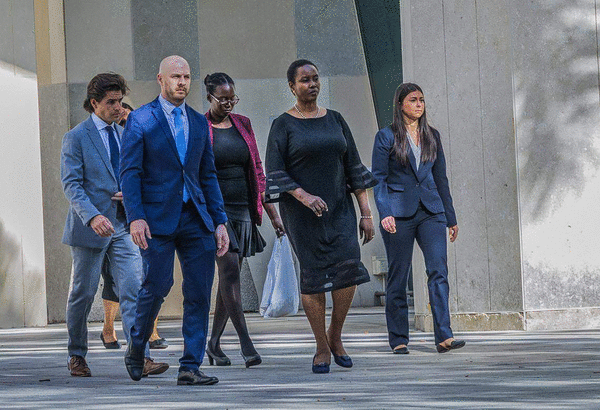
HAITI — The widow of Haiti’s slain president testified on Wednesday that her husband’s assailants were speaking Spanish when they fatally shot Jovenel Moïse — bolstering the government’s case that a Colombian hit team was recruited by four South Florida men charged with plotting the attack at the couple’s hilltop home outside Port-au-Prince.
Martine Moïse, testifying at their murder-conspiracy trial in Miami federal court, identified two of the gunmen as “Pipe” and “Jefe” and said “they were speaking in Spanish” after they wounded her and killed her husband as they ransacked the couple’s bedroom looking for a mysterious document.
“I had never heard [of] them before,” the wife, 51, testified through a Creole interpreter before the 12-member jury.
In a key court filing, federal prosecutors said that the gunman called “Pipe” was a former Colombian special-forces soldier named Victor Albeiro Pineda Cardona. They say he was hired as part of the Colombian crew by the four South Florida defendants on trial: Arcangel Pretel Ortiz, Antonio “Tony” Intriago, James Solages and Walter Veintemilla.
Prosecutors say Pineda traveled with Solages to Moïse’s house “with the objective of killing the president” on the night of July 7, 2021.
“Ballistic forensic evidence confirms these facts,” prosecutors said in a court document. “Bullets or bullet fragments from both Moïse and his wife Martine Moïse ... match an AR-15 assault rifle that belonged to the Colombian mercenaries and in particular the so-called ‘Delta’ team assigned to kill Moïse.”
The wife’s testimony undercut claims by defense attorneys that a senior Haitian government official, Joseph Felix Badio, and several national police officers carried out the deadly assault, and that Moïse was already dead when the Colombian crew arrived at his home with intentions of only arresting him.
Martine Moïse, the government’s star witness, provided the first insider account of how her husband was assassinated in the couple’s home in Petion-Ville and how his presidential security detail left him vulnerable to the attack. She described how she went to bed at 10 p.m. on July 6, 2021, and was awakened along with her husband at about 1 a.m. as gunshots rang out around their home.
Moïse said she heard constant gunfire outside the house for another 45 minutes before a group of men burst through the door to the couple’s bedroom on the second floor and started shooting. She was lying on her stomach with her head and shoulders tucked under the frame of their four-poster bed, she said, while her husband was on his back on the right side.
“As I was lying on the floor I could see Jo on the other side,” she testified, referring to Jovenel. “As they shot at me, I saw his face disfigured.... I lifted my right finger, so he could see that I was still alive.”
As the gunmen rummaged through the bedroom for the mysterious document, one of them shot Haiti’s president at point-blank range and then took a picture of him.
“Right there and then, I closed my eyes because I had no hope that anyone would come to my rescue,” she said.
While she pretended to be dead, the gunmen flipped her over and dragged her away from the bed, she said. Then, one of them pointed a flashlight at her eyes to see if she was dead — even though she testified that her eyes were closed and the bedroom light was on.
After the gunmen fled the home, she slid over to her husband’s side of the bed, leaving blood stains on the floor.
“I looked at him and could see his eye was missing,” she said, as she thought to herself, “Why am I still alive?”
She suffered gunshot wounds to her arm, elbow, buttocks and thigh, while one bullet grazed her lung. She underwent several surgeries at Jackson Health System in Miami. Her husband was riddled with a dozen gunshots and died immediately.
Minutes before the deadly assault, Moïse said she crawled downstairs on her hands and knees to check on the couple’s daughter and son, and found them in the son’s room. She said she instructed them to hide in a windowless bathroom, along with one of the family’s dogs, Delilah, for their own safety on the first floor of the house.
Then she crawled back upstairs to the master bedroom, where she found her husband lying near the bed. He told her to hide on the other side of the bed to avoid stray bullets being fired outside their home. She said she could not fit under the bed frame because it was too low.
She asked her husband if he had called any officials in charge of protecting the couple’s home. He told her that he called Dimitri Herard, head of presidential security; Jean Laguel Civil, a top security official, and Leon Charles, the Haitian national police chief. They were in charge of the security detail posted outside the couple’s home.
During her testimony on Wednesday, the wife said all three of those officials and their security officers betrayed her husband by failing to protect him when the couple was under attack.
“I lost trust in these three people when they didn’t show up,” she testified.
Four men on trial
The defendants standing trial are Ortiz, 53, a former FBI informant, Colombian national and U.S. permanent resident; Intriago, 62, the Venezuelan-American owner of a Doral security company that hired Pretel; Solages, 40, a Haitian-American handyman who also worked for Intriago; and Veintemilla, 57, an Ecuadorian American accused of helping finance the plan targeting Moïse. All have been in custody in the Miami federal detention center since their arrests.
On Wednesday, defense attorneys tried to catch Moïse in contradictions, claiming during an afternoon of cross-examination that she couldn’t get her facts straight.
Attorney David Howard, representing Ortiz, noted that the widow had told FBI agents immediately after the assassination that the gunmen looked for the document in the couple’s bedroom before killing her husband — just as she testified on Wednesday.
But Howard said that two weeks after the assassination, she told agents that the gunmen searched for the document before fatally shooting him. She said she did not know what the document was — though the Miami Herald has learned it was a presidential order naming Ariel Henry as Moïse’s prime minister.
“They were looking for the thing, and after they found the thing, they shot my husband,” she testified.
“Did you get it wrong or the FBI agent get it wrong?” Howard asked.
She didn’t answer.
“You’re changing your story, and that’s fine,” Howard said.
“I’m not changing my story,” she retorted.
©2026 Miami Herald. Visit at miamiherald.com. Distributed by Tribune Content Agency, LLC.




Comments