Lindsay Clancy trial: Jurors end first day of deliberations
Published in News & Features
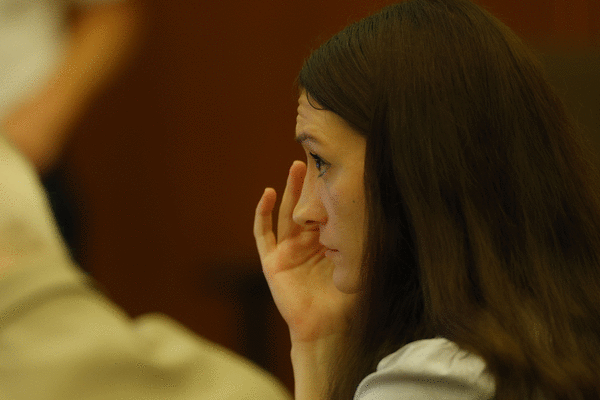
BOSTON — The jurors in the Lindsay Clancy triple murder trial have been sent home after deliberating this afternoon for the first time after weeks of testimony and closing arguments.
Clancy killed her children on January 24, 2022, then tried to kill herself, leaving her paralyzed from a fall out of her second-story bedroom window.
She isn’t disputing that she strangled Cora, 5, Dawson, 3, and Callan, eight months. Instead Clancy’s defense claimed that she suffered from postpartum psychosis at the time of the killings.
It will be up to the jury to decide whether she is criminally responsible for their deaths.
Judge William Sullivan instructed the jurors that in order to find Clancy not guilty by reason of insanity, they had to determine that she had a mental disease or defect that either made her unable to appreciate the wrongfulness of the killings or impeded her ability to comport her behavior to the law.
Before the nine women and three men on the jury went into the deliberations, Clancy’s attorney Kevin Reddington and Plymouth Assistant District Attorney Jennifer Sprague had one more chance to persuade them during their closing arguments.
Reddington started his opening by thanking the jury and calling out the Plymouth County District Attorney’s Office. DA Timothy Cruz sat in the front row.
“This is a prosecution that has ripped the soul out of this girl,” Reddington said.
He tried to point out inconsistencies between the evidence present and the story the prosecution is telling.
“Watch the manipulation … because that is what this case is built on,” Reddington told the jurors.
He said that the prosecution had tried to discredit Dr. Paul Zeizel, a psychologist for the defense who examined Clancy and found that she was in psychosis at the time of the killings. The Commonwealth had asked whether he could be impartial as he said he’d come to care for Clancy over the course of seeing her. Reddington said that the doctor was just being humane trying to help Clancy.
“She’s a good kid, she’s beautiful soul,” Reddington said.
By the time January 2023 came around, Clancy had been suffering for months, taking the medicines she was prescribed, seeing different doctors, hospitalized, but “her mind was gone.”
Reddington highlighted testimony from Dr. Phillip Resnik, a renowned expert in filicide and malingering, who also concluded that Clancy was suffering from psychosis and couldn’t control herself. He referred to one of Resnik’s papers that stated that auditory hallucinations can come from within and without a person’s head, lending credibility to the idea that some of Clancy’s intrusive thoughts in December about killing her children and herself might have been hallucinations.
The prosecution had called their own experts who disagreed with that, but Reddington said their credentials were missing experience with postpartum women.
“You have these men coming in here who don’t even know schizophrenia from psychosis,” Reddington said.
He told the jurors their expert testimony didn’t rise to the level of proof beyond a reasonable doubt.
“Even though the person is a defendant … you don’t have to defend against anything,” he said. “The government has the burden of proof.”
“There was no dispute that Lindsay Clancy was suffering from a mental illness and she tried to kill herself,” Sprague said at the start of her closing. “That’s not the issue in this trial.”
Sprague conceded that Clancy tried to get help, that she wanted to get better, but argued that it had to be on Clancy’s timeline and that she wasn’t always honest with her providers.
Sprague noted that those providers never saw any signs of hallucinations and psychosis in Clancy throughout her care in fall 2022 through January 2023.
“So, they’re all wrong?” Sprague asked. “That doesn’t make sense.”
Clancy was depressed, the prosecutor admitted. The defendant’s journal tracking her medicines stopped on Jan. 18, and Sprague said, “It’s as if she’s decided she’s done trying.”
The prosecutor said that the planning started around 4 p.m. Jan. 24. Clancy looked up a medication for Cora, where to get takeout, and how long it would take to get.
“She knew that she had a limited amount of time to do what she wanted to do,” the prosecutor said.
Sprague described the killings, which she said must have started right after Patrick Clancy left the house, something the defense has disputed.
“There wouldn’t be time to strangle each one,” she said, had the phone call happened before Lindsay Clancy said she heard the voice.
Clancy cried quietly while the prosecutor talked about the asphyxiation, arguing Clancy was pulling on the exercise bands for at least 30 seconds for them to fall unconscious, then a few minutes more to kill them. Reddington said both Clancy’s ex-husband and first responder reported the bands had been tied.
“How many seconds is it OK for them to be in pain?” Sprague asked. “They all felt it.”
“She could have killed herself and left her kids alone,” the prosecutor continued said, “she didn’t lock herself in her bathroom upon hearing ‘some voice,’” making an air quotes motion.
Sprague tried to bring up the Andrea Yates case, an example of another mother who’d reported attempting suicide twice before killing her kids in psychosis, but Reddington objected.
“Their mom is the one who’s hurting them,” Sprague said, “that’s extreme atrocity and cruelty.”
_____
©2026 MediaNews Group, Inc. Visit at bostonherald.com. Distributed by Tribune Content Agency, LLC.






Comments