Trump and Xi buy time on trade with neither able to afford a fight
Published in News & Features
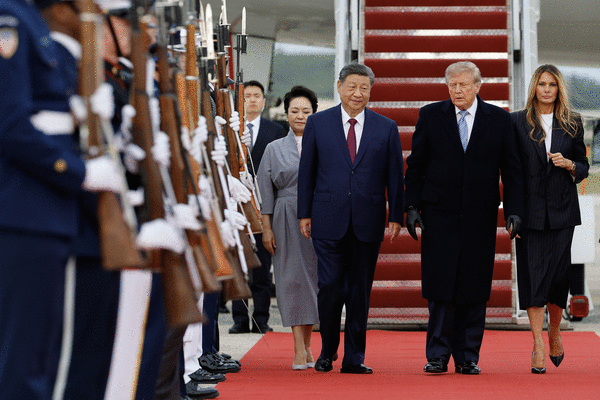
Donald Trump and Xi Jinping agreed to maintain a trade truce until early 2027, with neither ready to upend relations between the world’s biggest economies even as tensions persist over rare earths, technology curbs and Taiwan.
Just as Xi landed in the U.S. on Wednesday, Treasury Secretary Scott Bessent announced that an agreement struck by the leaders last year will now run an additional two months until Jan. 10. That removes much of the tension around Xi’s first state visit to the U.S. since 2015, and clears the way for two more meetings between the presidents planned in the coming months at summits in Shenzhen and Miami.
Still, the brief extension shows that the “constructive strategic stability” underpinning the relationship remains fragile. The U.S. has accused China of failing to live up to pledges to provide a steady flow of rare earths, while Beijing remains confident that its grip over the elements crucial to defense and high-tech manufacturing will deter Trump from reimposing sky-high tariffs.
“We can live with that because we are confident that within two months the U.S. cannot become independent of Chinese rare-earth supply,” said Wu Xinbo, director of Fudan University’s Center for American Studies and a former adviser to China’s Foreign Ministry. “They’ll come back and beg for Chinese exports of rare earth magnets to the U.S.”
News of the extension appeared to reduce the immediate risk of a supply disruption, hurting shares of companies seeking to provide alternatives to Chinese rare earth supplies. Toyo Engineering Corp. slid about 9% in Tokyo and Australia’s Lynas Rare Earths Ltd. fell as much as 5%. The broader markets showed little enthusiasm, with China’s benchmark CSI 300 Index falling 1.7% and MSCI’s gauge of Asian stocks dropping 0.8%, also pressured by elevated oil prices and U.S. bond yields.
Bessent on Wednesday met with his Chinese counterpart He Lifeng in Washington to hammer out the terms, building from talks held in New York last weekend. Even so, the U.S. treasury secretary made his displeasure clear while announcing the truce.
“There are some deliverables that have not been perfect on the Chinese side,” Bessent told Fox News. U.S. officials had spelled out their expectations and now wanted to see if Beijing “could be a bit more fulsome in enacting the agreement” in the coming months.
Both sides appear to have settled for less than expected. Trade Representative Jamieson Greer indicated this week the U.S. was looking to extend the truce for three to six months while highlighting the lack of trust between the nations. China had sought a longer period, aiming to lock in the current deal through the Trump presidency.
Agriculture is another source of dissatisfaction on the U.S. side. China is about than halfway toward meeting its pledge to buy 25 million tons of U.S. soybeans this year, but progress has been slower on a separate commitment to purchase about $17 billion in additional American agricultural goods.
“We are encouraging them to pick those up,” Bessent said on Wednesday.
The lack of tangible progress on trade didn’t stop Trump from rolling out the red carpet for Xi at Joint Base Andrews, where he became the first U.S. president in six decades to receive a foreign counterpart, excluding visits by the Pope. The two will hold more substantive meetings and a state dinner on Thursday in Washington.
“The summit is producing managed stabilization,” said Han Lin, China country director of The Asia Group, adding that the truce extension fulfilled the low expectations held by both sides entering the gathering. “If Trump and Xi do meet again in November or December, maybe the goal is to save the best for last.”
China has sought to keep U.S. tariffs at a relatively low level while also pushing Trump to eliminate national-security restrictions and hold off on any weapons sales to Taiwan. Although the two sides have sought to boost trade in non-sensitive items, they’ve made little progress on a Board of Investment that could open the door for Chinese companies to expand operations in the U.S. — a prospect that faces widespread opposition in the U.S. Congress.
China is also seeing trade tensions rise with Europe, where leaders have grown increasingly concerned about the erosion of manufacturing in the face of Chinese exports of electric vehicles, consumer electronics and other cutting-edge goods.
“Potential tariff risks from the U.S. and E.U. represent potential downside risks to China’s export outlook,” said Lynn Song, chief economist for Greater China at ING Bank NV in Hong Kong. “It becomes increasingly important for China to shore up domestic demand moving forward.”
Both leaders are also facing domestic challenges that would become more difficult with a wider trade fight. Trump, 80, is approaching November’s midterm elections with his fellow Republicans at risk of losses that could weaken his position in Congress. Xi, 73, is contending with sluggish economic growth, weak domestic demand and elevated youth unemployment ahead of a year that will see the Communist Party pick new leaders at a twice-a-decade gathering.
“Looking at the broader bilateral relationship, neither side can afford more turmoil at this point,” said Zhao Hai, vice president of the Chinese Institute of Hong Kong, a think tank affiliated with the Chinese Academy of Social Sciences, a government research group in Beijing. “Especially a further escalation that would result in a lose-lose situation.”
—With assistance from Nectar Gan and Yujing Liu.
©2026 Bloomberg L.P. Visit bloomberg.com. Distributed by Tribune Content Agency, LLC.





Comments