Commentary: Books we read in 2025 that prepared us for tech's future
Published in Books News
Trillions of dollars hang in the balance of two questions that dominated this year and loom perilously large over the next. “Will the artificial intelligence bubble burst?” and “Will China beat the US?”
Searching for answers is the theme of this year’s book recommendations from Bloomberg Opinion’s technology columnists. We’ve chosen a list that sets the intellectual table for the tech year ahead: new books with the latest insights, established ones with renewed relevance and even instructive fiction.
Now into its third year, the list shows the shift in the tech sphere’s collective mood. In 2023, the first full year of ChatGPT’s availability, the picks leaned into the unnerving sense of unknown surrounding AI’s impact and its existential threat. Last year, as tech company valuations started to head toward the stratosphere, the chosen books examined societal questions of industrial revolutions, corporate power and fears over who might be left behind.
In 2025, looking to the past may not provide all the answers about an AI bubble, but it’ll offer some invaluable clues.
Dave Lee is Bloomberg’s US technology columnist, based in New York. Parmy Olson covers AI and the tech industry from London and is the author of Supremacy. Catherine Thorbecke is Bloomberg’s Asia tech columnist, based in Tokyo.
"Breakneck: China’s Quest to Engineer the Future"
by Dan Wang (2025)
China is run by engineers, and America is run by lawyers. That’s tech analyst Dan Wang’s disarmingly simple yet eye-opening thesis. It explains how Beijing was able to connect the nation with high-speed rail, while California’s project has been endlessly delayed.
After all, engineers get stuff done — a virtue when building bridges, skyscrapers and train lines but a potential catastrophe when the same mindset is applied to social policy. And lawyers tend to proceed more cautiously.
My favorite parts of the book are Wang’s portraits of his travels across the mainland. They offer a ground-level view, rarely available to American readers, of a country Washington increasingly casts as its chief geopolitical nemesis. Yet no two people are more alike, Wang argues, than Americans and Chinese. From their can-do attitudes to their unabashed materialism, the cultures have more in common than their governments might like to admit. — Catherine Thorbecke
'Dot.Con: The Greatest Story Ever Sold"
by John Cassidy (2002)
Why a forensic account of the dot-com crash might be useful as we head into 2026 doesn’t need any explaining. Yet John Cassidy’s entertaining post mortem makes the stark differences between that moment and today’s speculative AI bubble equally clear, too.
Cassidy, a British-American journalist and staff writer at The New Yorker, describes the coalescence of forces that both created the bubble around internet stocks and led to its collapse. No single factor — be it venture capitalists, Wall Street, the press or the Federal Reserve — is let off the hook, nor entirely blamed. Reading this 25 years after the events it describes does, of course, bring a sense of dark foreboding. — Dave Lee
"The Curious Case of Mike Lynch"
by Katie Prescott (2025)
Even in the eccentric world of tech billionaires, Mike Lynch was an odd character. His cautionary tale, which culminated in a $5 billion lawsuit, is especially handy in the middle of an AI bubble.
The founder of $11 billion software firm Autonomy, Lynch refused to fix his teeth or improve his drab sense of dress as he grew wealthy. He served cheap wine from the local grocery store to guests at his English countryside manor. He collected model trains and his favorite phrase was, “Always bring a gun to a knife fight.”
But as press criticism and competitive pressures rose, his ambition turned into aggressive sales tactics and shady financial reporting, which the book lays out in forensic detail. That led his company’s acquirer, Hewlett-Packard, to sue for alleged fraud. The tale ends in a tragic irony when Lynch dies in a freak accident on his yacht. He’d been celebrating his acquittal. — Parmy Olson
"Technology and the Rise of Great Powers"
by Jeffrey Ding (2024)
If you want to understand who might win the AI race, start by looking backward. In this deeply researched text, political science professor Jeffrey Ding does exactly that. He charts how past “GPTs” — in this case, that’s “general purpose technologies” — have shaped the rise and fall of empires.
The tech world tends to obsess over big breakthroughs and which nation lands them first. But Ding argues it’s the far less glamorous work of spreading a technology across an economy that ultimately determines who pulls ahead.
From Britain’s rise as the dominant economic power after the first Industrial Revolution to Japan’s missteps in the information age, his data-packed historical analysis is dense but rewarding. And as today’s AI arms race accelerates, his point is hard to ignore: Diffusion, not discovery, may prove the real battleground. Ding’s framework culminates in a stark warning for policymakers that they may not even be running the race that matters. — Catherine Thorbecke
"Parallel Worlds"
by Michio Kaku (2006)
Several episodes of Star Trek have used wormholes as plot devices, and lo and behold, they might really exist as shortcuts through spacetime, according to renowned theoretical physicist Michio Kaku.
Tech dabblers who enjoy a bit of science fiction will get a kick out of this highly accessible introduction to our universe, including its rapid expansion and potential parallel versions. The book’s best feature is its storytelling, which dips into the surprisingly dramatic lives of physics icons from Isaac Newton to Albert Einstein.
William Shatner, the actor who played Captain James T. Kirk in Star Trek, openly wept in 2021 after returning from a private space flight and later explained he’d been terrified looking out at the bleak expanse of space and our tiny place in it. Reading this book is similarly humbling. — Parmy Olson
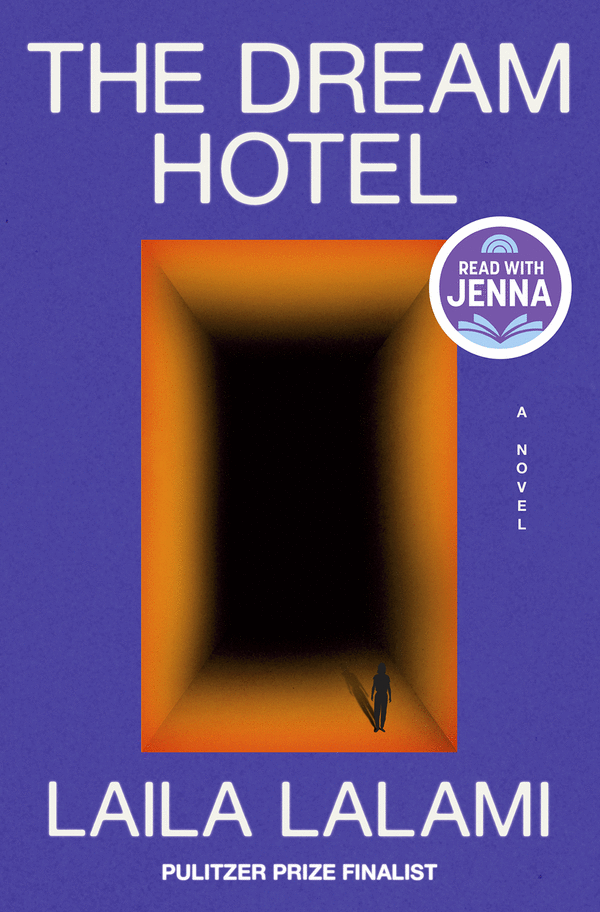
"The Dream Hotel"
by Laila Lalami (2025)
I feel the same way about dystopian tech novels that I imagine a doctor feels watching ER: Only the smallest lack of realism will snap me out of the plot. I have no such qualms with Laila Lalami’s The Dream Hotel. It’s a vivid portrayal of how data could be used to imprison any of us.
The story follows Sara Hussein, a Moroccan American detained at Los Angeles International Airport after an algorithm determined she was at an elevated risk of killing her husband. She is told the “holistic” system drew from hundreds of sources and indicators to make its determination.
Such blending together of immense data sets lies at the heart of some of Silicon Valley’s most ambitious companies today — with law enforcement and the military already some of the keenest clients. “I'm not terribly optimistic that regulation is going to keep up,” Lalami told me earlier this year. Her book is a compelling warning of what’s in store if our digital freedoms erode even further. — Dave Lee
____
This column reflects the personal views of the author and does not necessarily reflect the opinion of the editorial board or Bloomberg LP and its owners.
Dave Lee is Bloomberg Opinion's US technology columnist. He was previously a correspondent for the Financial Times and BBC News.
Parmy Olson is a Bloomberg Opinion columnist covering technology. A former reporter for the Wall Street Journal and Forbes, she is author of “Supremacy: AI, ChatGPT and the Race That Will Change the World.”
Catherine Thorbecke is a Bloomberg Opinion columnist covering Asia tech. Previously she was a tech reporter at CNN and ABC News.
©2025 Bloomberg L.P. Visit bloomberg.com/opinion. Distributed by Tribune Content Agency, LLC.







Comments