Dustin Hoffman's book doesn't mention Meryl Streep's claim he slapped her
Published in Books News
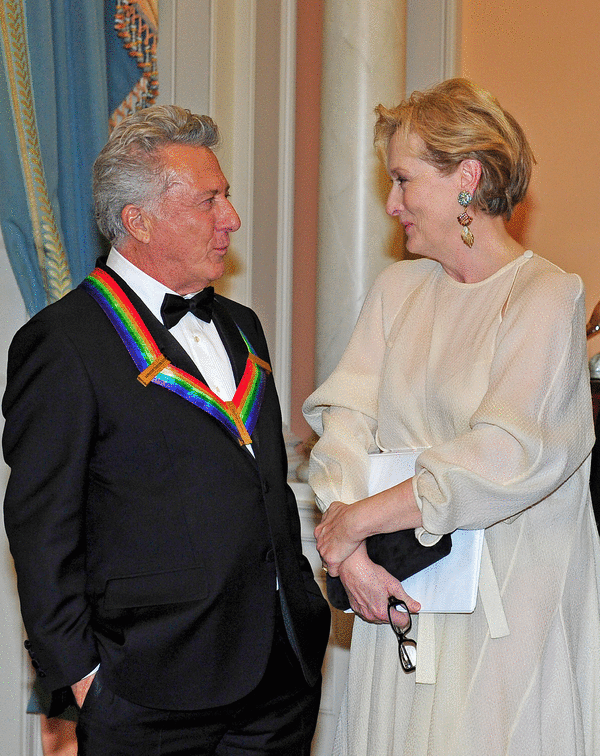
In his new memoir, “Look at Me,” Dustin Hoffman praises Meryl Streep as “one of the greatest actresses of her generation” while explaining that any tensions they had on the set of “Kramer vs. Kramer,” their Oscar-winning, 1979 divorce drama, was due to the two stars approaching their work differently.
In Hoffman’s account of the film shoot, the 89-year-old screen veteran always liked to work “spontaneously,” while Streep was “very controlled and deliberate” and liked to map out how a scene would unfold. Hoffman explained that Streep was then acting in one of her first movies and was not yet a star. So, he apparently felt he needed to “shock” the young Yale drama graduate into delivering some genuine, spontaneous reactions in key scenes involving their characters, divorcing spouses Ted and Joanna Kramer.
In a restaurant scene, when the Kramers bitterly argue about custody of their 5-year-old son, Hoffman said he decided to surprise his co-star by suddenly getting up from the table, knocking over a glass and shattering it — something that wasn’t in the script.
“Meryl was shocked,” Hoffman wrote. “The reaction that you see in the movie is genuine: she sort of jumps in her seat. It’s perfect. But she didn’t have an opportunity to think it through in advance, and I don’t think Meryl liked that.”
But, there were some more extreme things Hoffman said and did during the film shoot in order “to fill every screen moment with tension,” according to a 2016 biography of Streep, and according to the actress herself. For whatever reason, Hoffman doesn’t appear to mention these things in his book, including Streep’s claim that he slapped her while they were performing the film’s opening scene.
Like knocking over the glass, slapping Streep wasn’t in the script. It’s also not something Ted Kramer would likely do, and it’s not in the final cut of the film. According to the biography, “Her Again: Becoming Meryl Streep,” the slap was Hoffman’s way of trying to get Streep to better show her desperation and distress in the moments that her housewife character Joanna tells Ted, her self-centered, workaholic husband, that she’s leaving him.
“On the second day, they continued shooting the opening scene, when Ted follows the hysterical Joanna into the hallway,” author Michael Schulman wrote in his book, a chapter of which was was excerpted in Vanity Fair in 2016. “Dustin and Meryl took their positions on the other side of the apartment door. Then something happened that shocked not just Meryl but everyone on set. Right before their entrance, Dustin slapped her hard across the cheek, leaving a red mark.”
Schulman said that Robert Benton heard the slap and saw Streep charge into the hallway, Schulman reported. “We’re dead,” Benton thought, suddenly afraid that Streep would report Hoffman to the Screen Actors Guild and the production would be shut down. Instead, Streep continued to act in the scene, even though she knew she could have conjured her character’s distress without being hit by her co-star.
Streep acknowledged that Hoffman slapped her in a 2017 interview with the New York Times. She said the issue is “tricky because when you’re an actor, you’re in a scene, you have to feel free.”
“I’m sure that I have inadvertently hurt people in physical scenes,” Streep continued. “But there’s a certain amount of forgiveness in that. But this was my first movie, and it was my first take in my first movie, and he just slapped me. It was overstepping.”
In his memoir, Hoffman just said he talked over Streep as he was trying to deliver her speech about leaving her husband and son. He said, “I just behaved the way I believed that Ted Kramer would under those circumstances: I didn’t listen.”
“I don’t think Meryl liked that much, either,” Hoffman added. “She probably thought I was trying to steal her scene, which was nonsense.” He said he only ever cared about doing everything he can to show his “scene partner in his or her best light” because that was in his self-interest as an actor.
The Streep biography notes other ways that Hoffman “overstepped” with Streep, while driving “everyone nuts.” In that scene in which Joanna tells Ted she’s leaving him, she also tells him she doesn’t love him anymore and she’s not taking their son Billy with her.
With the cameras set on Streep’s face, Hoffman continued acting off-screen and improvised some lines that were designed to exploit one of her personal vulnerabilities, according to Schulman. He began to taunt her about the recent death of her boyfriend, actor John Cazale, from cancer. Cazale, best known for playing Fredo in “The Godfather” movies, was diagnosed with lung cancer shortly after they moved in together. He died in 1978.
Hoffman “was goading her and provoking her,” producer Richard Fischoff told Schulman. He was “using stuff that he knew about her personal life and about John to get the response that he thought she should be giving in the performance.”
Streep went “absolutely white” and left the studio “in a rage,” Fischoff also said.
Somehow Benton and the cast and crew managed to get “Kramer vs. Kramer” made, though Streep also said in an interview that year that Hoffman grabbed her breast during their first meeting, according to The Hollywood Reporter. Hoffman apologized, Streep’s representative later said.
“Kramer vs. Kramer” was a major commercial success when it was released in late 1979, becoming the highest-grossing film that year in the United States and Canada. The legal drama also received widespread critical acclaim and became the subject of numerous think pieces about changing gender roles in American society at the end of the 1970s, as well as about fathers’ rights, work-life balance and single parenting.
At the Academy Awards in 1980, “Kramer vs. Kramer” was named best picture, while Hoffman won the first of his two best actor Oscars. The film also made Streep a new Hollywood star and won her a best supporting actress Oscar, the first of three competitive Oscars she would win over the next five decades.
Meanwhile, Streep’s 1979 interview about Hoffman touching her inappropriately resurfaced during the #MeToo movement in 2017, as multiple women came forward with accounts of Hoffman’s behavior, which included a steady stream of obscene comments, allegedly inappropriate gropes and demands, dating back to 1975, as People reported.
In his memoir, Hoffman does not address specific accusations of sexual misconduct but said he never pressured or forced a woman into doing anything sexually with him.He admits that “my my life, especially 40 years ago, I made some women uncomfortable.”
“But ‘uncomfortable’ is a subjective emotional state,” Hoffman said. “What is crass and offensive to one person, another individual might find hilarious, or enlivening, or even sort of cozy.”
In writing about his sense of humor, Hoffman called himself “out there.” Hoffman also said, “I love a so-called dirty joke. I am ‘a Borscht Belt flirt,’ as Bill Murray once put it. That’s not the same thing as pressuring someone to do something they didn’t want to do.”
©2026 MediaNews Group, Inc. Visit at mercurynews.com. Distributed by Tribune Content Agency, LLC.










Comments