How a new singer saved the Sex Pistols
Published in Entertainment News
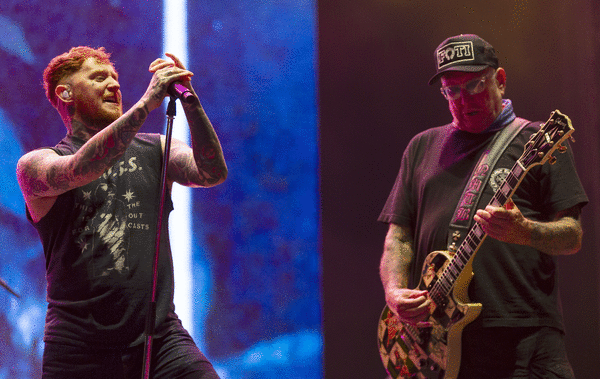
MINNEAPOLIS — It was perhaps the most notorious rock tour in history: Just seven concerts by the Sex Pistols, England’s infamous punk band, invading the United States in 1978. It was later described as “a disaster wrapped in chaos.”
There were bloody fights between the band and fans, fights between the musicians and their own security guards, heroin withdrawal onstage, the lead singer quitting the band onstage after the encore in San Francisco.
And that had nothing to do with the controversy over the Sex Pistols’ songs like “Anarchy in the U.K.” and “God Save the Queen” from their lone album in 1977, “Never Mind the Bollocks, Here’s the Sex Pistols,” which Rolling Stone hailed at the time as “the most exciting rock & roll record of the Seventies.”
Nearly 50 years later, the Pistols are back in the United States with three founding members — Paul Cook, Glen Matlock and Steve Jones — and a new singer.
Jones, 71, who broke his wrist last year, recently Zoomed in from London to talk about new singer Frank Carter and old singer John Lydon, aka Johnny Rotten.
Answers have been edited for length and clarity.
Q: How’s your wrist?
A: It’s not bad. I see the chiropractor once or twice a week. No problems with it. The only thing that makes it easier is if I have the guitar higher and not so low.
Q: What do you like about Frank Carter, your new singer since 2024?
A: I like that he’s 42. He’s got a ton of energy. We’re rocking hard. It doesn’t sound like old farts playing. Obviously I’m not jumping up in the air, nor is Glen. We have fun. Frank, he’s great. He really is. It just works. It’s actually a joy to do it. I look forward to the shows.
I can’t say I enjoyed the show the last time the Pistols did it in 2008. We did 30 shows in Europe and I kept looking at my watch: When is this tour going to end? It was miserable.
Q: All those years as a DJ in Los Angeles (2004-19), what kind of perspective did it give you on the Sex Pistols?
A: I always knew the Pistols was important. For me, [DJing] really brought me out of my shell. You learn a lot when you interview people all the time. Your mind starts working in a different way.
Q: How would you describe your relationship with John Lydon now?
A: There is no relationship. I haven’t spoken to him since 2008, the last time we toured, even though we both live in L.A. I’ve got no animosity towards him. I can honestly say I wish him well.
It was a magic moment when the Pistols came together. It seemed like a fluke, one of those things that just happened. I think fondly of him, how talented this guy was, how original he was, how sharp he was back then for being like 20 years old. He looked great. Obviously, he’s a pain in the ass a lot of the time.
Q: What is punk rock? A genre? An attitude?
A: I have a different opinion. Punk rock is a just word slung out there and it kind of stuck. To me, it’s just an extension of rock ‘n’ roll. You had the solo artist in the ‘50s, Elvis, Jerry Lee Lewis, Chuck Berry. Then the Beatles come along and there was a million bands. Then come big-hair rock bands Led Zeppelin, Deep Purple, the rest of it. Big stadium rock. Then came punk. Then there was a million bands imitating the Ramones or us or whatever. It was the whole deal, like the fashion. Just like every genre. It was a look. Punk was just a continuation.
Q: I got a kick that your post-Pistols band was called the Professionals. Are punk rock and professionalism mutually exclusive?
A: I was a mess when we did the Professionals. When you’re shooting dope, you don’t really know what’s going on. It wasn’t a good time for me even though we knocked out some decent songs and did a little bit of touring. My head was a mess after the Pistols.
Q: Where does the energy come from that you can play so fast?
A: I don’t think we play that fast. It’s a steady tempo. We never were that fast in the Pistols. It’s almost like a rock band with a different style of singer. When we first started, I couldn’t play guitar and John couldn’t sing so that gave it that certain sound. We got good when we did a reunion in ‘96. That was the first time when we actually made a bit of cash.
Q: What was it like recording with Bob Dylan on the song “Sally Sue Brown” on 1988’s “Down on the Groove” album?
A: I met him a few months beforehand. Then he called me out of the blue and said, “I’m going to do a session, do you want to put a band together.” I said, “Sure.” We did it at Sunset Sound. I got Paul Simonon from the Clash and the drummer from Pat Benatar’s band. There was a keyboard player from Rod Stewart’s band.
I’ve never recorded this way before. Bob comes up with his acoustic [guitar] and a bunch of words he puts on the piano. He’d come up with a tune. He wanted to see what we brought to the table.
He tried five or six songs and they all kind of sounded the same. It was only like three chords. My theory: He thought, “these guys don’t know what I’m doing, let me sling this cover one (’Sally Sue Brown’) out and see what happens.”
Q: Did he give you directions?
A: No. He’s a bit of a grump. I love him. I love his songs. He’s written a few classics, I’d say. I’m glad I did a Bob Dylan song, even if it was a cover.
©2026 The Minnesota Star Tribune. Visit at startribune.com. Distributed by Tribune Content Agency, LLC.





Comments