Northern California reports first measles outbreak since 2020. What to know
Published in Health & Fitness
California reported its first confirmed measles outbreak since 2020 on Tuesday.
The highly contagious disease infected 2,276 people nationwide in 2025, according to the Centers for Disease Control and Prevention. So far in 2026, the U.S. has confirmed 733 cases, and 93% of those infected were unvaccinated.
The heightened spread of the disease is a “canary in the coal mine” moment, representing the rapid return of several vaccine-preventable diseases in the United States, according to Dr. Peter Chin-Hong, an infectious disease specialist and professor of medicine at the University of California, San Francisco.
How dangerous is measles in California? Is the state at risk of skyrocketing cases?
Here’s what to know about the deadly virus and how to prevent it:
What is measles? Where are outbreaks in the U.S.?
Measles is a “highly contagious” virus that spreads through the air when an infected person coughs or sneezes, according to the CDC.
The disease can cause “serious health complications,” especially in children younger than 5 years old, the federal public health agency said.
Complications due to measles can include pneumonia, “brain swelling, even blindness and death,” Chin-Hong said.
Measles was declared eliminated in the United States in 2000, the CDC said, meaning that the continuous spread of the disease was stopped for longer than 12 months.
Already, as of Feb. 5, 20 states have reported measles cases.
Why are measles cases increasing?
About 90% of unvaccinated people who come in contact with measles will get sick with the disease, the California Department of Public Health said.
The highly contagious virus can live airborne in a room for up to two hours, the agency said, and it only requires a small amount of particles to infect someone.
Measles rates are rising primarily due to high rates of the disease in other parts of the world paired with falling vaccination rates in the United States.
Cuts to public health funding have also contributed to the spread, he added, along with a wave of fake conspiracy theories that mislead people about the importance of getting vaccinated.
Chin-Hong compared the country to a bone-dry forest that’s vulnerable to wildfires.
“You just light a match and the whole thing goes ablaze,” he said. “That’s what happened in West Texas and New Mexico, and a little bit in Oklahoma.”
Disease expert predicts more cases, hospitalizations and deaths
Many public health officials suspected the United States will lose its measles elimination status by the end of 2025, according to Chin-Hong. It hasn’t yet, but 2026’s outbreaks may have that result.
That would mean there’s sustained measles transmission in local communities for more than 12 months, he said, without the disease being introduced from outside the country.
Chin-Hong predicted that there would be “more cases ... more hospitalizations, more complications, more deaths potentially,” if the United States loses its elimination status.
It would also be a “psychological blow,” he said. “It’s embarrassing because we have the resources to deal with it.”
How many measles cases have been reported in California?
As of Tuesday, Feb. 10, 17 confirmed measles cases had been reported in California so far in 2026, according to the California Department of Public Health.
In comparison, California had 15 confirmed measles cases in 2024 and four measles cases reported in 2023, the public health department said.
Measles cases have been reported in the following California counties so far in 2026:
—Los Angeles County
—Orange County
—Riverside County
—San Bernardino County
—Shasta County
Is California at risk of more outbreaks?
Chin-Hong said measles cases in California remain relatively low because the state has some of the strictest vaccine requirements in the country.
California imposed rigorous vaccination rules for measles following a 2014 outbreak linked to Disneyland that sickened 131 California residents, according to the California Department of Public Health.
Measles immunization rates in California remain above the national average, the state public health department said in a 2023-24 report, with 96.2% of kindergarten students at public schools receiving the shots.
The approximate threshold to prevent measles transmission is 95%, according to the state agency.
However, Chin-Hong urged Californians not to become complacent about the disease, as immunization rates have been gradually dipping.
What are common measles symptoms?
Measles cases typically start with a high fever, cough, runny nose and watery eyes, according to the CDC.
After a few days of symptoms, tiny white spots pop up inside the mouth, the public health agency said, followed by a rash of small red spots that appear on the face and then the rest of the body.
Symptoms typically appear about seven to 14 days after being exposed to the virus, the national public health agency said.
Here are some of the most common measles symptoms, according to the CDC:
—High fever
—Cough
—Runny nose
—Red, watery eyes
—Rash
Complications from measles usually include ear infections and diarrhea, the CDC said, while more serious complications include pneumonia and encephalitis.
“Some people think of measles as just a little rash and fever that clears up in a few days,” the CDC warned. “But measles can cause serious health complications.”
Who is most at risk of measles?
“Anyone who is not protected against measles is at risk” of getting sick, according to the CDC.
What’s the best way to protect against the virus?
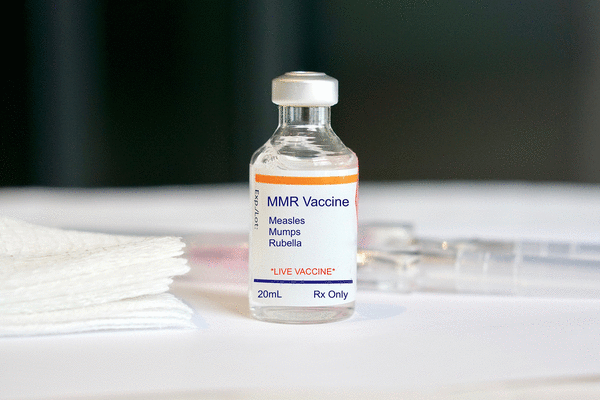
“The best way to protect against measles is with the measles, mumps and rubella vaccine,” the CDC said.
The federal health agency said the two-dose vaccine is safe and about 97% effective at preventing measles.
“The vaccine is so amazing, it’s probably one of the best vaccines we have ever had,” Chin-Hong said.
Children can get vaccinated against measles as early as 6 months old.
The CDC recommends that kids get one dose between ages 12 to 15 months of age, and the second dose at 4 to 6 years old.
_____
©2026 The Sacramento Bee. Visit sacbee.com. Distributed by Tribune Content Agency, LLC.








Comments