The Outfit You Wear at Home Doesn’t Count—Except It Does
Published in Fashion Daily News
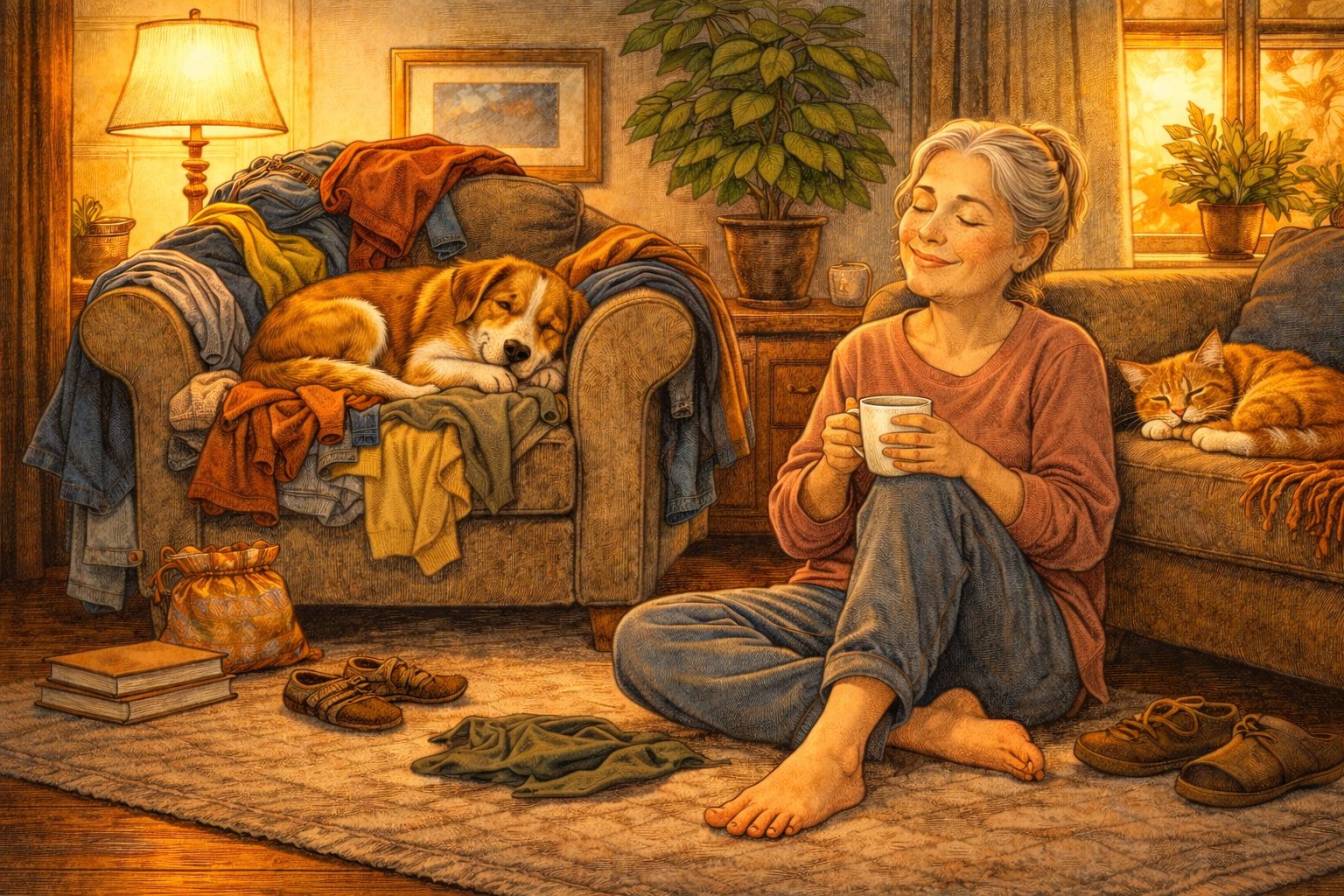
The doorbell rings, and there is a brief pause before it is answered. On the other side stands a delivery driver; on this side stands a person who has made a decision. From the waist up: presentable, even intentional. From the waist down: something softer, older, less accountable. The exchange lasts seconds, but the truth lingers longer.
This is not an accident. It is a system.
Across households, a quiet consensus has formed around a category of clothing that exists just outside the boundaries of fashion. These are the garments worn after the day is done, before it begins, or during the long middle hours when no one else is expected to see. They are rarely photographed, seldom discussed, and almost never defended.
And yet, they may be the most revealing clothes a person owns.
The Uniform No One Sees
Every home has one: the unofficial uniform.
It might be a faded hoodie that has outlived its original purpose by years, a pair of shorts that have been washed into a kind of permanent softness, or a T-shirt that no longer communicates anything except familiarity. These items are not chosen each day so much as resumed, like a conversation already in progress.
Unlike public clothing, which requires decisions—what matches, what fits, what signals the right message—the at-home uniform removes friction. It narrows the field of choices to a handful of reliable options, often repeated with near-ritual consistency.
Experts in decision-making have long noted the mental toll of constant choice. At home, that burden is quietly set aside. The uniform becomes less about appearance and more about continuity, a stable baseline in a day otherwise shaped by variability.
It is, in its own way, efficient.
Soft Clothes, Hard Truths
When stripped of external expectations, clothing choices tend to converge on a few key qualities: softness, flexibility and predictability.
Elastic waistbands are common. So are fabrics that stretch, breathe and yield without resistance. Tags are removed. Seams are tolerated only if they are unobtrusive. The goal is not to impress but to disappear—into comfort, into ease, into the background of one’s own awareness.
These preferences reveal something fundamental. When no one is watching, people do not dress aspirationally. They dress truthfully.
The appeal of soft clothing is not merely physical. It carries an emotional component as well, signaling a shift from performance to rest. The moment these garments are put on, the day’s demands are, if not gone, then at least diminished.
Comfort, in this context, is not indulgence. It is infrastructure.
The Myth of ‘Getting Dressed’
To “get dressed” traditionally implies preparation for the outside world—a readiness to be seen, evaluated and, to some degree, interpreted. At home, that framework loses its urgency.
Many people report a subtle resistance to changing into more structured clothing once they have settled into their domestic environment. The act can feel disproportionate, as though adopting a role that no longer applies.
This shift became more visible during the early years of widespread remote work, when the boundary between public and private wardrobes blurred. Video calls introduced a hybrid form of dress—formal from the shoulders up, informal below—that mirrored the delivery-door compromise seen in homes long before.
Even as routines have normalized, the underlying pattern remains. Clothing at home is not about presentation. It is about alignment—between body, environment and expectation.
And often, the expectation is simply to be at ease.
Feet, Floors, and the End of Performance
If there is a single, near-universal gesture that marks the transition from public to private, it is the removal of shoes.
Footwear, more than any other element of dress, is tied to movement through shared space. It protects, supports and, in many cases, completes an outfit. But it also signals readiness—to go somewhere, to do something, to be seen.
When shoes come off, that readiness recedes.
Bare feet or socked steps across familiar floors carry a different message: the performance is over. The day’s roles—professional, social, transactional—are set aside. What remains is a more immediate relationship with the environment, one defined by texture, temperature and habit rather than expectation.
This transition is rarely articulated, but it is widely understood. It is the moment a person becomes, fully, at home.
The Clothes That Know You
Over time, certain garments take on a quality that extends beyond their material function. They become repositories of memory, shaped not only by wear but by experience.
A sweatshirt may recall a specific season of life. A pair of shorts may carry the imprint of countless evenings spent in the same chair, under the same light, in the same quiet rhythm. These items persist not because they are fashionable, but because they are familiar.
There is a durability to this kind of clothing that resists standard measures of value. It is not about cost or brand, but about continuity. To replace such an item is not merely to acquire something new, but to relinquish something known.
As a result, many of these garments remain in circulation far longer than their public counterparts. They are repaired, repurposed and retained, often beyond the point where they would be considered appropriate elsewhere.
At home, appropriateness is redefined.
Long-Range Outlook: This Is Who You Are
The distinction between public and private dress is not new, but it has taken on renewed significance in a culture increasingly shaped by visibility. Social media, workplace norms and shifting expectations all contribute to a heightened awareness of how one appears.
Against that backdrop, the at-home outfit stands apart.
It is not curated for an audience. It is not optimized for approval. It is assembled, often unconsciously, in response to comfort, habit and personal rhythm. It reflects not who a person intends to be, but who they are when intention relaxes.
The version of oneself that steps out the door may be polished, deliberate and effective. But the version that settles onto the couch at the end of the day—barefoot, familiar, unguarded—is something else entirely.
Not lesser. Not unfinished.
Just accurate.
========
Maren Ellery is a lifestyle and culture writer focusing on the intersection of routine, identity and domestic life. Based in coastal Virginia, she examines how everyday habits quietly define who we are. This article was written, in part, utilizing AI tools.






Comments