The Weather According to Your Pet
Published in Cats & Dogs News
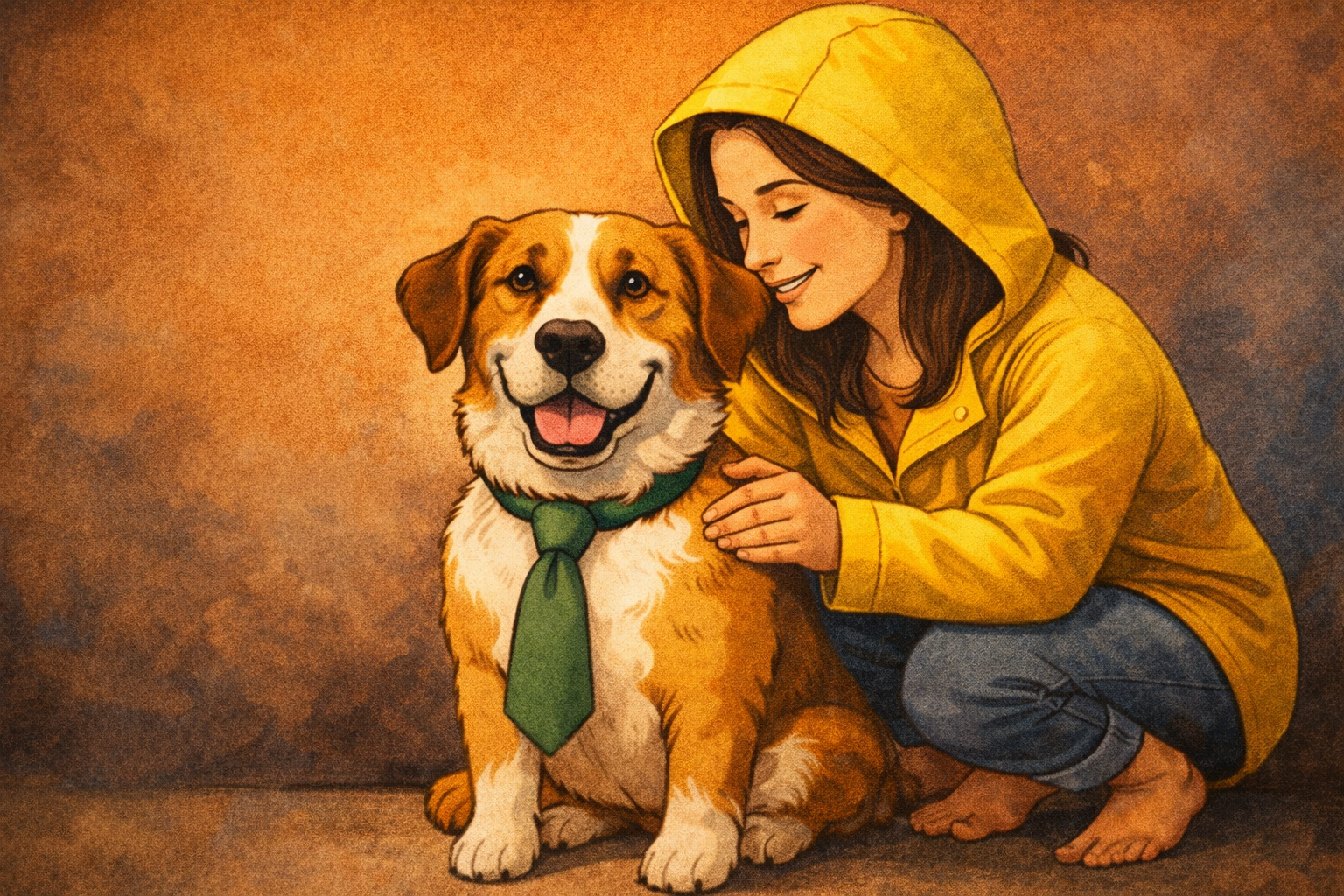
NORFOLK, Va. — The forecast calls for mild temperatures, light winds and a 20 percent chance of rain, but inside one local home, conditions are far more specific. A large hound named Mason stands six feet away from his owner, watching closely, one ear cocked, one back paw lifted in a slow, deliberate scratch.
This, by his estimation, is ear-scratch weather.
Across the country, pet owners are familiar with these quiet recalibrations of reality. While humans rely on satellites, radar and smartphone apps to interpret the skies, animals operate on a different system entirely — one that has less to do with clouds and more to do with the subtle shifts of daily life.
Barometric Pressure, But It’s Emotional
Animals do not ignore the physical environment, but they rarely prioritize it the way humans do. Instead, they track changes in mood, routine and presence with remarkable sensitivity, often reacting before their owners are aware anything has shifted at all.
A dog may begin pacing long before a thunderstorm arrives, responding not only to distant atmospheric pressure changes but to the tension in its owner’s posture or voice. Cats, by contrast, tend to preemptively remove themselves from instability, disappearing into closets or beneath furniture as if anticipating disruption.
This responsiveness creates the impression that pets can “predict” events. In reality, they are reading a complex set of cues — body language, tone, movement — that humans themselves often overlook.
To a pet, pressure is not measured in inches of mercury. It is measured in whether the household feels calm, unsettled or on the verge of change.
Forecast: 100% Chance of Treats
If emotional weather defines the climate, the promise of food defines the forecast.
The sound of a crinkling bag, the opening of a refrigerator door, or even a familiar time of day can trigger an immediate shift in behavior. Dogs become alert and attentive; cats materialize from unseen corners. These responses are not random but the result of carefully learned patterns, reinforced over time.
Pets maintain internal schedules that rival — and often exceed — the precision of human timekeeping. Mealtimes are anticipated down to the minute. Deviations are noted and, in many cases, protested.
What begins as an occasional reward quickly becomes an expected event. A single treat given after a walk can establish a routine that persists indefinitely. From the animal’s perspective, the pattern is not a coincidence; it is a rule.
In this way, pets construct their own predictive models of the household — and they expect those models to hold.
Severe Weather Events
Within the pet-defined forecast, certain phenomena rise to the level of emergencies.
Thunderstorms are among the most common triggers of distress. The low-frequency rumble of thunder, combined with flashes of lightning and shifts in air pressure, can provoke anxiety in many animals. Fireworks produce similar reactions, though their unpredictability often heightens the response.
Then there is the vacuum cleaner.
Unlike storms or fireworks, the vacuum is a controlled, recurring presence — and yet it is frequently treated as a hostile force. Some animals retreat immediately, seeking safety in another room. Others confront it directly, barking or circling as though engaged in a territorial dispute.
Behavioral experts suggest that these reactions stem from a combination of noise sensitivity and unfamiliar movement patterns. To the animal, the vacuum is neither natural nor predictable. It appears suddenly, makes noise, and moves with intent.
Each pet develops its own interpretation of these events, assigning meaning based on experience. What humans see as routine maintenance may be understood as a recurring threat.
The Microclimate of the Couch
While storms and disturbances shape the extremes of a pet’s weather system, comfort defines its center.
Nowhere is this more evident than in the selection of resting places. Pets demonstrate a consistent ability to identify the most comfortable spot in a room — often with greater accuracy than their owners.
A section of couch with optimal cushion density, a chair warmed by recent use, or a patch of sunlight on the floor becomes a preferred location. Once claimed, that space is rarely relinquished without negotiation.
These choices are not arbitrary. Animals are highly attuned to temperature, texture and support, and they seek out environments that meet those needs with precision.
The result is a series of microclimates within the home, each defined by comfort rather than convenience. What appears to be a simple act of lying down is, in practice, a calculated decision.
Long-Range Outlook: You Are the Climate
Ultimately, the most significant factor in a pet’s environment is not the weather outside but the person inside.
Owners provide the structure around which a pet’s world is organized. Daily routines, emotional states and physical presence all contribute to a stable — or unstable — environment. When that structure changes, pets respond accordingly.
A departure from the home can produce restlessness or withdrawal. A return can trigger excitement and relief. Even minor shifts — a delayed meal, an unfamiliar schedule — can alter behavior.
In this sense, pets do not merely observe their environment. They inhabit a world in which their owners function as the primary source of consistency and meaning.
Mason, standing quietly across the room, does not need a forecast to determine the nature of the day. He observes, interprets and decides.
For now, conditions remain favorable.
It is still, unmistakably, ear-scratch weather.
========
Rowan Hale is a features writer focusing on everyday life, human-animal relationships, and the quiet patterns that shape domestic routines. Based in coastal Virginia, Hale explores how ordinary moments reveal deeper connections. This article was written, in part, utilizing AI tools.






Comments