Michael Hiltzik: These federal judges are building a legal wall against Trump's assault on transgender rights
Published in Op Eds
President Donald Trump wasted no time before turning the right wing's cherished assault on transgender rights into government policy.
On the very day of his inauguration, he issued an executive order titled, "Defending Women from Gender Ideology Extremism and Restoring Biological Truth to the Federal Government."
The order purported to "recognize two sexes, male and female," as federal policy. "These sexes are not changeable," it stated. It labeled "gender ideology" and "gender identity" as a "false claim."
The order directed federal agencies to "remove all statements, policies, regulations, forms, communications, or other internal and external messages that promote or otherwise inculcate gender ideology."
About a week later, Trump posted an order banning federal spending on gender-affirming therapies for children, which he defined as "mutilation" based on "junk science."
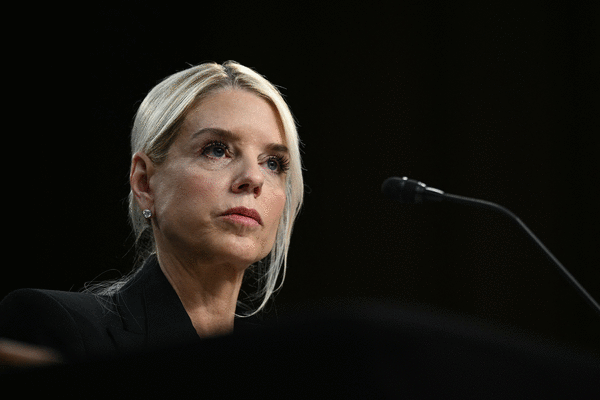
Under Atty Gen. Pam Bondi, Trump's Justice Department took action. On July 9, Bondi boasted of having sent "more than 20 subpoenas to doctors and clinics involved in performing transgender medical procedures on children."
In her news release, Bondi said the subpoenas targeted "medical professionals and organizations that mutilated children in the service of a warped ideology."
That's when Trump's campaign ran into a judicial brick wall. In recent weeks at least three federal judges blocked some of these subpoenas as flagrantly illicit overreach.
At least two questioned the DOJ's actions in these cases, with one warning that a federal official's inaccurate declaration could be interpreted as perjury. Another implied that a DOJ filing in his courtroom might have reflected "deliberate misuse ... of court procedure." (I am indebted to Chris Geidner of Lawdork.com for pulling these facts together.)
These cases raise questions about the professionalism of Trump's DOJ that have been raised by other federal courts on other topics. Those include the invalidation of the appointments of three U.S. Attorneys put in place to pursue criminal charges against Trump's political enemies, and the rejection by grand juries of indictments proposed by Trump-appointed prosecutors.
"The Department has defeated many of these lawsuits all the way up to the Supreme Court and will continue to defend the President's agenda with the utmost professionalism," a DOJ spokeswoman told me by email.
The transgender cases may have a more personal effect on millions of struggling youths and families. As I've written, the Trumpian hand-wringing over the "mutilation" of children via gender-affirming therapy or surgery melds medical ignorance with fantasy.
Therapies such as puberty blockers or hormone treatments typically are administered to minors only after painstaking medical consultations, and actual surgeries aren't commonly performed on minors by reputable medical providers.
Trump made an assault on transgender treatments a plank in his campaign platform, spinning a weird claim that schools had been subjecting innocent children to secret operations. "The school decides what's gonna happen with your child," he said. "And you know, many of these childs (sic) 15 years later say, 'What the hell happened? Who did this to me?'" None of that happens in the real world.
After the Supreme Court invalidated bans on same-sex marriage in 2015, Republican strategists found "the struggle over trans rights" to be "an especially potent wedge issue," observes political scientist Paisley Currah, a professor of women's and gender studies at Brooklyn College, in a new report in the New York Review of Books.
Their target, Currah writes, is "a very small proportion of the population (roughly 2.8 million people above the age of thirteen), not well understood by most Americans, living in ways that confounded common assumptions about sex."
For the most part, this war has unfolded at the state level. North Carolina passed its notorious "bathroom bill," requiring residents to use only the bathrooms designated for the sex on their birth certificates, in 2016. The measure drew widespread threats of boycotts by sports leagues and corporations, prompting its repeal the following year.
Legislators soon found an approach more tolerable for the public: banning transgender women from participating in women's sports. In 2015 there were 21 antitrans bills introduced in state legislatures; in 2025 there were more than 1,000.
In June the Supreme Court's six-member conservative majority appeared to bless this approach by turning away a challenge to a Tennessee law that bans puberty blockers and hormones for trans youth, even when parents and physicians prescribe them. With this ruling, Justice Sonia Sotomayor wrote in a ringing dissent, "the Court abandons transgender patients and their families to political whims."
She might have added that Trump's intimidation works. Medical providers coast-to-coast, including Children's National Hospital in Washington, D.C., and Kaiser Permanente, ended gender-affirming care for minors to avoid legal hassles; some institutions even ended such care for adults, although that care isn't targeted by the government.
None of that means that there aren't guardrails on the federal antitrans campaign, which brings us back to the judges placing a collar on the DOJ.
In the most recent ruling issued Nov. 21, federal Judge Mark Kearney of Philadelphia took aim at subpoenas Bondi served on Children's Hospital of Philadelphia. Purporting to be investigating the mislabeling and misuse of puberty blockers and hormones, the DOJ demanded the hospital's "billing and insurance records, communications with manufacturers and sales representatives, and the names and complete medical and psychological records of children receiving gender-affirming care," Kearney wrote.
The hospital acceded to most of this request, but did not provide the identities of its child patients and their families and their confidential medical files.
Kearney quashed those subpoenas, ruling that the privacy rights of the children and their families "substantially outweighs" the DOJ's "need to know the children's names, addresses, and treatment."
Kearney noted that federal law left questions about medical care entirely to the states; policy disagreements such as those pitting the DOJ against the hospital are not federal crimes. "Congress never authorized a roving mandate to regulate and alter state-licensed medical care," he wrote.
He also focused on a declaration filed in court on Oct. 6 by DOJ official Lisa K. Hsiao, stating that "the government is aware of a lawsuit filed just this year" with "allegations of a minor being put on puberty blockers after his first visit and cross-sex hormones after his second with no meaningful assessment."
As it happens, there is no such lawsuit. The day after Hsaio's declaration was filed "under penalty of perjury," Kearney observed, it was withdrawn and replaced with one that removed the reference to a lawsuit and substituted the claim that the government was aware only of "concerning allegations" about the treatment.
The hospital said in court that it hadn't been served with any such lawsuit. Kearney questioned "the veracity of Director Hsiao's sworn statements" and noted that DOJ lawyers agreed with him that "false statements may be subject to a perjury investigation."
Kearney's ruling followed one issued Sept. 9 by federal Judge Myong Joun of Boston. Joun quashed the entire subpoena issued to Boston Children's Hospital seeking extensive information about its personnel and medical records of patients, including their Social Security numbers and home addresses.
"It is abundantly clear," he wrote, that the administration's "true purpose" is to interfere with the state's right to authorize gender-affirming care, "to harass and intimidate BCH to stop providing such care, and to dissuade patients from seeking such care."
In the third case, federal Judge Jamal Whitehead of Seattle on Oct. 27 threw out a subpoena the government served on QueerDoc, a telehealth provider serving patients in the West. The subpoena demanded complete personnel files for all QueerDoc employees and all private information about patients for whom it prescribed puberty blockers or hormones.
Whitehead concluded that the subpoena — compounded by Bondi's news release — was aimed "not to investigate legal violations but to intimidate and coerce providers into abandoning lawful medical care." (Emphasis his.)
Whitehead also found that a legal filing in which the DOJ cited legal grounds for the subpoena "represents a fundamental misunderstanding — or deliberate misuse — of court procedure": Filings of its kind generally were used to correct minor clerical errors in a previously filed document, he noted, not for making new legal arguments after the deadline. In this case the filing underscored that the government was targeting "the provision of gender-affirming care itself, not any legitimate federal violation."
The government appealed the Joun and Whitehead rulings though not, as yet, Kearney's action. The battle to protect treatment for transgender youths is plainly not over.
____
_____
©2025 Los Angeles Times. Visit at latimes.com. Distributed by Tribune Content Agency, LLC.































Comments