Commentary: Farmers should unite to fight unfair trade policies
Published in Op Eds
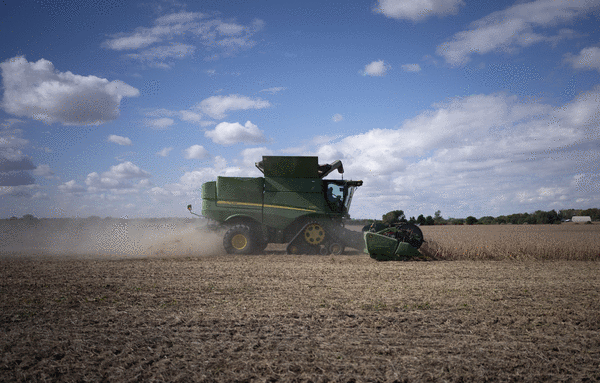
2025 has been a tough year for farmers.
As if the perennial problems of price volatility and changing weather patterns were not enough, the Trump administration’s trade war with China made matters worse. In the past year, grain farmers have seen their markets increasingly taken by their Brazilian counterparts. Even after reaching a deal to purchase American soy, China’s 13% tariff on the commodity will continue to hurt farmers’ pocketbooks.
To make matters worse, the president’s decision to hike imports of Argentine beef into American markets instead of dedicating resources to build U.S. herds served yet another gut punch for farmers, who have also had to deal with higher prices for inputs like fertilizer.
With their markets ruined, it is no wonder that farmers desperately await $12 billion in relief payments that Trump promised to send their way. But what they’d rather have is a fair price for the crops they’ve grown. As one farmer told Trump at a Dec. 8 roundtable, “With this bridge payment, we’ll be able to farm another year.” But that’s not good enough for people who work year-in-and-year-out getting food onto our tables.
Mexican producers, also facing economic problems, have recently taken to the streets to call for change. Since October, thousands of farmers have periodically blocked roads with their tractors around the country to demand fair prices, protect their water rights, and renegotiate the United States, Mexico, and Canada Agreement (USMCA).
As in the case of the Canadian Union of Postal Workers strike this past October, free market reforms are the target. As such, this moment offers a chance for U.S. farmers to join their neighbors to the south, in seizing the opportunity to push back on free trade and encourage policymakers to support domestic markets.
Mexico isn’t the only country to witness mass farmer protests. Last year, farmers from around Europe protested falling prices, harsh environmental legislation and free trade agreements. Before that, in 2020 and 2021, millions of Indian farmers marched to protest price-support policies in the face of their government’s attempts to deregulate markets.
If there’s any doubt that farmers should fight to keep price protections and government programs, look no further than to the impact of free-market reforms on U.S. agriculture. From 1987 to 2022, under the original NAFTA trade agreement and its Trumpian replacement USMCA, implemented in 2020, about 200,000 farms left production. Meanwhile, according to the advocacy group, Farm Action, four companies came to control 90%, 80% and 70% of our nation’s cotton, corn and seed markets, respectively. The Canadian-based Nutrien produced around 60% of potash fertilizer annually mined in North America.
With free-market policies driving people off the land and enriching corporations, farmers would benefit from USMCA reform.
To start, as urged by the National Family Farm Coalition and the Institute for Agriculture and Trade Policy, countries should not be required to ratify the 1991 Act of International Convention for the Protection of New Varieties of Plants. Currently part of the USMCA, this provision allows biotech firms to own seed patents, preventing farmers from saving, sharing and growing their own. Removing this provision would give farmers freedom from consolidated seed markets.
Next, re-installing Mandatory Country of Origin Labeling for beef would help consumers make informed decisions about the origins of their products. Increased market transparency could improve demand and put money into U.S. ranchers’ pockets. This policy has widespread support from groups including from the Farm Bureau.
Part of the reason Trump turned NAFTA into the USMCA was to open Canadian markets to U.S. dairy exports. Expanding free trade has not helped U.S. producers. In Wisconsin, from 2014 to 2024, the state experienced a 46 percent decrease in the number of dairy farms and has lost 1,888 licensed dairy herds in the five years since the USMCA was implemented. Wisconsin also led the country in farm bankruptcies in 2020 and 2021. This time, leave Canadian farmers alone.
Our farming neighbors have had enough, marching to demand economic justice. Maybe U.S. farmers should join them, ensuring our government hears their demands and does not continue down the path of further farm consolidation and corporate monopolization.
_____
Anthony Pahnke (anthonypahnke.com) is vice president of Family Farm Defenders and an associate professor of international relations at San Francisco State University in San Francisco. This column was produced for Progressive Perspectives, a project of The Progressive magazine, and distributed by Tribune News Service.
_____
©2025 Tribune Content Agency, LLC.





















































Comments