Commentary: US health care in 2025: Chaos, costs, and controversy without real progress
Published in Op Eds
The year 2025 has been one of the most turbulent years in modern U.S. health care. The headlines were explosive, the rhetoric dramatic, and the controversies nonstop. Yet for all the hoopla and upheaval, the medical care Americans receive now, month in and month out, looks no better than what they experienced on Jan. 1 — but far more expensive.
Here are five areas of health care that generated chaos, confusion, and conflict in 2025 without meaningful improvement.
1. Political Chaos: Turning Science Into A Battleground
No aspect of health care saw more volatility in 2025 than in the political arena. The tone was set in January when President Donald Trump returned to office and began reshaping federal health agencies with unprecedented speed.
Within days, he issued a record flurry of executive orders targeting the Affordable Care Act, Medicaid waivers, Medicare Advantage oversight, prior-authorization rules, and federal nutrition standards.
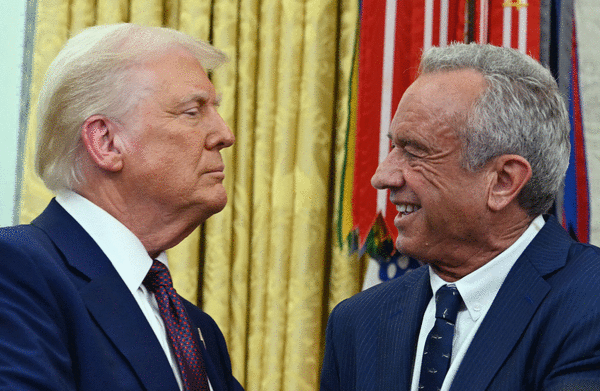
He replaced long-entrenched leaders at HHS, NIH, CDC, and FDA with political outsiders, many of whose views on vaccines, chronic disease, and scientific evidence diverged sharply from the career experts they superseded. The nomination of RFK Jr. to lead HHS became a flashpoint. His reluctance to confront the measles outbreak in Texas, combined with mixed messaging on vaccine policy, has deepened public health concerns.
Since then, senior scientists and leaders in federal health care agencies have resigned, with key programs becoming stalled and career staff reporting political interference in decisions that previously rested on data and expert consensus.
2. Economic Crisis: Costs Soar As Coverage Becomes More Fragile
Beneath the political theatrics of 2025 lay a sobering reality: Americans will once again pay far more for health care next year than the year before. And for many, the financial protections that once softened those increases are disappearing.
Insurers on the Affordable Care Act marketplace requested median premium hikes of 18% for 2026, the steepest jump since 2018 and well above this year’s 7% hike. If Congress fails to extend the enhanced ACA subsidies, families who once paid affordable monthly premiums will see their costs double or even triple.
The broader economic picture makes these pressures unavoidable. The United States is now spending $5.6 trillion annually on health care, with costs projected to rise 7.1% this year, far outpacing economic growth.
3. Regulatory Confusion: Agencies Rebooted, But Improved Health Still Distant
This year shook the foundations of America’s public-health architecture and left yawning gaps where trust, clarity, and expert oversight once stood. Politics has replaced science as the primary driver of health care policy.
The Centers for Disease Control and Prevention lost its director just weeks after her confirmation. Within days, top-level scientists and center heads resigned en masse, citing political interference and a collapse of scientific independence. At year’s end, there still is no permanent CDC head.
Federal health recommendations — particularly those issued by agencies and advisory committees — have shifted away from rigorous, peer-driven review and toward decisions increasingly shaped by anecdote and ideology.
Meanwhile, the administration’s sweeping “health-freedom agenda” (under the banner Make America Healthy Again) has identified food packaging, additives, school-lunch standards and “ultra-processed” diets as public-health priorities. But the proposals to improve nutrition remain largely unformed, as the likelihood of meaningful improvements fade in the face of pushback from the food industry.
What remains at year’s end is a set of agencies still functioning, but with public trust weakened and no clear path to rebuilding it.
4. Technological Contradiction: AI Leapt Forward While Medicine Stood Still
No field generated more excitement, or exposed more contradictions, in 2025 than generative artificial intelligence.
In the broader economy, GenAI models transformed finance, logistics, law, retail and customer service. New large language models, including GPT-5, DeepSeek and Gemini 3, demonstrated near-expert performance on clinical reasoning, interpretation of complex symptoms and risk prediction. And with the emergence of Artificial General Intelligence (AGI), Americans are increasingly relying on large language models when they have medical questions. In polling I conducted this fall, 77% of patients and 63% of health care professionals reported using a generative-AI tool in the past three months for health-related information or decision support.
Yet inside traditional medicine, progress remains stalled. Clinicians continue to be encouraged to use AI for administrative shortcuts (coding, charting, prior authorization claims) but national specialty organizations haven’t pushed them to use GenAI for diagnosing disease, reducing medical errors or improving clinical outcomes.
Meanwhile, medical schools still teach pre-AI workflows, even as medical students and residents turn to GenAI for clinical knowledge and case analysis. The divide between institutional practice and the behaviors of patients and the next generation of physicians is expanding at an accelerating pace.
5. Cultural Conflict: A Growing Divide Between The Public And The Profession
If 2025 revealed anything about American health care, it was a widening cultural rift: between younger patients and medical professionals, and between science and public belief.
This rift is felt particularly among Gen Z and Millennials, generations that grew up online, are accustomed to second-screen verification and skeptical of traditional authority. Younger Americans expect shared decision-making, transparency and digital-first convenience — expectations medicine failed to fulfill in 2025.
At the same time, disinformation and political rhetoric seeped deeper into public life. Social media spread half-truths faster than public-health leaders could correct them. Vaccine skepticism rose thanks to political disinformation. Basic nutritional science became partisan, too. And the public’s confusion intensified.
What 2025 Reveals About the Road Ahead
By year’s end, one truth became impossible to ignore: despite unprecedented political turmoil, economic instability, scientific breakthroughs and cultural upheaval, the health of our nation failed to improve.
The incentives driving the system, the chronic diseases afflicting the population and the unaffordability confronting families all persist as we enter 2026. At the same time, as generative AI transforms nearly every other sector of the economy, the fax machine remains the most common method physicians use to exchange vital medical information.
The biggest question for 2026 is whether the pressures now bearing down on the system — economic, political, technological, cultural — will finally force American medicine to change, or whether the year ahead will look much like 2025 did.
____
Robert Pearl, the author of “ ChatGPT, MD,” teaches at both the Stanford University School of Medicine and the Stanford Graduate School of Business. He is a former CEO of The Permanente Medical Group.
©2025 The Fulcrum. Visit at thefulcrum.us. Distributed by Tribune Content Agency, LLC.





































Comments