Commentary: Attacks in Australia and Syria show how difficult it is to eliminate terrorism
Published in Op Eds
A decade ago, the Islamic State terrorist group was a household name. Tens of thousands of fighters, many from countries as far afield as Australia and France, traveled to Iraq and Syria to join an organization that sought to establish the world’s first modern-day caliphate.
It was a time when civil war raged in Syria, the Iraqi government was teetering from the weight of incompetence and the Barack Obama administration was deciding whether the United States needed to get militarily involved in the region yet again, less than three years after U.S. troops withdrew from Iraq.
We know how events progressed from there. A U.S.-led coalition was assembled to snuff out the Islamic State group before it captured more land. A constellation of militias on the ground, including the Syrian Kurds and Iraqi Shia militias, were mobilized to clear the Islamic State group from the cities it controlled. In 2019, after five years of airstrikes and ground combat, the Islamic State group lost Baghouz, the last Syrian town under its thumb.
But terrorism is one of those perennial problems that doesn’t go away, no matter how many ingenious solutions its opponents throw at it. It’s also a problem that must be taken in perspective; the simple fact of the matter is that terrorist groups don’t need control of territory to inspire attacks halfway around the world.
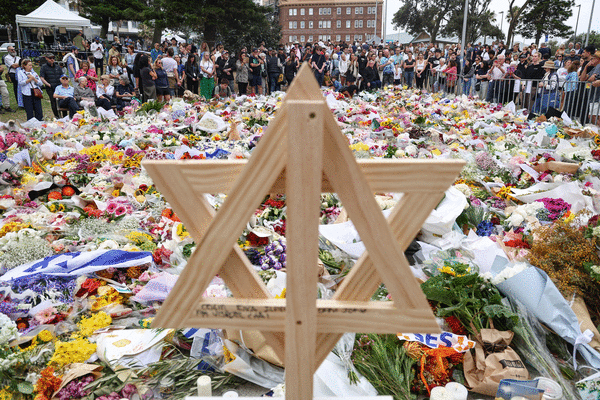
Last week’s gruesome slaughter during a Hanukkah celebration in Bondi Beach, Australia, which killed 15 people, is a case in point. The father-and-son gunmen were purportedly motivated by the Islamic State group’s extremist ideology. Australian authorities are examining the pair’s trip to the southern Philippines, an area where Islamist groups once held sway, to determine whether they perhaps received instructions to carry out the strike.
Yet the truth is that anybody who is deranged enough to kill innocent people doesn’t need detailed instructions from a terrorist organization — all they need is access to firearms, a soft target and a willingness to act on their bankrupt ideology. That appears to be what transpired in Sydney, and it’s one of the reasons why preventing every terrorist attack is an impossible endeavor for even the most elite intelligence services.
Australia isn’t the only place where alleged followers of the Islamic State group made headlines this month. In Syria, a member of Syria’s newly constituted security services assaulted a meeting of U.S. and Syrian military officials, killing three Americans. The shooter allegedly was about to be dismissed for his extremist views. The United States responded with a vengeance, as you expect it would; 70 Islamic State group targets were bombed by our Air Force in retaliation.
For President Donald Trump, the incident in Syria is likely more concerning than the terrorist attack in Australia due to the American casualties involved and the potential for the strike to undermine the strategic relationship he’s attempting to build with Syrian President Ahmad al-Sharaa, a man who was once imprisoned by U.S. troops in Iraq but is now committed to fighting the very jihadists he used to lead.
Trump, who has taken a liking to Sharaa, has met with him three times — including at the White House in November — and believes he’s the man who can turn Syria around after nearly a decade and a half of civil war. Trump has backed up those sentiments with action — terrorism designations have been suspended on Sharaa and his top advisers, Trump loosened U.S. sanctions on Syria in the spring and Congress recently passed a bill that would lift those comprehensive sanctions in full.
Sharaa, in turn, has formally joined the U.S.-led counter-Islamic State coalition and has conducted counterterrorism operations against Islamic State remnants in Syria, which U.S. officials are clearly pleased with.
In the grand scheme, the Islamic State group remains a shell of its former self. In 2014 and 2015, the group could legitimately claim authority over a swath of land in Syria and Iraq that was about as large as the United Kingdom. It was making millions of dollars a day on the sale of black market oil, not to mention the antiquities the group stole as it rampaged both countries.
Eight million people were unfortunate enough to live in the so-called caliphate, giving the Islamic State group a huge resource base to extort. If it wasn’t for the Shia militias that popped up in response, the entire Iraqi state could have collapsed.
Today, the Islamic State group is nowhere near this kind of strength. It holds no territory and has many enemies, from Iran and Russia to the new Syrian government and the Kurdish militias that continue to be propped up by U.S. military support. It is no longer the world’s richest terrorist organization either.
The group has claimed 1,100 attacks so far in 2025, but the vast majority of them are unsophisticated, low-scale strikes on Syrian, Iraqi and Kurdish military outposts. It doesn’t take a genius to plant an improvised explosive device on a road, ambush a convoy coming down the highway or fire indiscriminately into a crowd celebrating the holidays. Unfortunately, as we saw in Sydney, those seemingly random acts of violence can still cause fatalities.
Terrorism is no longer occupying the entire U.S. national security establishment as it did immediately after 9/11. The Trump administration’s national security strategy, released earlier this month, discussed the terrorist threat only sporadically. This is just as well; there are a number of perceived national security dangers that need to be accounted for, and on this list, terrorism is no longer at the top of the list.
Even so, terrorism isn’t going away anytime soon. The question is less about whether terrorism is still a threat and more about how the United States chooses to respond to it — with the overly militarized, highly resourced nation-building enterprises of the past or through coordinated intelligence work with partners who share as much of an incentive to adequately manage it as we do.
_____
Daniel DePetris is a fellow at Defense Priorities and a foreign affairs columnist for the Chicago Tribune.
_____
©2025 Chicago Tribune. Visit at chicagotribune.com. Distributed by Tribune Content Agency, LLC.



















































Comments