Lisa Jarvis: America's year of health-care chaos will have these consequences
Published in Op Eds
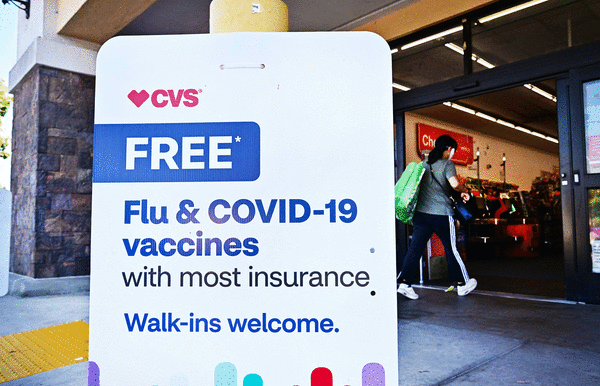
The unprecedented turmoil at the top U.S. health agencies, under the leadership of Health and Human Services Secretary Robert F. Kennedy Jr., is sure to have a long-term impact on the well-being of Americans. Although Kennedy’s mantra has been to “Make America Healthy Again,” the most visible changes he and his allies have made within the Department of Health and Human Services in 2025 appear, in practice, designed to do the opposite.
The consequences of Kennedy’s first year in office — marked by sweeping cuts in funding and personnel at the agencies under his purview, the erosion of expertise and the mainstreaming of anti-vaccine rhetoric into national policy — will unfold over years or even decades. However, several key metrics could serve as early indicators of how quickly Kennedy’s influence, combined with President Donald Trump’s broader agenda, will shape Americans’ health.
From the spread of preventable diseases to access to both established and emerging drugs and vaccines to health care coverage, here are a few things I’ll be paying attention to in 2026:
The Measles Outbreak Could Worsen
Kennedy faced his first significant test within days of his confirmation: a rapidly spreading measles outbreak in West Texas. Unfortunately, he failed the exam. He waffled for weeks, failing to forcefully encourage vaccination, while simultaneously promoting unproven treatments for the virus. Meanwhile, the Trump administration’s deep cuts to the Centers for Disease Control and Prevention left local health authorities struggling to contend with the outbreak.
By July, measles cases had reached 1,288, their highest level since the virus was declared eliminated in the U.S. in 2000. By late December, the number of cases had grown to 2,012, of which approximately 87% were associated with an ongoing outbreak. Cases have been reported in several states, and at least three unvaccinated people are reported to have died from the disease.
The situation has continued to deteriorate as we head into 2026, as evidenced by an accelerating outbreak in South Carolina that, by mid-December, had infected more than 135 people and sent hundreds more into quarantine. The question for 2026 seems to be not whether, but when, the U.S. will lose its measles elimination status — and how severe the consequences may become amid future outbreaks.
Fewer Children Are Receiving Routine Shots
The measles outbreak was fueled by vulnerabilities in the vaccine safety net that helps keep everyone protected. Eliminated diseases remain eliminated only if enough people — typically around 95% of the population — are immunized. Data indicate that acceptance of routine childhood vaccines is softening, and the share of children entering kindergarten with all their shots has gradually declined over the past five years. During the same period, many more children received non-medical exemptions from required vaccinations.
The question now becomes how Kennedy’s influence over both public opinion and actual policy might amplify those twin trends. Last summer, he overhauled the influential CDC advisory panel that makes recommendations on the use of vaccines nationwide, appointing members who more closely align with his anti-vaccine views. The panel has since restricted the use of certain vaccines, most notably by revoking the longstanding advice that all newborns be vaccinated against hepatitis B. The group is also poised, under Trump’s direction, to review the entire childhood immunization schedule, raising concerns about rollbacks of other established protections.
Meanwhile, lawmakers, emboldened by Kennedy’s actions, have sought to pass laws that make it easier for parents to obtain exemptions that allow their children to forgo routine vaccinations. Kindergarten exemption data for this school year could provide our first indication of whether these efforts have significantly affected parents’ decision-making.
A Crisis in Health Insurance Coverage Awaits
During the Biden administration, the number of uninsured Americans fell to record lows, largely due to the introduction of pandemic-era subsidies that made insurance purchased through the Affordable Care Act more affordable. The looming expiration of those tax credits at the end of this year led to months of congressional gridlock over whether and how to extend them. Democrats advocated extending them, while Republicans debated whether they should be preserved in a more limited form or discarded altogether.
Lawmakers failed to reach a consensus before Congress adjourned for the year. The expiration of the credits means millions of Americans will see their insurance premiums roughly double in January. Negotiations will continue after the holiday break, and if a deal is reached, health policy experts at KFF say the Trump administration could help consumers by making the subsidies retroactive to Jan. 1 and extending the sign-up deadline to allow enrollees to switch to more affordable plans.
The stakes are high: The number of Americans receiving coverage through ACA plans has more than doubled since 2020 to more than 24 million. Without the subsidies, some 4.2 million people are projected to forgo coverage.
Early numbers from the Centers for Medicare & Medicaid Services suggest that fewer new customers are enrolling in ACA plans, but they also indicate a slight increase in returning customers compared with this time in 2024. And, of course, the ultimate unknown is how many Americans will end up uninsured — and how that could affect the nation’s long-term health and strain its infrastructure.
The Approval Process for New Drugs Remains Unclear
U.S. consumers have long benefited from the country’s leadership in biomedical innovation, a position predicated on a gold-standard regulatory body that carefully evaluates scores of new drugs, vaccines and medical devices each year.
But that typically predictable approval process has been disrupted by turmoil and ever-shifting policies at the Food and Drug Administration. As FDA Commissioner Marty Makary puts existing vaccines and other long-used drugs under new scrutiny, there is reason to worry that the approval thresholds for newer ones could become unreasonably high.
At the same time, Makary is intent on speeding up new drug approvals. He is reportedly planning to reduce the number of late-stage studies required for FDA approval from two to one. He has also introduced a controversial “national priority review voucher,” which promises reviews within weeks for companies that align with Trump’s focus on affordability, domestic manufacturing, and unmet public health needs.
All of this is unfolding at a time of significant churn at the FDA, both at the leadership level and among the career scientists who review new products. The question for next year is whether the flow of new therapies can increase without compromising safety and efficacy — a difficult balance to strike.
These key health measures use real-time data to capture the immediate impact of a transformed HHS. But it is essential to ensure there is a full accounting of the many other areas — including opioid deaths, maternal mortality, and drug prices — that could be affected by the seismic shifts to our nation’s health infrastructure.
____
This column reflects the personal views of the author and does not necessarily reflect the opinion of the editorial board or Bloomberg LP and its owners.
Lisa Jarvis is a Bloomberg Opinion columnist covering biotech, health care and the pharmaceutical industry. Previously, she was executive editor of Chemical & Engineering News.
©2025 Bloomberg L.P. Visit bloomberg.com/opinion. Distributed by Tribune Content Agency, LLC.















































Comments