Tom Philp: How oil-hungry California plays into Trump's quest for Venezuela's crude
Published in Op Eds
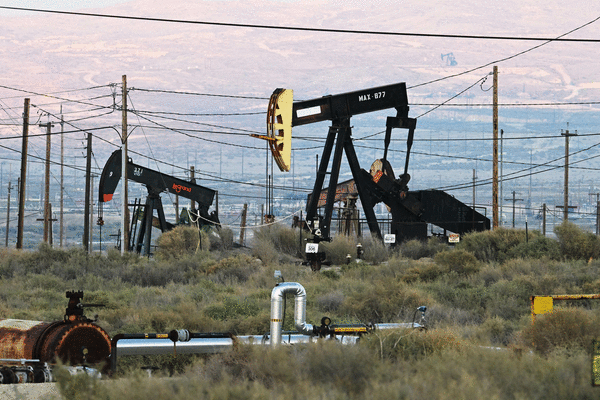
Listening to President Donald Trump speak on the U.S. military’s decapitation of the leadership in Venezuela, it is clear that the act was more about oil than anything else. Our brazen pursuit of the world’s largest remaining oil reserves should serve as a wake-up call to California and its waning commitment to an independent, renewable energy future.
The state’s political appetite to keep transitioning away from oil has been clearly ebbing as residents balk at the cost of everything in California, most notably the chronically high cost of gasoline and the periodic spikes during a hiccup in production.
Affordability is in fashion. Climate change adaptation is not. Why else would Gov. Gavin Newsom champion legislation last year to drill more oil wells in Kern County?
The state’s addiction to oil products, mirrored throughout the nation, is revealing a despicable downside: We’re willing to take military action in our hemisphere largely to expand our control of this resource.
Maduro’s greatest sin was his oil hoarding
This is by no means a defense of Nicolás Maduro. His disdain for democracy, the rule of law, and his own people made his widespread unpopularity justifiably deserved. He horribly mismanaged his country, which is more than twice the size of California. The unsealed federal indictment against Maduro has detailed examples of his role in international drug trafficking for personal financial gain.
Yet Maduro is hardly the only head of state with this political pedigree. He does have, however, one thing that the others don’t: His country sits on top of an estimated 20% of the oil remaining on the planet. And that’s what Trump appears to care about the most.
“The oil business in Venezuela has been a bust, a total bust for a long period of time,” Trump told reporters after the nighttime capture of Maduro and his wife on Saturday, killing at least 40 Venezuelans in the process. “We’re going to have our very large United States oil companies, the biggest anywhere in the world, go in, spend billions of dollars, fix the badly broken infrastructure, the oil infrastructure and start making money for the country.”
The largest oil refiner in California, Chevron, also happens to be the American oil company that has maintained operations in Venezuela.
This brazen move fits Trump’s view of the world. He doesn’t take climate change seriously but cares deeply about expanding fossil fuel production and shoring up our nation’s power in the hemisphere. The seizure of Maduro is merely the latest expansion of the president’s petroleum portfolio.
What are California’s values?
But what are California’s values?
Do we want to be silent beneficiaries of a presidency seeking to dominate this resource? Or do we strive for economic independence from the oil cartels by weaning ourselves off their products?
Newsom is winding up eight years as governor with a mixed record at best. He and Attorney General Rob Bonta are fighting federal efforts to repeal California’s plan to phase out the sale of gas-burning cars by 2035. But the transition away from the internal combustion engine simply isn’t wildly popular. We are at a proverbial fork in the road.
Newsom has manifested this weird love-hate relationship with oil, craving it in the short-term to keep California running while vilifying its manufacturers as the architects of our climate change crisis. His relationship with the industry became beyond dysfunctional. As California refineries have shut down in recent years and companies like Chevron have shifted offices elsewhere, it has left the state exposed to shortages.
This mismanagement has made the costs of transitioning away from oil seem insurmountable.
Newsom, through inartful resource management, has been playing right into Trump’s hands.
The United States should not devolve into one of the world’s last-standing oil warlords. And California should not go along for the ride. A future of energy independence through renewable resources is not only good for the planet, but it’s good for global democracy.
_____
©2026 The Sacramento Bee. Visit sacbee.com. Distributed by Tribune Content Agency, LLC.


























Comments