Frank Barry: What Vance gets wrong about being an American
Published in Op Eds
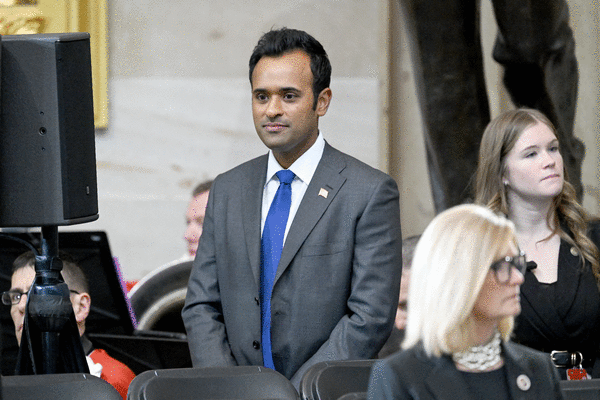
What does it mean to be an American? That question lies at the heart of a debate between Vivek Ramaswamy and Vice President JD Vance that will help determine the future of the Republican Party. The run-up to the country’s semiquincentennial is the perfect time to hold the debate, but it also presents an enormous problem for Vance: The Founders were on Ramaswamy’s side.
In a recent speech and op-ed, Ramaswamy, who is running for governor of Ohio, argued that American identity centers on shared ideals, particularly freedom and meritocracy. He took direct aim at Nick Fuentes and other far-right “Groypers,” the xenophobic and antisemitic faction within the Republican Party, and urged his fellow party members to condemn their hatred and intolerance, rather than indulge it.
His real target, however, was his old Yale Law School classmate, Vance, who has shown little interest in such condemnations and seems to believe that white, Christian Americans who trace their lineages back to some earlier age — so-called “heritage Americans” — have preferred status. Ramaswamy denounces such “blood and soil” nationalism, a phrase that has roots in Nazi Germany, while Vance flirts with it.
Ramaswamy and Vance are both anti-woke crusaders, but while the former channels Ronald Reagan’s politics of economic aspiration, the latter channels Pat Buchanan’s politics of ethnic and cultural grievance. Speaking at a Turning Point USA conference, Ramaswamy seemed to refer to Vance’s claim that those with ancestors who fought in the Civil War have a greater claim to the country than those who didn’t.
“The idea that a ‘heritage American’ is more American than another American,” Ramaswamy said, “is un-American at its core.” He called it the right’s version of toxic identity politics, “about as loony as anything the woke left has actually put up.”
He’s right that Americans’ heritage isn’t primarily about whose family had a homestead in 1860. It’s about the cause for which the founding generation heroically fought, and which subsequent generations joined. All the branches on the American family tree stem from a Revolution that was sparked in no small part by a newly arrived immigrant, Thomas Paine.
Jan. 10 marks the 250th anniversary of the publication of Paine’s ground-shaking pamphlet, “Common Sense,” in which he dared make the case for a “declaration for independence” at a time when few leaders supported it. His argument, which became the talk of the colonies, rested not only on the “absurdity” and “evil” of hereditary monarchy, which he mocked mercilessly, but on the opportunity the colonists had to usher in a new global age of freedom.
“The cause of America is in great measure the cause of all mankind,” he wrote, only a year after immigrating. “The birthday of a new world is at hand.”
Other leading founders understood the revolution in such global terms. They were children of the Enlightenment, and they believed — correctly — that they were fighting not merely for themselves and their property, but for groundbreaking principles that could revolutionize the world and, they hoped, rescue it from tyranny and war.
Never had a nation been created on such revolutionary and universalist grounds, and Americans’ deep attachment to those founding principles has long defined our sense of who we are and what we will fight for. Yet in his speech at the 2024 Republican National Convention, Vance downplayed them, saying, “People will not fight for abstractions, but they will fight for their home.”
For Americans in the revolutionary era, freedom was not an abstraction. Nor was equality, or religious liberty, or self-government. They were concrete principles that, thanks in no small part to Paine’s brilliant rhetoric, inspired them to launch a revolution. To dismiss those principles as abstractions is an insult to the founders and soldiers who birthed history’s most exceptional nation, many of them paying for it with their lives.
Vance’s claim of an uber-status for Americans with ties to the Civil War is particularly ironic, given that more than 40% of all U.S. Army soldiers — the men who saved the nation from destruction — were immigrants or sons of immigrants. And the commander in chief who put down that insurrection, which claimed his life and the lives of some 700,000 Americans, made clear that he rejected Vance’s view.
In an 1858 speech commemorating the Fourth of July, Abraham Lincoln noted that about half the country had immigrated here or descended from those who had, and yet they were “our equals in all things,” because the Declaration of Independence’s promise of equality was “an electric cord” that connected all Americans, no matter their family lineage. Immigrants, said Lincoln, had the right to claim ownership of that heritage “as though they were blood of the blood, and flesh of the flesh of the men who wrote that Declaration.”
Lincoln understood what some of MAGA’s militants do not: All Americans are heritage Americans. He shared the common sense of Paine and the other founders. So do Ramaswamy and many other Republicans. If they convince more party members to join them, there will be even more to celebrate this semiquincentennial.
____
This column reflects the personal views of the author and does not necessarily reflect the opinion of the editorial board or Bloomberg LP and its owners.
Frank Barry is a Bloomberg Opinion columnist and member of the editorial board covering national affairs. He is the author of the new book, "Back Roads and Better Angels: A Journey Into the Heart of American Democracy."
©2026 Bloomberg L.P. Visit bloomberg.com/opinion. Distributed by Tribune Content Agency, LLC.














































Comments