Editorial: Sen. Hawley flirts briefly with courage on Venezuela -- then retreats as usual
Published in Op Eds
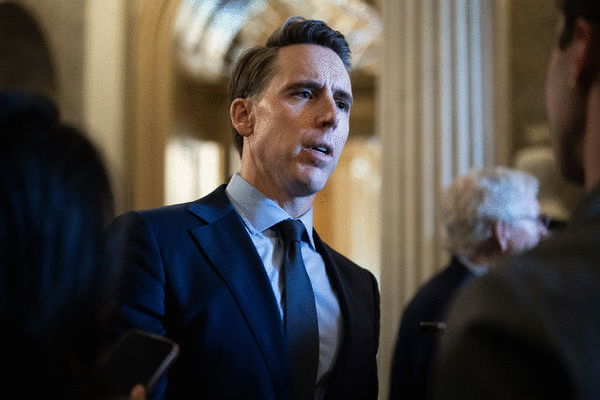
Does Sen. Josh Hawley really believe in anything?
It’s a question we end up asking frequently about Missouri’s senior senator, whether the topic is health care, labor rights or — this time — the Trump administration’s military adventurism in Venezuela.
U.S. forces swooped into the Caribbean nation Jan. 3 to capture Venezuelan President Nicolas Maduro, bringing him to New York to face drug trafficking charges. Though it was clearly a military operation — and though President Donald Trump has openly mused about a continuing U.S. role there, including potentially “running” the country — the administration didn’t consult with Congress at all before the operation.
Hawley was one of five Republican senators last week who defied Trump by joining with Democrats to narrowly advance a resolution that, on its merits, should have passed 100-0. It sought to prevent Trump from taking further military action in Venezuela without congressional authorization.
Hawley’s political fortitude lasted all of six days. On Wednesday — after predictable social media brow-beating from Trump against the five rebellious GOP senators — Hawley became the first of them to fall back in line, announcing he wouldn’t support final passage of the resolution after all. Sen. Todd Young, R-Ind., then followed suit, creating a tie that Vice President JD Vance broke to kill the resolution.
The implications of that defeat go beyond Venezuela. What Hawley helped kill here was an opportunity to finally challenge the entrenched phenomenon of undeclared wars by American presidents throughout the post-World War II era.
That era has encompassed the Korean, Vietnam, Iraq and Afghanistan wars, as well as numerous smaller U.S. military operations overseas. Yet not once during that time has Congress passed a formal declaration of war as required by the Constitution.
Article 1, Section 8, explicitly gives Congress — and only Congress — the authority to declare war. Only after obtaining such authorization is the president empowered as commander-in-chief to direct military action against other countries.
Congress in recent decades has approved military force authorizations that are short of formal war declarations. But Trump's refusal to accept even that kind of half-measure congressional oversight in Venezuela only shows how far the Constitution's guardrails regarding war have degraded.
In that light, the now-dead Senate resolution was little more than a reaffirmation of how the process was always supposed to work. Hawley said as much in a statement explaining his initial support of the resolution: “My read of the Constitution is that if the President feels the need to put boots on the ground there in the future, Congress would need to vote on it."
Or not, it turns out.
Hawley’s flip-flop here is sadly familiar. This is the senator, after all, who vowed to protect Medicaid from draconian cuts demanded by Trump last year, then voted for those cuts, then turned around and filed meaningless show-boat legislation to restore them.
As we’ve noted here before, other examples abound of Hawley’s habit of posing as an independent populist before obediently toeing the Republican line. On health care affordability, labor rights, wealth-coddling tax cuts and more, he tries to have it both ways, telling regular Americans what they want to hear, sometimes to the point of feigning intra-party rebellion — but then ultimately doing whatever Trump and his party want him to do.
This time, Hawley's about-face is joined by some deeply misplaced credulity. To explain his Venezuela flip, Hawley told an interviewer Wednesday that Secretary of State Marco Rubio assured him: “‘This is not another Iraq. We’re not gonna occupy Venezuela.’ And you know what? That’s good enough for me.”
Really. Has Hawley already forgotten how Health Secretary Robert F. Kennedy Jr. vowed during his confirmation hearings last year, right to senators’ faces, that he wouldn’t make his anti-vaccination zealotry into official federal policy — which he is now busily doing?
Has Hawley also forgotten how the administration vowed to release the Epstein files, yet still has failed to despite a new law requiring it? Or how it has defied both Congress and the courts to decimate congressionally approved funding and programs? Or how it has continued lying to the country with its slanderous up-is-down narrative of the killing of an American citizen by a federal immigration agent in Minneapolis?
That anyone in Congress, of either party, could take this administration’s word as “good enough for me” on any topic — let alone the fraught topic of military force — is astonishing. If and when American boots hit the ground in Venezuela, maybe Hawley will finally learn that lesson.
_____
©2026 STLtoday.com. Distributed by Tribune Content Agency, LLC.













































Comments