Howard Chua-Eoan: Think dry January is hard? Try my year off the booze
Published in Op Eds
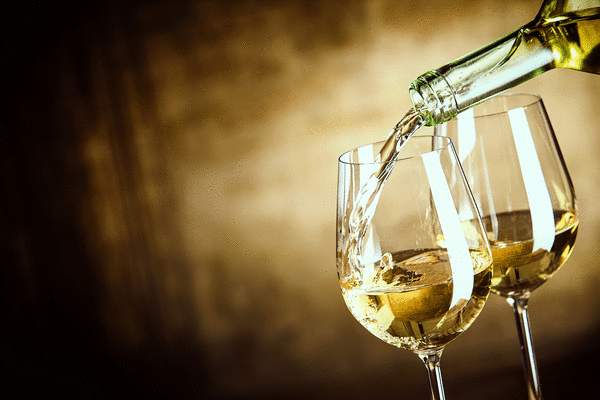
I gave up drinking on Jan. 20, 2025. What has a year without alcohol been like? And has it been worth it?
The world is certainly a more accommodating place for abstainers. But my memories run deep. I still frequent my favorite wine bars where I listen longingly as the sommeliers describe vintages to other customers. It’s like poetry — rounds of nostalgic reverie. The other night I had a dream about a Jura white from a tiny appellation called L’Etoile. I woke up and tried to dream again. No luck.
The bartenders know I’ll stick to the non-alcoholic pours from the likes of MURI in Copenhagen or Domaine des Grottes in Beaujolais-Villages. The latter makes a lovely non-alcoholic sparkling gamay appropriately called L’Antidote. It’s a solution — or at the very least, a distraction.
Apart from a small but vibrant sip taking communion in church on Good Friday last year, I’ve had no wine. Even at the communion rail, I felt a twitch of shame at the alcoholic droplet. Several years ago, at a service back when I lived in New York, the communicant ahead of me held on to the chalice and wouldn’t let the priest draw it back as she guzzled down all the wine with a deep and slurpy gurgle. I had to wait for a refill — and I prayed I’d never ever be as desperate for a drink.
I wrote about non-alcoholic choices back in June. I’ve discovered more, including a nice little shop on Drury Lane called Club Soda (rather belatedly — it’s been on that site for three years and is about to look for a new location). I had such a tasty Amaretti Sour there that I bought an entire bottle of 0.0% Rebels Sweet Amaretti to have on the rocks at home.
The posh cocktail bars of Ryan Chetiyawardana, including Lyaness at the Sea Containers hotel in London, serve wonderfully balanced, delicious non-alcoholic concoctions, quite unlike the syrupy sweet offerings that were the predominant options just a couple of years ago. Seedlip, a UK-based producer of non-alcoholic spirits, is the frontrunner in a global industry estimated at more than $350 million last year and which is expected to nearly double by 2034.
Non-imbibers are a potent market for spirit-free potables. According to an August poll by Gallup, a record low 54% of people surveyed in the U.S. said they consumed alcohol. The previous detox milestone was 55% in 1958. The last significant high was 67% in 2022 as the country was emerging from COVID. The late 1970s had the highest rates of drinking — a period marked by high inflation, the Iranian revolution and subsequent hostage crisis, as well as the Soviet invasion of Afghanistan. Perhaps new crises will make more people want to reach for a bottle.
If so, there are enough options without alcohol. And if you really need a buzz, there are some that contain tetrahydrocannabinol, the main psychoactive compound in cannabis, in what’s called the “functional” category.
I do miss wine. But health issues in 2025 helped keep me teetotalling — an emergency appendectomy, the long decision about whether to begin a life-long regimen of statins, leg injuries, a colonoscopy, doctors wondering about my high ferritin level (which can indicate inflammation). Ah, the joys of aging.
But I also learned not to be too obsessive about abstaining: Sobriety does not require you to be 100% alcohol-free. I once cringed that some beverages were 0.5% ABV — until someone told me that a ripe banana (or yogurt or soy sauce or vinegar) can sometimes have the same amount or more. The amounts of ethanol involved are easy enough for the body to metabolize and eliminate quickly. A healthy liver can speedily clear the body of moderate amounts of ethanol and its byproduct acetaldehyde. And some long-term damage can be reversed or diminished by giving up drinking — though substantial recovery can require months or years. In any case, it’s going to take a lot of Lucky Saint to get you wasted. (It would help, however, if bars served low- or no-alcohol beers really cold.)
I appreciate the morning clarity that’s resulted from abstaining, especially the greater ease of getting out of bed. It used to be a struggle — and the change didn’t come quickly. Only in the last four months has a sense of wakefulness and an ability to spring out of bed accompanied the ringing of the alarm clock.
I never considered myself an alcoholic. I still don’t. I’ve never passed out from drinking or been incoherent. But, that doesn’t mean I didn’t abuse alcohol. Before last January, I drank a lot: maybe three glasses of wine a day from Monday to Friday, and sometimes the equivalent of one or two bottles over the weekend. More during the celebratory months of November and December. When I told a doctor, she said I had to stop.
Morning clarity contributed to realizing why I was imbibing so much alcohol. I was socially anxious — and took sips of whatever was in the glass in my hand to fill gaps in conversation that I thought I was obliged to contribute to. It was too easy at parties or even over small talk to sip at the wine in front of me. It didn’t help that I ate out every night (I’m a terrible cook).
Soon enough, alcoholic drinks used to soothe nervousness became the all too easily accessible key to conviviality — when merriment can emerge in many other less damaging ways. I may have sensed that in the past; I know it to be true now. I still finish my 0.5% ABV beer so much faster than my companions go through their drinks.
I’ve had wonderful wines and spirits over the decades. I’m glad I can still remember how delightful they can be — and I can assuage nostalgia and envy by absorbing the joy wine gives to my friends. Giving up alcohol isn’t a panacea. But it clears a path for me to deal with other demons and, slowly and surely, to look at life with renewed lucidity.
Here’s to another year.
_____
This column reflects the personal views of the author and does not necessarily reflect the opinion of the editorial board or Bloomberg LP and its owners.
Howard Chua-Eoan is a columnist for Bloomberg Opinion covering culture and business. He previously served as Bloomberg Opinion's international editor and is a former news director at Time magazine.
_____
©2026 Bloomberg L.P. Visit bloomberg.com/opinion. Distributed by Tribune Content Agency, LLC.


















Comments