Beth Kowitt: CEOs' ICE letter (that doesn't mention ICE) isn't good enough
Published in Op Eds
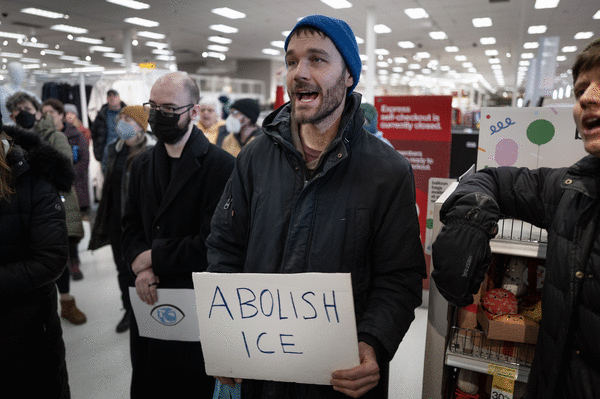
More than 60 leaders of some of Minnesota’s largest companies broke their silence over ICE’s immigration crackdown that’s wreaking havoc in Minneapolis, releasing a public letter over the weekend calling for “an immediate deescalation of tensions.”
CEOs, you’re getting warmer.
The letter did not once mention ICE, nor Renee Good and Alex Pretti, the two Minnesotans killed by federal agents. Instead, it read like a case study in carefully worded both-siderism. It said the local business community had been working behind the scenes with government officials to “advance real solutions.” But without stating a position, readers were left with no idea what these solutions might entail.
Still, there was a letter. And after weeks of silence, I guess that’s something. Among the signatories were Target Corp., which has still not made its own public statement since two of its employees, both U.S. citizens, were tackled by ICE agents in the entryway vestibule of one of its stores and hauled off in a van. (In his first company-wide comments on the upheaval, incoming Target CEO Michael Fiddelke called the violence in Minneapolis “incredibly painful” in a video message sent to employees on Monday.)
The Minnesota CEOs letter is what happens when statements are written by committee and legal departments. Getting some 60 executives to sign off on the wording inevitably required plenty of compromise and watering down. But here’s the upside: It also tells us that this letter represents the median position — which means there were CEOs who wanted to say and do more.
When Donald Trump won the 2024 election, I argued that these kinds of collective missives would be the most effective way for the business community to confront and push back against misguided policies. Since few companies would have the stomach to take on the White House alone, coalitions would provide strength in numbers, let companies speak more forcefully and help protect against individual retribution.
But if this is the result, I’m no longer so sure it is the way forward. Instead, one of those CEOs who was advocating for stronger, more forceful language behind the scenes needs to break from the pack and have their Ken Frazier moment.
Back in 2017, Frazier, then the CEO of Merck & Co., resigned from a presidential advisory council after Trump — then in his first term — said there was “blame on both sides” following a white supremacist rally in Charlottesville, Virginia, that turned deadly. “As CEO of Merck and as a matter of personal conscience, I feel a responsibility to take a stand against intolerance and extremism,” Frazier wrote as he stepped down.
His move forced the hands of other CEOs who sat on the council. What kind of leaders did they want to be — those who rejected hatred and bigotry, or those who remained silent? Within days, most of the CEOs aligned themselves with Frazier, and the group was disbanded.
Frazier, whose grandfather was born into slavery, later explained his decision to The New York Times this way: “In this case, we were not talking about politics. We were talking about the basic values of the country.”
When federal agents are killing U.S. citizens in the streets, it’s clear we are in another one of those moments. This is no longer about politics. Do CEOs want to be the kind of leaders who stand up for the rights and safety of their employees and customers — or the kind who show up at the White House for a screening of a documentary about First Lady Melania Trump hours after Pretti was killed? (We see you, Apple Inc. CEO Tim Cook.)
The public is increasingly signaling that it wants the former. A recent New York Times/Siena poll found that 61% of respondents believe the tactics used by ICE have gone too far. As Puck News has reported, ICE’s net favorability among Americans has swung 30 points to negative 14 since Trump was inaugurated, and 46% support abolishing ICE — a stance that not long ago was viewed as a far-left rallying cry. It’s hard to imagine those numbers haven’t moved higher since Pretti, an ICU nurse at a Veterans Affairs hospital, was shot and killed by federal agents on Saturday.
We are now past the point of asking where corporate America stands on this issue. The right question: which of its CEOs will be the next Ken Frazier and have the courage to take a stand first?
_____
This column reflects the personal views of the author and does not necessarily reflect the opinion of the editorial board or Bloomberg LP and its owners.
Beth Kowitt is a Bloomberg Opinion columnist covering corporate America. She was previously a senior writer and editor at Fortune Magazine.
_____
©2026 Bloomberg L.P. Visit bloomberg.com/opinion. Distributed by Tribune Content Agency, LLC.









































Comments