David M. Drucker: The problem with making every election an existential threat
Published in Op Eds
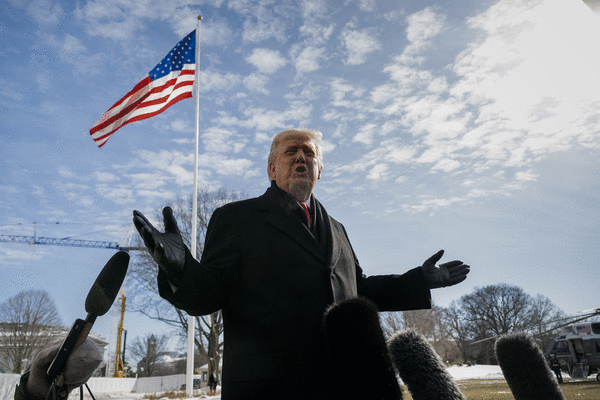
The next election is not an existential event for the United States. Neither is the one after that — or the one after that. But that won’t stop American politicians from claiming otherwise, nor anxiety-ridden voters from believing them.
For at least the last decade, our politics has been gripped by a malady I call “The-End-Is-Near-ism.” It’s fueled by Democrats and Republicans (incumbents, candidates, activists) declaring the next election the most important of our lifetime. That’s how the fever starts, anyway. Then, as the body politic’s temperature rises, we’re told the election is that important because if the opposition wins, the US as we know it will cease to exist. Lately, we’ve been told that the next election is more important than all the rest because, if the opposition wins, there might not be more elections.
Paul Sracic, a senior fellow at the Hudson Institute, a conservative think tank in Washington, calls this phenomenon “Armageddon politics,” explaining to me in an email exchange that the danger this attitude poses “lies not just in its rhetoric but in the actions it inspires.”
“When political discourse frames the opposition as a mortal threat, it creates a moral imperative to act beyond the bounds of traditional governance,” Sracic said. “Once these boundaries are breached, the Overton Window shifts, normalizing increasingly extreme actions. Those who warn against such escalation are dismissed as naïve, given what the ‘other side’ has done, and the cycle of retaliation accelerates.”
The other problem with making every election existential is that it’s ridiculous and has been proven demonstrably untrue, over and over again.
President Donald Trump was viewed through this lens by his opponents on both the right and the left in 2016. The midterm elections that followed saw Democrats recapture a majority in the House of Representatives in a 41-seat rout of the GOP. The presidential election that followed delivered a Democratic trifecta: Democrats defended their House majority and recaptured the White House and Senate. Four years later, it was the Republicans who won a governing trifecta.
Not at all what Trump insisted would happen on Jan. 6, 2021, when he urged congressional Republicans and Vice President Mike Pence to overturn Joe Biden’s Electoral College victory. “We fight like hell. And if you don’t fight like hell, you’re not going to have a country anymore,” Trump said that day during a speech at the Ellipse. Meanwhile, the country he insisted wouldn’t exist if he was no longer president is now, by his telling, “the hottest country anywhere in the world.” Maybe there’s a better example of the existential election canard. I have yet to find it.
To be sure, Trump at times has undermined my argument.
On Monday, he told political ally and podcaster Dan Bongino that Republicans should “take over the voting … they ought to nationalize the voting.” And as referenced above, the president tried to overturn the 2020 election. Plus, in the year-plus since Trump’s second inauguration, he has stretched executive authority in ways that are not only particularly alarming for Democrats, but also some Republicans. (The president’s job approval ratings with independents began cratering several months ago.)
But to my point about elections: In 2025, while Trump was turning the Department of Justice into his personal team of attorneys, there was a series of off-year elections. They happened on schedule, as planned, and Democrats romped.
Heck, in a special election in Texas just this past weekend, the Democrats flipped a state senate district that had been drawn to elect Republicans. Democrat Taylor Rehmet defeated Republican Leigh Wambsganss 57% to 43%, just shy of 15 months after the district backed Trump over Kamala Harris by 17 percentage points.
This is all demonstrable evidence that neither political party has a lock on power and that the country is not irretrievably lost because “the other side” won. So what’s driving our Armageddon mentality — beyond candidates and activists looking for ways to juice voter turnout?
Craig J. Calhoun, a social scientist at Arizona State University in Tempe, Arizona, said the culprit in part is a dynamic whereby “hyper-partisanship intersects with a winner-take-all mentality, and both ways of thinking are reinforced by divisions in actual social life.” This is a problem among grassroots conservatives and progressives, as Calhoun detailed. “The Left is not immune to similar predictions of imminent disaster — and efforts to counter them by ‘winning’ rather than de-escalating.”
Indeed, anxiety on the right has a lot to do with the societal divisions referenced by Calhoun, according to Jack A. Goldstone, a public policy expert at George Mason University in Fairfax, Virginia.
“It’s the fear that cosmopolitan elites, with WOKE/diversity-driven ideas, want, as Trump would say, to open the borders, push White Christians to the sidelines, and create a world without morals where people of color, Muslims, (maybe Jews too) and perhaps women are given special rights and privileges,” Goldstone told me via email. “That is a false narrative, of course. But has a grain of truth in Democrats’ past policies — and is sufficiently terrifying to lead many ordinary patriotic Americans to treat every election involving Trump as a life-or-death matter.”
All of this has led to a rather mind-boggling situation in Washington.
This century, as power ping-ponged between Democrats and Republicans, I’ve watched each party, newly elected and in charge of fresh majorities in Congress (and sometimes the White House) forge ahead with expansive policy agendas that exceeded the voters’ mandate. Despite having won at the ballot box, sometimes impressively, they conclude that politics, or the opposition’s dirty tricks, will prevent them from winning another election for years, if ever, and set out to enact every policy on their wish list. Voters, repulsed by the overreach, respond by throwing them out of office the very next chance they get.
Perhaps some enterprising Democrat or Republican will come along who exhibits more faith in our constitutional system, governs with the foresight that there are more elections to come than just the next one — and reaps the benefits.
____
This column reflects the personal views of the author and does not necessarily reflect the opinion of the editorial board or Bloomberg LP and its owners.
David M. Drucker is a columnist covering politics and policy. He is also a senior writer for The Dispatch and the author of "In Trump's Shadow: The Battle for 2024 and the Future of the GOP."
©2026 Bloomberg L.P. Visit bloomberg.com/opinion. Distributed by Tribune Content Agency, LLC.




















































Comments