Editorial: Kids spend hours in school on screens. And for what?
Published in Op Eds
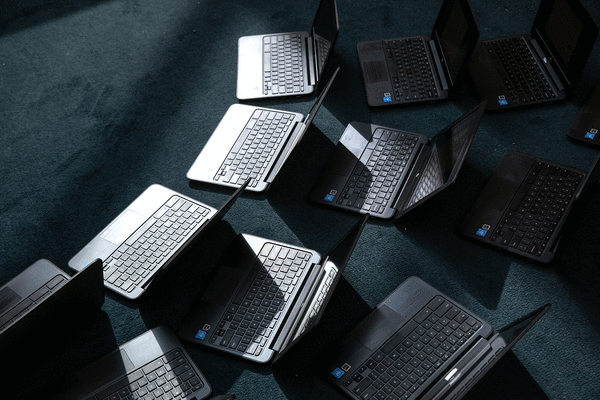
U.S. schools spent $30 billion on educational technology in 2024, roughly 10 times the amount they spent on textbooks. By one estimate, this sum could double in six years. Yet as children spend more time on school-issued screens, learning is deteriorating. Before spending another dime, school districts should rethink this “edtech” experiment.
For more than a century, IQ scores across the West climbed steadily as schooling increased. This trend reversed about two decades ago. Gen Z, recent findings show, is the first generation to be less cognitively capable than their parents — by IQ as well as other measures including numeracy and creativity — despite spending more time in school. What changed?
One potential factor is that class time has become increasingly screen-based. Almost 90% of schools give students a device, some as early as kindergarten, and almost two-thirds of elementary-age children spend up to four hours parked in front of a laptop. Many districts have signed edtech contracts that require kids to be online.
Some screen time is defensible for students learning computer skills, especially older ones. But there’s an important distinction between edtech — software that teaches traditional subjects on a device — and technical education, such as learning to code.
Until recently, educators were relatively sanguine about the former. Students who appear engaged must be learning, they reasoned. A different picture is now emerging. Although edtech purveyors argue that their products can boost results — and some research shows potential benefits under certain conditions — the bulk of independent studies suggest that learning online is often less effective than using paper text and may even be harmful. Edtech, as one researcher puts it, is “fundamentally incompatible with how human beings actually learn.”
Consider the biology involved. When reading a word on a page, the brain maps the physical spot of that word, strengthening recall and deepening retention. When scrolling on a screen, this process doesn’t seem to work as well: After a few minutes, the brain wants to start skimming, jumping vertically down the page instead of across. The learning that results may thus be much shallower. The trade-offs between typing and handwriting are similar: By engaging more parts of the brain, the latter reinforces the learning process.
The impact of edtech — for young children, above all — could be profound. As lessons move online, the worry is that students will learn less and develop weaker skills. Cognitive development may be impaired by diminished interactions with adults. Distractions may proliferate. And the perils of excessive screen time — anxiety, depression, weakened social skills — may be worsened.
More research is needed. But what’s clear is that the benefits of edtech are often oversold and the downsides overlooked. For years, companies in the field promised that personalized learning would improve academics, develop “future-ready learners” and relieve teachers of administrative drudgery. Many schools now hope that AI can help students offload “rote memorization.” Such thinking fundamentally misunderstands the learning process. In important respects, friction is the learning: Tools that make it easier could well be counterproductive.
Parents are starting to push back. Many are frustrated that efforts to limit screen time at home are undone the moment their children walk into school. Other families have simply asked for more transparency. Some states have proposed legislation that would allow students to opt out.
These approaches make sense to an extent. But school districts should recognize what many scientists have concluded: There’s too little evidence that edtech improves learning and many reasons to think the opposite. Combined with the concerning effects of screen time more generally, that suggests the default should be prohibiting technology from the classroom unless it’s proven to be effective. The growing success of mobile phone bans offers a useful example.
Thanks to edtech, a generation of students have been unwitting participants in a costly nationwide experiment. The results are starting to come in. On the evidence so far, that $30 billion a year is far better spent on actual books.
____
The Editorial Board publishes the views of the editors across a range of national and global affairs.
©2026 Bloomberg L.P. Visit bloomberg.com/opinion. Distributed by Tribune Content Agency, LLC.





















































Comments