Commentary: The US government's brain drain has reached alarming levels
Published in Op Eds
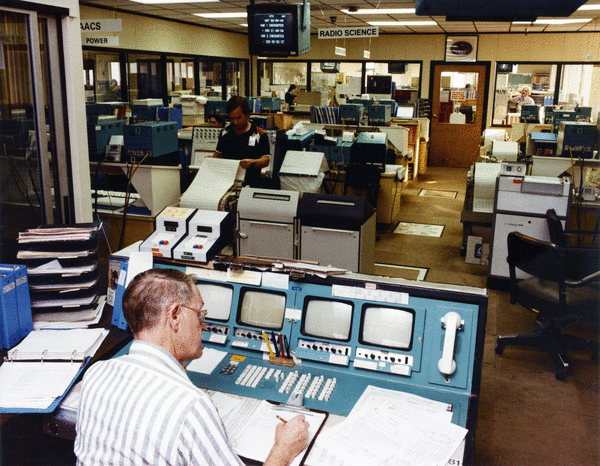
In November 2023 and more than 15 billion miles from Earth, NASA's Voyager 1 spacecraft, started sending gibberish back to mission control. The signals received from Voyager are only one ten-quadrillionth of a watt strong, or about one twenty-billionth of the power of a digital watch. But those infinitesimal signals still transmit valuable scientific data. So the Jet Propulsion Laboratory decided to debug 40-year-old code running on hardware designed before anyone on the current team was born, working across a distance so vast that each command takes 22.5 hours for a round trip, and do it all with systems that have just under 70 kilobytes of memory.
They pulled it off! Engineers sent a command that returned a full memory dump of the flight data system. They identified a single corrupted chip, realized no single location in the tiny memory could accommodate relocating the affected code, and devised a workaround that split the code into pieces and distributed it across functioning memory. It was a technical miracle performed by peerless scientists and engineers, requiring both brilliance and institutional memory built over decades.
Here's the problem: A new report shows more than 10,000 workers with doctorates in science, technology, engineering and mathematics, or STEM, have left federal service since 2017. The people who do this kind of work are rapidly dwindling. And the problems that will cause stretch far beyond a space probe at the very edge of the solar system.
When it comes to technical capacity, the government does two things the private sector can't and won't. First, it funds research that pays off 20 to 30 years in the future. The Defense Advanced Research projects Agency (DARPA) created the internet. National Institutes of Health (NIH) basic research enabled modern cancer treatments. NASA's deep space missions answer questions that have no immediate commercial application. But the returns can be huge. Every one of the 12 key technologies underlying the iPhone component tracks back to government-funded research.
Second, government manages complex infrastructure that is of enormous public importance even if it doesn't generate direct profits. My father spent more than 20 years at the Department of Energy managing nuclear materials. This required deep expertise in nuclear physics, materials science, and chemical engineering. It's not the type of job you want people focused on next quarter's profit margins to be overseeing. The relevant timelines are more concerned with the next thousand years. When he retired, my father took with him enormous technical expertise and decades of knowledge about what worked, what failed, and why.
The people doing this work aren't interchangeable bureaucrats. They're often among the most skilled people in their fields, choosing government service because the problems are uniquely challenging and because they want to serve the public (like my father, who left a more lucrative private sector career to give back to the country that welcomed him as an immigrant from India). The Voyager engineers who debugged code across 15 billion miles weren't just experienced; they were brilliant enough to reverse-engineer decisions made before most of them were born.
The current approach to government "efficiency" is identical to the playbook pioneered by the late Al “Chainsaw Al” Dunlap at Sunbeam Corp. and Scott Paper Corp. Dunlap loved to slash research & development and defer maintenance, as both goose short-term earnings. But both guarantee long-term catastrophe. At Scott Paper, Dunlap delivered great quarterly earnings, cashed out, and left behind a company that collapsed. At Sunbeam, he was eventually exposed for accounting fraud and forced out. Dunlap died a wealthy man. Sunbeam just died.
Today’s cuts to the government are exactly what Chainsaw Al would have done. We’re eliminating the people who do the R&D and who maintain the systems we depend on in return for some quick headlines. My father retired after a full career. The STEM Ph.D.s leaving now aren't retiring — they're being pushed out or fleeing dysfunction. Top talent has options. When you make government work intolerable, the most capable leave first. And rebuilding the lost skills won’t be easy. You can't hire someone off LinkedIn to manage plutonium. Even if you could find someone with the technical capability, the learning curve for specific systems is measured in years, and the consequences of error are measured in centuries and lives.
We've seen this pattern before. The Defense Department's catastrophic procurement failures, where major programs are routinely decades behind schedule and tens or hundreds of billions of dollars over budget, are well-known. Their root cause — the 1990s cutback of the civilian workforce that drove civilian program management expertise and left the Pentagon unable to supervise its contractors — is not. But those "savings" ended up being unimaginably expensive.
Some failures will be immediate while other failures will take years to surface. Infrastructure doesn't maintain itself. When the last engineer who understands why a particular fix was applied to a dam in 1987 retires, that knowledge often walks out the door. The R&D that would have created the next generation of technology simply won't happen.
Neither governments nor businesses can Dunlap their way to sustained innovation leadership or functional infrastructure. Sunbeam could declare bankruptcy when the bill came due. The Hanford nuclear waste site’s 56 million gallons of radioactive waste can’t be absolved with the stroke of a pen. The technical capacity we’re losing took generations to build. We should preserve it before the next great foundational technology is invented elsewhere. Or at least before the nuclear waste leaks.
____
This column reflects the personal views of the author and does not necessarily reflect the opinion of the editorial board or Bloomberg LP and its owners.
Gautam Mukunda writes about corporate management and innovation. He teaches leadership at the Yale School of Management and is the author of "Indispensable: When Leaders Really Matter."
©2026 Bloomberg L.P. Visit bloomberg.com/opinion. Distributed by Tribune Content Agency, LLC.



















































Comments