Commentary: Can young Americans reinvent the starter home?
Published in Op Eds
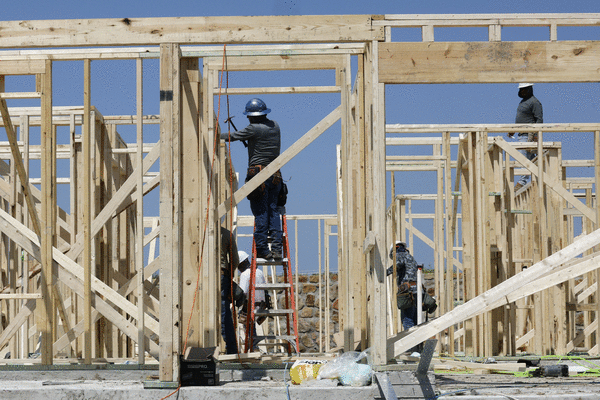
Will 2026 be remembered as the year of the starter home? Since January, bills have been introduced in Florida, Connecticut, Maryland and at least nine other state legislatures to allow smaller houses on smaller lots. And in Massachusetts, voters will decide by referendum whether to override town zoning rules and allow small-lot houses across the state.
Ten years ago, young professionals were shocked that they couldn’t afford apartments near their well-paid jobs. They launched the YIMBY movement in an effort to change how people feel about development in their “backyards” from “no” to “yes.” By 2026, many of them have children and are ready to own a piece of the American dream.
Spoiler: the homeownership market is even further out of reach than urban rentals.
It may be hard for young Americans to imagine, but developers in the mid-20th century did brisk business selling houses the size of two-bedroom apartments. Today, builders face a restrictive regulatory environment and high land costs, and starter homes are one casualty. To recoup their investments, builders now build fewer, larger homes aimed at the upper third of the market. The anemic supply of new homes keeps the prices of existing homes high, too.
The priced-out generation is pushing for regulatory changes that would allow builders to make money selling starter homes. One of those young professionals is Andrew Mikula, a researcher in Greater Boston. As Mikula watched elected leaders painstakingly advance a modest bill to allow some apartments near transit, he decided to try something radical: placing a question on the state’s 2026 ballot.
Mikula took aim at the single-most prevalent and least justifiable regulation in American zoning codes: the minimum lot size.
A minimum lot size determines how much land is legally required for a house lot, and it can vary from several hundred square feet to tens of thousands. Homes with septic systems have a scientifically grounded need for land based on site-specific factors such as soil type. But for houses connected to public water and sewer, lot size rules are arbitrary, lacking even a fig leaf of public health or safety concern. They often differ block by block, reflecting the vagaries of history and often the hostility of neighbors to homes more affordable than their own.
In a sign of the broadening interest in zoning reform, Mikula was able to raise the money necessary for a blitz of signature-gathering in late 2025. On January 5, Massachusetts Secretary of State Bill Galvin certified the petition and Bay State voters will soon decide whether to overrule local regulations or leave them in place.
Mikula’s approach has outsized importance because it will be the first time U.S. voters are on record about a statewide zoning rule. But the substance of the proposal is not so different from what another young New Englander, Maine House Speaker Ryan Fecteau, successfully passed in 2025: No town there can require more than a professional basketball court’s worth of land for a house connected to local utilities.
Alli Thurmond Quinlan, a civic-minded Arkansas architect, told me that lot size was the key to affordability in a new neighborhood she’s helping to lay out on the site of a defunct hospital in Bloomington, Indiana. Quinlan expects new homes to cost about $270,000 on “micro-lots,” down from $425,000 if she had followed the existing zoning.
Indiana is among the twelve states considering starter-home legislation. Its bill would allow micro-lots of 1,400 square feet statewide. Fixing lot sizes is the most important step toward more American starter homes – but it’s not the only step. Quinlan had to work with Bloomington officials to sidestep the onerous subdivision process. If Indiana’s law passes, cities will need to streamline processes.
The last piece of the puzzle is technology. Young Americans are taking the lead in one of the boldest attempts to break homebuilding out of its 50-year productivity rut. In Austin, Texas, a builder from Philadelphia, a couple of rocket scientists, and a very online housing activist recently announced their new startup: The American Housing Corporation. They build prefabricated rowhomes and dream of growing to a national scale.
To be sure, the odds are never great for any individual effort, whether it’s a homebuilding startup or a bill. But from the ballot to the statehouse, and from incremental redevelopment to industrialized housing, a new generation is fighting its way into homeownership.
_____
Salim Furth is a senior research fellow and director of the Urbanity project at the Mercatus Center at George Mason University.
_____
©2026 Tribune Content Agency, LLC.





















































Comments