Commentary: A veterinarian's take on the Iditarod
Published in Op Eds
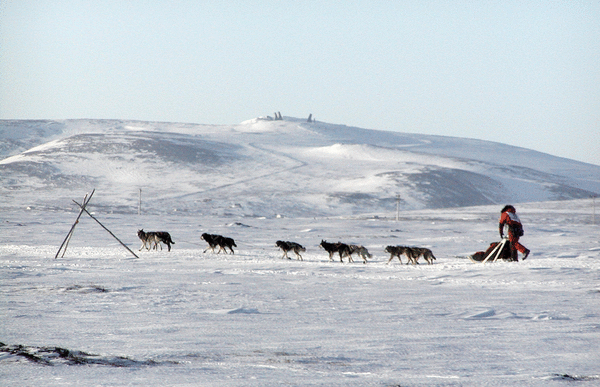
As a veterinarian whose life purpose is to protect animals from harm and to treat those who need help, it pains me to know that in the coming days, dogs will suffer—and some will likely die—on the Iditarod trail.
Every March, Iditarod mushers make hundreds of dogs run up to 100 miles per day in freezing temperatures on icy trails and through high winds, blizzards and other extreme weather conditions. The race is approximately 1,000 miles long—like running from New York City to St. Louis. Up to half the dogs who start the race do not finish due to illness, injuries, exhaustion and other causes, leaving the rest to work even harder.
While mushers start the race with up to 16 dogs, they are allowed to finish it with as few as five. Research shows that the extraordinary amount of physical exertion endured by the dogs has harmful effects on their health, causing them to suffer from various ailments and hardships, including gastrointestinal diseases and orthopedic injuries.
More than 150 dogs have died while running the Iditarod, including a 4-year-old pregnant dog named Ventana who collapsed and died on the trail last year. Although she was in the late stages of her pregnancy, musher Daniel Klein forced Ventana to run for more than 300 miles.
Multiple studies have shown that the Iditarod and other endurance races have severe health impacts on dogs. A study published in the American Journal of Respiratory and Critical Care Medicine in 2002 reported that more than 80% of the dogs who had finished the Iditarod had sustained persistent lung damage.
In 2003, a study in the Journal of Veterinary Internal Medicine showed that dogs used in endurance racing had a 61% higher rate of stomach erosions or ulcers. In a paper published in 2005 in Medicine & Science in Sports & Exercise, researchers concluded that dogs used in sled races suffer from airway dysfunction similar to “ski asthma” (an asthma-like condition caused by intense exercise in cold weather), which persists even after four months of rest.
The development of gastritis (inflammation of the stomach lining) among these dogs is so common that administering daily medication to reduce their stomach acid is now standard racing practice. Even so, many dogs still end up with painful digestive conditions. A study published in the Journal of Small Animal Practice showed that by the end of a 2019 race, nearly 90% of the dogs had developed stomach lesions and 100% of them had small intestinal lesions.
Life off the trail is no picnic. The conditions in which dogs are kept when not used in endurance races—such as daily exposure to harsh weather, prolonged tethering and disease or parasite infections related to crowded dog yards—also affect dogs’ overall well-being and long-term health.
Alaska’s rugged beauty makes it among the most awe‑inspiring places in the world. Our 49th state has much to be proud of. But the Iditarod is a moral failure.
_____
Dr. Mason Payne is a veterinarian with the PETA Foundation, 501 Front St., Norfolk, VA 23510; www.PETA.org.
_____
©2026 Tribune Content Agency, LLC.





















































Comments