Editorial: Unclear war aims are a recipe for disaster in Iran
Published in Op Eds
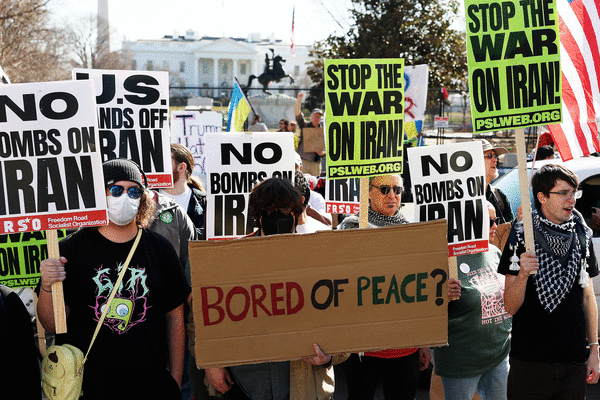
President Donald Trump’s decision to launch a major conflict with Iran is almost certainly his most consequential presidential decision to date, and may be the most important action of the U.S. government since former President George W. Bush’s Iraq War.
Yet while that conflict was preceded by several months of (often misleading or deceptive) arguments and evidence in favor of the war, both to the United Nations and the American people, the build-up to this war has not. Until the early hours of Saturday, Feb. 28, the president had said nothing substantial about his plans or aims.
And as of Monday afternoon, the administration has offered only a few tidbits, often contradictory, about America’s war rationale and goals. This raises serious concerns about whether the government is prepared strategically, militarily, diplomatically or politically for the consequences of its decision to launch strikes on Iran.
Above all, the American people deserve to be told, clearly and unambiguously, by their president why American servicemembers are dying, and will continue to die, in the Middle East, and why the nation is expending its limited supplies in this conflict that may be needed in others.
Trump consistently campaigned as a “peace president” and specifically against the 2002 Iraq War. What has changed?
It is clear enough that this weekend’s air assault represents the culmination of nearly a half-century of tension between the United States and the Islamic Republic. What is not clear is “Why now?” and “What is the precise purpose of Operation Epic Fury?”
The administration’s public statements do not inspire confidence that it can satisfactorily answer either question. Trump initially spoke about ensuring the freedom of the Iranian people, and the U.S. appeared to encourage Iranian dissidents to overthrow the government, echoing Bush-era claims — remembered today as fatal naivete and hubris — that American soldiers would be “welcomed as liberators” in Iraq.
But then on Monday Secretary of Defense Pete Hegseth said, “This is not a so-called regime-change war, but the regime sure did change, and the world is better off for it.” According to him, the purpose of initiating the conflict is to permanently cripple Iran’s ability to menace American and allied interests in the Middle East and elsewhere.
He also claimed that the U.S. and Israel were stopping Iran from developing a nuclear weapon, despite the fact the Trump administration claimed to have achieved this goal just eight months ago.
Knowing the purpose of this war is essential to giving the war a moral justification and, if it is justified, to assuring the American people that the sacrifices imposed on them — from military casualties to the economic cost of disrupting the world’s oil markets — are commensurate. There is no better way to ensure an open-ended and ruinous commitment, as Trump and his advisors should know better than most, than having unclear war aims.
This does not mean that initiating this conflict was moral, prudent and in America’s interests. That will depend on the Trump administration having, and articulating to the American people, a coherent justification for war.
So far, the only conclusion to be drawn is that Trump, in assuming America has the right and the ability to wage a limited but decisive pre-emptive war, is repeating the dangerous and destabilizing errors of his predecessors. Without a cogent explanation from the administration, the only plausible response is two words: Iraq and Afghanistan.
_____
©2026 PG Publishing Co. Visit at post-gazette.com. Distributed by Tribune Content Agency, LLC.



















































Comments