Commentary: In wildfire country, EVs aren't a grid problem -- they're a power solution
Published in Op Eds
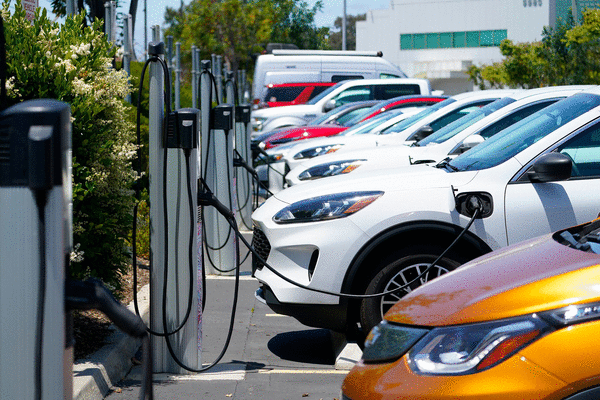
When wildfire risk spikes in Southern California, the lights often go out before the flames arrive. Public safety power shutoffs have become a grim ritual: Utilities cut electricity to prevent sparking fires, leaving families without refrigeration, medical devices, internet access or a way to cool their homes during heat waves. For many in Los Angeles, resilience now means planning for outages — not assuming the grid will always be there.
That reality makes one thing clear: California doesn’t just need more electricity. It needs smarter, more flexible power. And electric vehicles, often portrayed as a strain on the grid, are actually one of the most powerful tools we have to strengthen it.
The California Energy Commission’s latest forecast projects a major rise in electricity demand through 2045, with EVs expected to be the largest driver of that growth — even larger than data centers. EVs account for roughly one-third of projected demand growth, a fact critics often cite as a warning sign.
But that projection should be seen for what it is: an opportunity. EVs are a solution that California must intentionally harness for people and for the grid.
Unlike data centers, which require massive amounts of electricity around the clock, EV charging is flexible. Most EV charging happens at home overnight or during other low-demand periods, when electricity is cheapest and renewable generation is high. Managed charging systems enable this by allowing EV owners to take advantage of discounted utility rates. Utilities already plan for load growth, and EVs are no exception.
That matters because instead of paying money at the pump, EV charging shifts investments to the grid — investments that help fund upgrades and spread fixed costs across more kilowatt-hours, putting downward pressure on electricity rates for everyone, not just EV drivers. At a time when Californians are struggling with rising utility bills, that affordability benefit should not be ignored.
And unlike other growing electricity uses, every kilowatt-hour used to charge an EV replaces gasoline combustion — cutting smog and cancer-causing pollution in regions like Los Angeles that already bear some of the nation’s worst air quality.
What’s often missing from the grid debate is what happens when the power goes out.
Modern EVs are essentially large batteries on wheels. While a typical home backup battery stores about 13.5 kilowatt-hours, many EVs carry 40 to well over 100 kilowatt-hours of stored energy. In practical terms, that means a single EV can hold several times more electricity than a home battery system.
Some EVs already on the road can send that power back into a home during an outage. The Chevrolet Equinox EV, for example, carries a battery that supports bidirectional power, allowing it to run a home’s essential needs for multiple days. Larger electric trucks store even more energy, turning a single vehicle into a powerful backup resource during extended outages.
In wildfire-prone communities where public safety power shutoffs can last hours or even days, that capability is transformative. EVs can keep food from spoiling, keep medical equipment running, keep phones charged and keep families connected — turning vehicles into mobile resilience assets instead of stranded liabilities.
With smart charging and managed load programs, EVs can actually reduce stress on the grid. Studies show that active managed charging can cut peak EV demand by 50% or more, easing strain on local transformers and extending the life of our current grid infrastructure.
EVs also help integrate renewable energy. California produces so much solar power during the middle of the day that it often outpaces demand — a key feature of a grid powered by clean energy. EVs provide an efficient way to store that excess, low-cost energy for when drivers need it — or eventually send it back to the grid to power our air conditioners on those hot summer evenings. Something not possible with the constant, much less flexible loads like data centers.
This is how millions of EVs will play a key role in ensuring California’s grid can affordably transition to 100% clean energy in the coming decades.
California’s grid challenges are real — especially in a future shaped by wildfires, heat waves and climate volatility. The smart path is for California’s leaders to accelerate electric cars, buses and trucks while investing in smart charging, time-of-use rates, and bidirectional power programs. Those policies lower costs, improve reliability and give communities tools to stay powered during emergencies.
In a state where the next outage is never far away, EVs offer something rare: cleaner air and greater resilience. California should stop treating them as a risk — and start using them as the grid solution they already are.
____
Ken Alex leads Project Climate at UC Berkeley’s Center for Law, Energy and the Environment.
_____
©2026 Los Angeles Times. Visit at latimes.com. Distributed by Tribune Content Agency, LLC.







































Comments