Adriana E. Ramírez: Is it a time for poetry? Aren't memes enough?
Published in Op Eds
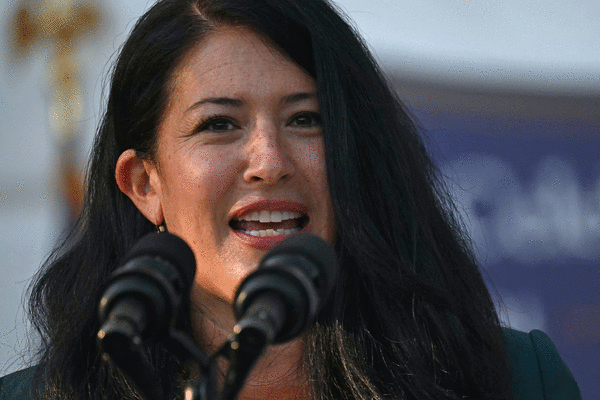
Former U.S. Poet Laureate Ada Limón’s newest book, “Against Breaking: On the Power of Poetry” is an easy read that packs a lot into its roughly 60 pages.
The tiny tome is the text of the closing lecture at the Library of Congress that Limón delivered last April, as she finished her term as Poet Laureate. She wanted, she said, “to make a case for poetry,” but to me the present doesn’t necessarily feel like a time for poetry.
The world is a dumpster fire of disagreement, with people divided by completely different realities, and not only in politics. Our country is at war, our purchasing power is down, slanted coverage of the world at large blinds everyone. Those of us who remain optimistic through wave after wave of terrible news are finding it increasingly difficult to do so.
But that’s exactly why we need poetry.
You make things all rhyme
Perhaps now is the moment to put away our attention-sucking gadgetry and try to describe the beauty and tragedy of being alive in this day. As Limón explains, there are no failures in poetry — “because didn’t it make you pay attention, the act of writing?”
As will the act of reading. Limón has a knack for describing the familiar in a way that feels inspiring. Consider how she reacts to a reader who once told her, “he only wrote poetry privately, poems he’d never share.”
She writes: “It gives me great joy to know people are writing secret poems. And if you are one of those people, I want you to keep going. Even if you never hand it to another person. There is power in making private poems. Aren’t we all walking around with some unsaid pain, or some uncelebrated wonder? Aren’t we all trying to find a place for our rage and despair?”
Poems mean so much because they put feelings and thoughts so concisely and memorably. And poetry can be more easily turned into someone’s personal form of expression.
Dylan Thomas’s “Do Not Go Gentle into that Good Night” is an example. The Welsh writer’s short poem of only 19 lines uses its villanelle rhyming scheme to make it sound like a dirge. The ending, written to his dying father, proclaims: “And you, my father, there on the sad height, / Curse, bless, me now with your fierce tears, I pray. / Do not go gentle into that good night. / Rage, rage against the dying of the light.”
It feels appropriate to read at someone’s funeral. I have done this before and did not make it far into the poem before my eyes welled. But last week, my husband and I watched an episode of “LOL: Last One Laughing UK” (it’s a better show than the clunky name implies). I watched the hysterical Diane Morgan (best known for her mockumentaries, including “Cunk on Earth”) recite Thomas’ poem in complete deadpan, while farting throughout in various keys and intervals.
My eyes welled again, but this time in ridiculous delight — a celebrated wonder. A poem contains infinite interpretive possibilities.
You’re the poetry
What kind of literature and art will come of recent history? Thomas’ poem, written just after WWII, used the wartime language of fighting the good fight. The writing of the 70s reflected the failures of both Vietnam and the international hippie movement. The 80s reflected a disenchantment with the future envisioned after the Reagan era.
What subjects will the poets of now take on? Or, given our technological advancements, will there even be a need for poets anymore?
In his 2011 novel, “Leaving the Atocha Station,” the poet Ben Lerner’s poet protagonist notes that his poems are not “machines that could make things happen.” To frame a poem as a machine implies that we want our poets to manufacture something for us. Perhaps, in the age of AI, that will be the defining feature of the language we love — how human it is or isn’t.
Our president recently noted that he doesn’t “believe in building libraries or museums,” a reflection of an American population that prefers YouTube to a book, a meme to a poem. Still, human-created poetry persists. Or as Limón put it, “We are not machines.”
When the Europa Clipper launched on its voyage to Jupiter’s moon in 2024, it carried a poem, written by a human. Ada Limón’s poem, “In Praise of Mystery: A Poem for Europa” was engraved, in her own handwriting, on the spacecraft itself.
You make things all right
History proves we prefer the human to the machine. Not because humans move as smoothly as machines, but because we don’t. Poets and their poetry, for example, are rough around the edges, full of contradictions and weirdness – that’s why they speak to us. “Poets must surrender to the mess of the world,” Limón writes.
My favorite poets are the ones who love the absurdity of existence as well as the ones who can name the quietness of an afternoon. I love the poets who linger over a phrase, who rejoice in the potential of language.
“For me,” writes Limón, “it’s as if a poem is always being made.” Perhaps that is the biggest lesson here. Poetry happens on good days, on bad days, on banal and boring days. It happens even during a dumpster fire.
Which is to say: we’re alive. That makes it a perfect day to write a poem.
_____
©2026 PG Publishing Co. Visit at post-gazette.com. Distributed by Tribune Content Agency, LLC.






































Comments