Noah Feldman: The Supreme Court's conservatives have a clear logic on voting
Published in Op Eds
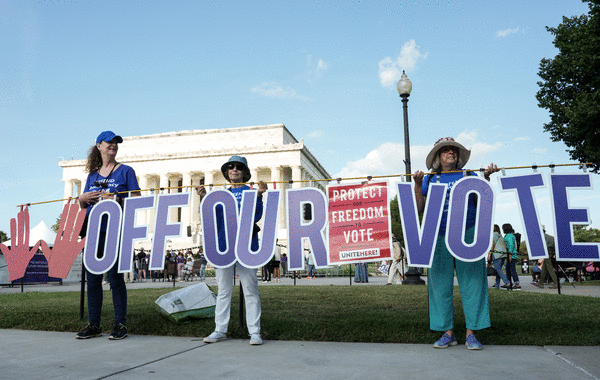
This week, four of the six conservative justices helped to block the Trump administration’s mail-in ballot scheme from going into place this Election Day. That’s a relief, but such partisan shenanigans aren’t permanently out of the question.
First, we can’t assume federal attempts to interfere with state-run elections are forever off the table. The majority didn’t give a reason for leaving in place the lower court order that prohibited the U.S. Postal Service from implementing the plan, backed by President Donald Trump, that would have made it harder to vote by mail. One of the conservatives, Justice Brett Kavanaugh, wrote a separate concurrence to say that his only real concern was that it’s now too close to November for a new plan to go into place lawfully. Justice Samuel Alito, joined by Justice Clarence Thomas, wrote a dissent saying that he thought the plan was permissible.
What is clear is that the justices, or at least seven of the nine, consider it part of their job to assure the regularity and orderliness of elections. That’s a good thing, not because the Constitution requires it, but because, in this day and age, someone has to do the job. Congress lacks the will or inclination to do it. The president, as we’ve just seen, is now in the business of disrupting electoral regularity, not ensuring it.
Second, we can’t assume that the Court will never make it easier for one party or the other to gain power. In 2019, in the case of Rucho v. Common Cause, the conservative majority held that partisan gerrymandering can never constitute a violation of equal voting rights, no matter how extreme it gets. That invited the states into an ever-escalating arms race of intense political gerrymandering. We haven’t seen the end of it yet.
And this year, the conservative majority built on its partisan gerrymandering jurisprudence to complete the gutting of the Voting Rights Act of 1965 that it had begun in a 2013 decision, Shelby County v. Holder. This time, the Court held that what the law previously considered an illegal racial gerrymander could be recharacterized as a constitutionally protected partisan gerrymander. The decision effectively encouraged formerly segregated states to gerrymander away so-called majority-minority districts that, for more than 50 years, had been designed to enable Black voters to select representatives of their choice.
In the minds of Chief Justice John Roberts, Justice Amy Coney Barrett, Justice Neil Gorsuch, and Kavanaugh, there’s a difference between constitutional rulings about setting electoral districts and giving in to Trump’s anti-democratic efforts to distort and suppress elections while they’re underway or in their immediate aftermath. Remember 2020 and 2021, when Trump’s denial of his defeat was in full swing, and various Trump officials were contemplating coup-like activities in the run-up to the Jan. 6 attack on the Capitol? The Supreme Court stood firm. Despite worries from Democrats, the justices rejected the various lawsuits that Trump brought to advance his objective.
Then, as now, Trump expressed frustration and anger at the justices he appointed for not being “loyal.” That didn’t matter to those justices, all of whom firmly believe that their loyalty is to the Constitution (as they interpret it) and not to Trump. It’s noteworthy that the only two justices who voted to allow the mail-in ballot scheme to go into place were appointed by previous GOP presidents. Given that the Court has been subject to coruscating criticism for voting rights decisions that (for now) help Republicans, it’s important to recognize that Trump’s own three Supreme Court appointees remain committed to defending the procedural integrity of elections from presidential meddling.
The ruling should give pause to Democrats, too. A rising tide of progressive voices is calling for weakening or destroying the Supreme Court by packing its membership with Democratic appointees and passing laws to deny the Court jurisdiction over issues where it might rule against Democratic legislation.
Progressive frustration with the institution is understandable amid a conservative constitutional revolution of the kind the U.S. hasn’t seen in nearly a century. Yet the Court’s progressive critics have failed to answer the most fundamental question that must be confronted by anyone who wants to make institutional change in our constitutional order. If you change things radically, who will undertake the most elemental tasks that the current institutions perform?
In a thoroughly partisan Supreme Court, there is no reason to expect the justices to cross party lines to protect elections. Progressive court packing, if it were ever to come to pass, would inevitably give rise to conservative court packing. The Court would gradually become a legislative body rather than a judicial one.
Similarly, legislation that prohibited the justices from ruling on election-related matters would block decisions protecting elections just as much as it would block decisions undermining the democratic system.
The conservative justices are extraordinarily conservative. Four of them, however, still think a president, including the one who appointed them, shouldn’t be able to meddle with the electoral process weeks before Election Day. That’s a low bar — but it’s also a bulwark we need, now and in the foreseeable future.
____
This column reflects the personal views of the author and does not necessarily reflect the opinion of the editorial board or Bloomberg LP and its owners.
Noah Feldman is a Bloomberg Opinion columnist. A professor of law at Harvard University, he is author, most recently, of “To Be a Jew Today: A New Guide to God, Israel, and the Jewish People."
©2026 Bloomberg L.P. Visit bloomberg.com/opinion. Distributed by Tribune Content Agency, LLC.












































Comments