Editorial: Why an independent Federal Reserve matters far more than renovations to a building
Published in Political News
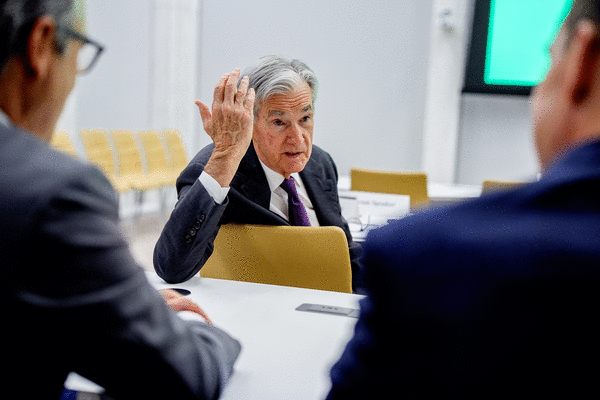
There’s a time-honored tradition of U.S. presidents, whose electoral fortunes tend to rise or fall with the state of the economy, grumbling about chairmen of the Federal Reserve Board.
Famously, Paul Volcker, who as Fed chair dramatically raised interest rates in the early 1980s to combat inflation rates considerably higher than those that helped doom President Joe Biden’s hopes for reelection, ruined many a day for President Ronald Reagan, particularly early in his first term.
But Volcker’s tough medicine was credited in large part for taming the rampant inflation of the era, a record that persisted for decades until the COVID pandemic recovery briefly sent inflation rates spiking.
Fast-forward to the present day, and President Donald Trump is doing far more than grousing about a Fed chair he doesn’t like — in this case Jerome Powell. News broke over the weekend that Powell is under criminal investigation by the Justice Department, which sadly has become an attack tool of the president’s, in connection with the rising costs of renovating the Fed’s Washington, D.C., office buildings. We all know, of course, that renovation costs are not what this really is about.
To his credit, Powell confronted the issue directly. In a video statement, Powell correctly cast the probe as a threat to the independence of the Fed itself and said he wouldn’t be cowed. He was backed by former Fed Chairs Alan Greenspan, Ben Bernanke and Janet Yellen and a bipartisan host of other economic luminaries. In a pointed statement all but accusing Trump of dictatorial overreach, they said, “This is how monetary policy is made in emerging markets with weak institutions, with highly negative consequences for inflation and the functioning of their economies more broadly.”
Trump makes a regular practice of busting norms that have served this nation well for decades and even centuries. Thankfully, the pushback to his attempts at dominating the Fed has been stiffer than with some other examples of Trumpian bullying (universities, law firms, etc.).
GOP Sens. Thom Tillis of North Carolina and Lisa Murkowski of Alaska roundly condemned the effort to intimidate Powell, with Tillis saying he wouldn’t vote to confirm any of Trump’s future Fed board nominees as a Senate Banking Committee member if the legal threat to Powell continues.
Why this reaction? Simply stated, the independence of the Fed is a bedrock of our economy.
Investors and creditors rely on stable monetary policy to make decisions that, taken together, help guide the course of our financial system. If Trump 2.0 has taught us nothing else, it’s that predictability and stability are critical to a well-functioning business environment.
Trump’s desire to move Powell out as Fed chair isn’t new, of course. His desire to change course at the Fed in favor of far more aggressive cutting of interest rates was evident the minute he retook office.
The administration made noises last year about firing Powell despite federal law that shields the chair from serving strictly at the president’s pleasure. The U.S. Supreme Court quickly made clear that it would uphold the Fed’s independence even as the high court allowed Trump to remove officials at other agencies that heretofore had been independent per federal statute.
What’s particularly puzzling about Trump’s latest machinations is that the Powell’s term as Fed chair expires in May. In just a few short months Trump will be able to select a replacement, subject of course to Senate confirmation.
Once he’s no longer chair, Powell can remain on the Fed board until 2028 if he so chooses. That could explain Trump’s unseemly maneuvering, as a Fed chair at the end of the day is merely one of 12 who get to vote on the setting of interest-rate levels. Powell will be one of those 12 if he stays on.
Last year, Austan Goolsbee, president of the Federal Reserve Bank of Chicago, sat on the Fed’s Open Markets Committee. As head of the Chicago Fed, Goolsbee serves on that panel every other year, so he won’t be voting on interest rates in 2026. But he will again in 2027; with his term ending at the end of next month, Goolsbee was reappointed late last year to another five-year term beginning in March.
Goolsbee was one of three committee members who dissented at the December meeting from the decision to cut the federal funds rate by a quarter point — a move Powell supported.
All of this is to say that, no matter whom Trump appoints as the next Fed chair, other central bankers on the Open Market Committee will cast their own votes about future monetary policy. Our monetary system is set up deliberately so that a presidential administration gets a say in who makes those crucial decisions but not a complete say.
So it should remain; that setup has served the U.S. well.
President Trump is free to voice his opinions about interest rates and nominate people he believes holds views similar to his own. But he is not the nation’s chief central banker. By threatening Powell with criminal prosecution on a peripheral and dubious matter, he is abusing his office’s powers.
___
©2026 Chicago Tribune. Visit at chicagotribune.com. Distributed by Tribune Content Agency, LLC.






































Comments