Sen. Maria Cantwell looks to federal testing role in AI safety framework
Published in Political News
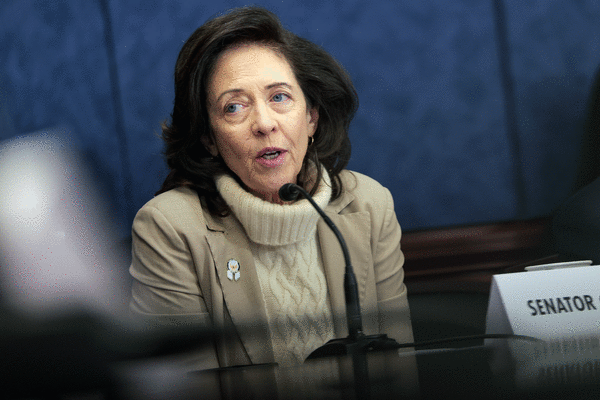
Senate Commerce Committee ranking member Maria Cantwell, D-Wash., released a framework for artificial intelligence regulation Wednesday that includes a major role for the federal government in setting safety standards and testing models for catastrophic risk.
The six-point framework, which does not include legislative text, stands in contrast to a focus from the White House and some congressional Republicans on voluntary standards and self-regulation and could set the tone for Cantwell’s potential return to the chair if Democrats take control of the Senate in the midterms.
“To manage risks from advanced AI systems we need clear safety standards, continuous testing, and reporting of serious failures,” Cantwell said in a statement Wednesday. “America can lead the world in AI by building systems that are not only more capable, but safer and more secure.”
While Senate Majority Leader John Thune, R-S.D., has said he’s working on an AI-focused bill, Cantwell is not involved in negotiating that legislation.
According to a Democratic committee aide speaking on condition of anonymity, the framework could develop into more than one bill, with the intention of developing bipartisan legislation.
Commerce Chair Ted Cruz, R-Texas, recently said he’d like to see a role for “independent judges” in AI safety and that a federal standard would need to “address the burgeoning patchwork of state laws.”
Cantwell’s new framework would rely on the National Institute of Standards and Technology to set standards for frontier AI models, including ways to address the potential for catastrophic risks, such as loss of control and AI agents “escaping secure testing environments.”
“Standards should establish proportionate safeguards and risk-management requirements, with heightened review and oversight for systems that exhibit dangerous capabilities or are capable of self-improvement that may bypass safety controls,” the framework said.
The standards would also need to address open-source models and be updated over time as risks evolve.
Models subject to the NIST standards would then need to go through “continuous” testing by the government and third-party groups. Independent audits would confirm compliance with federal standards.
The aide offered examples of which type of testing would be best suited to particular issues.
“If you’re testing an AI model to diminish its ability to design a biological weapon or a nuclear weapon, that might be something where you need national security expertise,” the aide said. “If you’re testing the ability of AI agents to deceive their operators and escape their testing environments, for example, that’s something that a third-party tester might have expertise on.”
Disclosure
Under the framework, frontier developers would be directed to publicly disclose potential risks and mitigation. They would also be required to report safety incidents, including “unsafe recursive self-improvement” in which an AI model develops itself or other models without human instruction.
The enforcement mechanism “will have to come out during discussions as we turn this into a bill and through discussions with partners as we bring on others on board,” the committee aide said, but it could include civil or criminal penalties based on the particular violation.
The framework represents an evolution of Cantwell’s previous work on AI amidst an industry where safety concerns have increased radically in recent months.
Earlier this year, she co-sponsored a bill by Sen. Todd Young, R-Ind., that would codify NIST’s AI standards center and directed it to develop voluntary AI testing standards (S 3952).
The framework also includes a section on government and industry partnering on “defensive AI” that can protect against AI-powered cyber attacks. It would direct the government to assist state and local governments in protecting “critical infrastructure and essential services.”
In addition to frontier model safety, the framework addresses children’s use of AI products, funding for worker training, the use of AI in “consequential decisions” and the U.S. role in international standard setting for AI.
_____
©2026 CQ-Roll Call, Inc., All Rights Reserved. Visit cqrollcall.com. Distributed by Tribune Content Agency, LLC.


































Comments