Trump, stadiums, and a presidential run: Takeaways from the Pa. governor's debate
Published in Political News
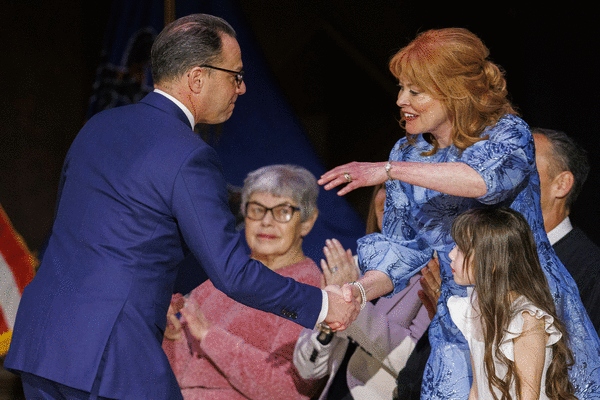
HARRISBURG, Pa. — Gov. Josh Shapiro and state Treasurer Stacy Garrity on Wednesday sparred over President Donald Trump's leadership, soaring gas prices, the state budget deficit, and other top issues facing Pennsylvania in their only scheduled debate before Election Day.
And at one point, the gloves came off.
In the wide-ranging and mostly even-tempered debate, Garrity, a Republican who is in her second term as the state's top fiscal officer, turned to Shapiro after he swiped at her, accusing her of taking direction from Trump by denying the results of the 2020 election. (Garrity in 2022 told a crowd at a Trump rally that "we know that he won," and has since walked back those comments.)
"I don't even know why you'd say that, and how you can look yourself in the mirror at night," Garrity said, turning to look at Shapiro across the abc27 studio in Harrisburg, in one of the most heated moments of the night.
The debate, moderated by abc27's Dennis Owens and WPXI's Lisa Sylvester, came as Shapiro maintains a double-digit lead in statewide public opinion polls of likely Pennsylvania voters ahead of the Nov. 3 midterm election, including a 25-point advantage over Garrity in a Quinnipiac University poll released Wednesday.
The televised debate, broadcast and streamed for free statewide, marked a consequential night for both candidates. Garrity needed to give an attention-grabbing performance to bring more eyes — and resources — to her struggling campaign. And the night presented Shapiro, who has long been rumored to have his eyes on a White House bid, the chance to show political observers whether he could compete on a crowded Democratic presidential primary stage.
Here are four takeaways from the debate:
With a potential 2028 run, Shapiro doesn't promise to fulfill another four-year term
Shapiro, 53, from Abington Township, again declined to say whether he would fulfill another full, four-year term as governor if reelected. A well-rehearsed orator with two decades of political experience, Shapiro gave the debate's moderators the same answer he's repeated to reporters for months:
"The only thing I am focused on is running for reelection as governor," he said, before restating his frequent refrain about Trump's chaos, cruelty and corruption.
(Although he maintains high popularity ratings in the state, Pennsylvania's likely voters are split on whether they'd like to see him run for president, according to a poll conducted by The Inquirer, New York Times and Siena University last month.)
Wednesday's debate took place on the third anniversary of the Oct. 7, 2023 attacks by Hamas on Israeli civilians that marked the start of the war in Gaza — a conflict that has divided Democrats nationally and is certain to remain a top issue in the years ahead.
Shapiro, who is Jewish, was asked by the moderators about a recent poll conducted by The Inquirer, New York Times and Siena University that found 60% of likely Democratic voters in Pennsylvania do not want the U.S. to provide economic and military support to Israel.
After first lamenting the attacks, Shapiro dodged the question. When he was asked for clarity, Shapiro said he wants "America to have a strong relationship with Israel and with the Israeli government," which he does not see as possible under Prime Minister Benjamin Netanyahu, whom he has criticized for years.
"I've been very, very, consistent in my position, in my love of Israel, and also in my disagreements with the Netanyahu government," Shapiro said, adding that he hopes Israel chooses a new leader in its upcoming election.
Garrity, for her part, opened her first response of the night — to a question about data centers — by recognizing "the lives that were stolen" in the Oct. 7, 2023 Hamas attacks.
Garrity distances herself from Trump
Garrity, 62, a retired U.S. Army colonel from Bradford County in Northeastern Pennsylvania, was endorsed by Trump in January and has remained largely loyal to him.
Shapiro's campaign has seized on this support, running millions of dollars worth of negative ads calling her "100% MAGA." Garrity, meanwhile, has no ads on TV with less than a month before the election, as she struggles to fundraise during an especially challenging midterm year for Republicans.
But as the president's job approval ratings continue to dip — just 34% of likely Pennsylvania voters gave him positive ratings in a poll conducted last month — Garrity said on the debate stage Wednesday that her alignment has its limits.
"Nobody, I think, agrees with the president 100% of the time," she said. "Who agrees with anybody 100% of the time?"
In an interview last month, Garrity said that she would have taken a different, "more targeted" approach to instituting tariffs on other countries and has called for a pause on data center development, in contrast to Trump's embrace of them.
During the debate, she also put an arm's length between herself and members of Trump's cabinet, including Health and Human Services Secretary Robert F. Kennedy Jr., with whom she stood with at a "Make America Healthy Again" rally in Harrisburg earlier this year.
Kennedy, an anti-vaccine advocate who rose to lead the nation's health agency, has publicly sparred with Shapiro in recent weeks over a number of measles-associated deaths as the state grapples with its largest outbreak of the disease in decades.
Garrity on Wednesday said she is vaccinated against measles, mumps and rubella, and added that she does not share all of Kennedy's views and that she attended the event to promote healthier food choices for children.
Blame game
Shapiro during his first term has frequently highlighted his ability to bring Democrats and Republicans together, as one of few governors leading a state with a politically split legislature, where Democrats control the state House and Republicans control the state Senate.
But he has struggled to forge consensus when it comes to solving some of the top issues facing Pennsylvania, including funding mass transit and taxing and regulating skill games. Garrity jabbed at that point multiple times during the debate.
"The governor has consistently... used the excuse that he can't do anything because he has a divided legislature," Garrity said. "Well, that's not what real leadership is. Real leadership, they call the leaders to the table and you negotiate."
During the debate, Shapiro blamed the legislature for its inaction on: voter ID, establishing new penalties for second-degree murder, temporarily halting the state's gas tax, and regulating skill games.
As the candidate at the top of the ticket, Shapiro is campaigning for Democrats up and down the ballot in hopes of flipping the state Senate to Democratic control for the first time in more than 30 years. If Democrats are successful, Shapiro would get the chance to lead a Democratic trifecta in Harrisburg, with the ability to more easily address the party's top priorities, such as increasing the minimum wage and codifying abortion rights in the state constitution.
Shapiro has negotiated four state budgets with the split-control General Assembly through the state's tough fiscal conditions, including one budget impasse over mass transit funding that lasted nearly five months and led to closures and pauses of state services. He noted that he brought lawmakers together to cut taxes for seniors, working residents, and startup businesses.
"I've got a strong track record of bringing Democrats and Republicans together to cut costs for the good people of Pennsylvania, and in a second term, we'll continue our work to cut taxes, not raise them," he added.
He pointed to Trump's leadership, his tariffs, and his war in Iran as the reason why some Pennsylvanians are struggling — all of which Garrity supports, he said. (Garrity has recently begun criticizing some of Trump's tariffs and has said she hopes the war ends soon.)
When asked how he would help make up the state's budget deficit, Shapiro said: "There's some priorities that the Republican Senate put in that I would likely cut. We'll see what the makeup of the legislature looks like next year."
He also rejected questions about why he had not called the legislature into a special session to handle time-sensitive issues, such as the upcoming deadline to enforce a court decision that found skill games are illegal slot machines or to pass a gas tax holiday. While a governor can call a special session, they cannot compel lawmakers to consider specific legislation.
"It's still up to the lawmakers to show up and do their jobs and vote on these matters," Shapiro added, noting that the GOP-controlled Senate has only been in session voting on legislation 34 days so far this year, with another five days scheduled for the rest of the calendar year.
Should taxpayers pay for stadiums?
Should taxpayer money help fund construction for professional sports stadiums?
In Pennsylvania, where many Philadelphia or Pittsburgh fans are fervently devoted to their teams, state taxpayer money has helped build stadiums and arenas in the past.
But as both the Philadelphia Eagles and the Pittsburgh Steelers eye new stadiums, the moderators asked both Garrity and Shapiro whether Pennsylvanians should help pay for them directly through direct state contributions or tax incentives.
Jeffrey Lurie, the owner of the Philadelphia Eagles who has contributed money to Shapiro's campaign, has said he is exploring the idea of renovating Lincoln Financial Field or building a new stadium.
He has emphasized that he would make a decision that's "best for the fans," but kept open a range of possibilities that could mean moving out of the city. The Steelers are similarly looking to upgrade their stadium or find a new home.
Shapiro said he's already spoken with Lurie and the owners of the Steelers about their new potential stadiums. And he noted that he opposed using public dollars toward the Sixers' new arena and he would "be a strong protector of our Pennsylvania taxpayers."
"On my watch, the Steelers will remain in Pittsburgh, the Eagles will remain in Philadelphia. Period," Shapiro said. "And as I've shown with the Sixers and Flyers scenario, you can do that without providing tax dollars in order to make that happen."
Garrity, who has said she supports all Pennsylvania sports teams but admitted she is also a Buffalo Bills fan, pledged to make any new stadium costs the responsibility of the owners, not taxpayers.
"I don't think that we need to be giving taxpayer dollars to billionaire owners," she said.
_____
© 2026 The Philadelphia Inquirer. Visit www.inquirer.com. Distributed by Tribune Content Agency, LLC.















Comments