Vahe Gregorian: Why Royals' biggest change could help club that hasn't 'traditionally won a ton'
Published in Baseball
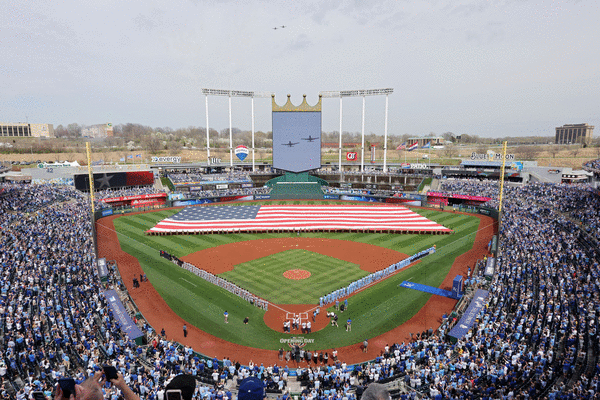
KANSAS CITY, Mo. — When Royals general manager J.J. Picollo and the club’s research and development staff over the offseason approached owner John Sherman about compressing the cavernous confines of Kauffman Stadium, Sherman initially was uncertain what to think. Perhaps he was even skeptical.
Even after being persuaded and granting the go-ahead, he has found himself wondering how recent winter weather is affecting the process on what he referred to as The K’s “frozen tundra.”
And the other day at Royals Rally at The K, the team’s annual spring-training kickoff event, he was momentarily jarred by the radical appearance of the change — largely, reeling in the arc of the outfield wall perimeter by 8-10 feet while still flowing out to the remaining 410-foot anchor of center field.
“I guess I was looking at the wrong line; I looked at those posts that are really the warning track …” Sherman said, smiling and joking that ace pitcher Cole Ragans was distressed by the sight.
More seriously, Sherman said he’d spoken with a number of Royals pitchers about the shift and found them “pretty comfortable” with the concept.
The Royals have compelling data. That includes but isn’t limited to how the cozier confines should enhance star Bobby Witt Jr’s production — he was one of the players who was “probably most negatively impacted,” Piccolo said last month — and leave (relatively) unmussed pitching that in 2025 induced MLB’s best soft-contact rate:
“The analysis,” Sherman said, “is that we’ll benefit.”
How it plays out and to what degree that proves true will be a fascinating variable in 2026 as the Royals seek to return to the postseason after falling short in 2025 in the wake of 2024’s rousing turnaround.
Because barring a blockbuster acquisition between now and their home opener on March 30 (after the Royals launch the season in Atlanta on March 27), this dimensional reset looms as the most substantial change the club has made in an offseason marked more by spackle than any obviously profound roster addition.
This move, years in consideration and understood to be for the duration of the Royals’ projected time at The K, wasn’t intended to be a substitute for adding an imposing bat.
It’s meant to optimize the intriguing current roster.
One that’s highlighted at the plate by budding MVP candidate Witt, Sal Perez, Maikel Garcia, Vinnie Pasquantino and the intriguing potential of Jac Caglianone and Carter Jensen.
And one that figures to have a night-in, night-out chance with stellar starting pitchers, including Ragans, Seth Lugo, Michael Wacha and Noah Cameron, and an exceptional back end of the bullpen fastened down with Carlos Estevez and Lucas Erceg.
While Pasquantino perceives a vast number of ways to try to process what this means, he is exhilarated by the concept in terms of individual production — “you kidding me?!” — and appreciates the move in the context of the Royals’ history … and future.
The bottom-line rationale, as he sees it:
“Most people that follow baseball would agree the Royals have always built their teams in specific ways, which was to fit the ballpark,” he said at Royals Rally. “The Royals have not traditionally won a ton of games.”
As they take aim at resetting a modern tradition that has led to only three postseason berths since 1985, the Royals believe this boosts them in multiple ways. It enables them to maximize what they’ve built, be more flexible in future roster construction (particularly in the outfield) and benefit from a park that will play more neutral and fair over the course of 81 home games.
It should also alleviate at least some of those routinely exasperating moments over the years.
At a news conference last month to announce the change, the first instance that came to mind for Picollo was Eric Hosmer’s left-center shot in the 2014 American League wild-card game. But at least that became a triple when Oakland’s outfielders collided.
Too often, it’s been something like what then-new Royal Jonathan India experienced to lead off the 2025 opener.
He crunched the ball 368 feet … only to have it caught by Cleveland outfielder Steven Kwan.
That shot would have been out in 11 other stadiums, a routine matter to look up when watching games at Kauffman. Now that hit would be over the fence — just one of who-knows-how-many moments Picollo described thusly:
Seeing and hearing a ball and thinking it’s definitely gone ... “And it’s not,” he said. “Not only is it not gone, it’s an out.”
Given that both teams play in the same circumstances, how much of a positive difference this would have made had it been done sooner in the recent past isn’t entirely clear.
No point obsessing on it, anyway. Perez joked that he didn’t like thinking about how many more home runs he might have (303 as it is) because “I don’t want to get mad.”
But led by the formidable mind of Daniel Mack, the Royas’ assistant general manager for research and development, KC certainly has the metrics to support going forward with this.
Or as manager Matt Quatraro put it: “It wasn’t like, ‘Oh, let’s just give this a shot.’ ”
Instead, Quatraro sees it like this: “We believe that it will be more beneficial to the hitters than punitive to the pitchers, and overall more beneficial to us as a team.”
Naturally, starter Seth Lugo smiled and said he’d prefer to play on the biggest field possible. But in his decade in the big leagues, he’s also seen this before and has learned to shrug it off. And that’s perhaps more easily reconciled since metrics shared by the Royals revealed scant difference in how things might have gone in the 310 innings he’s pitched for them the last two seasons.
“It’s already part of my game plan not to let hitters get the ball to the gaps,” he said. “So if I can eliminate that, it shouldn’t be an issue to think about.”
As for the inevitable moments when this works against the Royals?
Maybe Lugo put that best.
“As you get older, you’re just kind of wasting your time and thought process thinking about the ‘what ifs’ or ‘what should have (been),’” he said. “You move past that pretty quick. I’m sure it’s going to happen, but hopefully (it won’t be) something I’m going to dwell on.”
It bears mention that this isn’t the first time the Royals have made such a move. Before the 1995 season, they moved the fences in 10 feet and went from artificial turf to grass.
At the time, The Kansas City Star wrote that doing so “will probably mean more, in the long run, than who owns the club or who is managing it or whom the players might be.”
It didn’t turn out that way.
Albeit coinciding with the steroids era and suspicions baseballs were juiced, a more accommodating home environment allowed the Royals to score the most runs in franchise history (879) in 2000. They enjoyed three of their four most prolific seasons ever before they moved the fences back for the 2004 season.
Trouble was, the Royals were outscored in each of those seasons and managed only one winning record in the nine-year span before the fences were moved pushed out again. Then the return transition started with three straight 100-plus-loss seasons for a franchise encumbered by an aging and less nimble lineup and an outfield “with more gaps than every mall in North America,” as The Star’s Joe Posnanski put it at the time.
This time around, the scheme is far more steeped in data and appears much more promising.
So this isn’t an identity crisis but a logical evolution, one that doesn’t abandon what the Royals have long stressed but seeks to fortify it.
And while Kauffman will retain top 10 status in outfield dimensions, the sight of it won’t be as extreme as Sherman thought at a glance the other day.
At least as the Royals get ready to report to spring training next week, though, the contrast still stands as their most pivotal move since last season.
Add a big bat or not, how much it proves to benefit them will be one of the prevailing storylines this season, for the rest of their time at The K and with potentially enduring implications in their next home.
©2026 The Kansas City Star. Visit kansascity.com. Distributed by Tribune Content Agency, LLC.






Comments