Mac Engel: A Baseball Hall of Famer for the Rangers is the last of a special breed
Published in Baseball
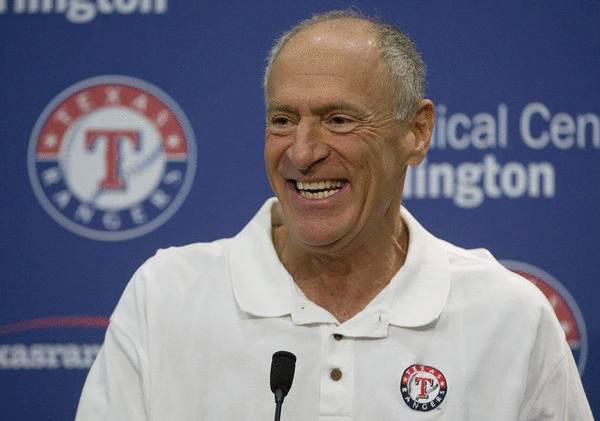
ARLINGTON, Texas — Eric Nadel is in a group that includes Mel Allen, Bob Uecker, Harry Kalas, Jerry Coleman, Denny Matthews, Red Barber, Ernie Harwell, Jon Miller, Jack Brickhouse, Marty Brennaman, Harry Caray, Jack Buck, and maybe the most revered of them all, Vin Scully.
You’ll notice some of these celebrated figures are retired, or no longer with us; there are a few who still go to the ballpark to call the game.
As the voice of the Texas Rangers, Nadel is one of last remaining “famous” radio baseball narrators. He joined the profession decades ago, before the internet changed the world, including a job that was formerly one of the most celebrated in sports.
Starting in 1921, these men, and few others, were a big part of America’s soundtrack. As habits changed from listening to baseball to watching it, it flipped the status of the announcer, save for those who had been with the team long before every game was televised.
“There are people who still listen to us on their boats, or mowing their lawns, or being on their tractor; there’s still a lot of people who don’t get the games on TV, especially out in the rural areas,” Nadel said in a recent interview.
This is his 31st season as the lead voice of the Rangers’ radio broadcasts, and 47th with the team.
His is the longest tenure of voice in the Rangers’ history, and the third-longest continuous run with the same team among MLB’s 30 franchises. In the American League, he is second only to Kansas City’s Denny Matthews, who completed his 56th season last year.
Nadel has been in the booth to see the sports media model change, from the height of the newspaper era, the growth of cable television, to the creation of the internet and streaming platforms.
Much like with the newspaper industry, the internet has had a similar impact on radio stations, just not quite as catastrophic. Being the “flagship” station of a sports franchise no longer carries the pop it once did.
Why listen to the game when a person can watch it live on a hand-held device from nearly any place in the world?
“There are those who may not be into streaming, or may not get the Rangers Sports Network [television] app. If [radio] is the only way they can get a game, there is still a place for radio,” Nadel said. “Clearly, it’s not as big as it used to be, at least in terms of people sitting around a radio and listening to a game.”
There are still those who prefer to turn the volume “down on their TV, and their radio up” for a Rangers, or any, game. Calling a game for TV is much different than radio, and most (not all) announcers react according to the medium.
“There are also a lot of people who are listing on their phones all over the place,” Nadel said. “We’re getting all kinds of communications from people, literally all over the world, who listen to the games off the MLB app, or on SiriusXM. To say that sports on the radio is dying maybe a little bit of an exaggeration.”
Dying? No. Shrinking? Yes.
Sports’ future on radio
The rise of streaming has pushed the radio broadcast team not out of the booth but “upstairs.” Seldom now are radio teams given the luxury of calling games in a stadium or an arena’s prime location. That’s beachfront real estate sold for thousands of dollars each game.
Some radio sports broadcasters no longer travel with their teams — “remote broadcasting” — a cost-cutting practice that is reviled by play-by-play people.
This practice took off during COVID when broadcasters handled the production from a studio thousands of miles away. Once COVID restrictions were lifted, most, but not all, teams and networks returned their broadcasters to games on-site.
Some team owners and networks care about the potential drop in production value. Others don’t. The Angels and Blue Jays still have their radio teams call the away games from a studio rather than travel.
The other cost-slashing option that is seldom practiced is the simulcast in which the radio network broadcasts the TV announcers, a path the Dallas Stars have preferred for decades. The radio listener is the big loser here.
Nadel wants no part of TV
Nadel’s predecessor, the late Mark Holtz, left the radio booth for TV because he saw the evolution.
“Once all of the games were on TV, he didn’t feel anymore that he was really the voice of the Rangers; the audience on television was so much greater, so he wanted to be the TV voice,” Nadel said. “He wanted to be the main guy communicating news to Ranger fans.”
Nadel has been approached about heading to TV, and every time the answer is an emphatic nope. He doesn’t want to wear a jacket and tie. He wants to call the postseason, something national TV broadcasts take over when the playoffs start. And radio allows him to create the picture whereas with TV he provides the caption.
Even if the TV audience is greater, Nadel is still the voice of the Rangers. He’s in just about every broadcasting Hall of Fame, and when people think of the “voice of the Rangers,” it’s Nadel.
He will turn 75 in May, and plans to call 100 games this season. He’s in good health, and he has no plans to retire.
“I’m really lucky, and really grateful,” Nadel said. “That I missed that two-thirds of that season in 2023 [because of mental health concerns] makes me more appreciative of being able to do this. And it made me realize how much I still enjoy doing this, and how much I missed it.
“It makes me more determined to keep working as long as I’m enjoying it.”
Eric Nadel is not the last of his kind, but there are precious few left.
©2026 Fort Worth Star-Telegram. Visit star-telegram.com. Distributed by Tribune Content Agency, LLC.






Comments